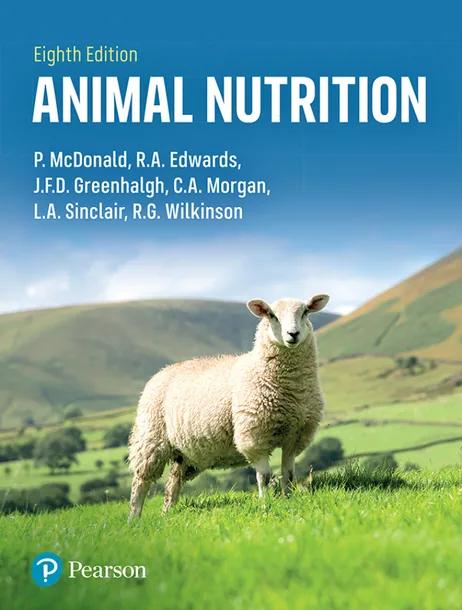
Greenhalgh: Animal Nutrition
by Peter McDonald, J.F.D. Greenhalgh, C A Morgan
8th Edition
Publisher: Pearson (Intl)
Book Details
| Print ISBN | 9781292251660 |
| eText ISBN | 9781292251677 |
| Publisher | Pearson (Intl) |
| Publishing Year | 2022 |
| Edition | 8th Edition |
| Language | English |
Greenhalgh: Animal Nutrition, 8th Edition, is an undergraduate textbook that introduces the scientific principles and practical applications of animal nutrition.
The text examines food components, the digestion and metabolism of nutrients, and methods for evaluating feed digestibility and energy. It addresses feeding standards across livestock species as well as horses, dogs, and cats, while also reviewing feed characteristics and the role of animal products in human nutrition.
Designed for students in animal science, veterinary science, agriculture, biology, and biochemistry, the textbook supports learning through worked quantitative examples and chapter-end review questions with solutions in the appendices.
Table of Contents
Chapter 1: The animal and its food
- • 1.1 Water
- • 1.2 Dry matter and its components
- • 1.3 Analysis and composition of foods
- • Summary
- • Questions
- • Further reading
Chapter 2: Carbohydrates
- • 2.1 Classification of carbohydrates
- • 2.2 Monosaccharides
- • 2.3 Monosaccharide derivatives
- • 2.4 Oligosaccharides
- • 2.5 Polysaccharides
- • 2.6 Lignin
- • Summary
- • Questions
- • Further reading
Chapter 3: Lipids
- • 3.1 Classification of lipids
- • 3.2 Fats
- • 3.3 Glycolipids
- • 3.4 Phospholipids
- • 3.5 Waxes
- • 3.6 Steroids
- • 3.7 Terpenes
- • Summary
- • Questions
- • Further reading
Chapter 4: Proteins, nucleic acids and other nitrogenous compounds
- • 4.1 Proteins
- • 4.2 Amino acids
- • 4.3 Peptides
- • 4.4 Structure of proteins
- • 4.5 Properties of proteins
- • 4.6 Classification of proteins
- • 4.7 Nucleic acids
- • 4.8 Other important nitrogenous compounds
- • 4.9 Nitrates
- • 4.10 Alkaloids
- • Summary
- • Questions
- • Further reading
Chapter 5: Vitamins
- • 5.1 Introduction
- • 5.2 Fat-soluble vitamins
- • 5.3 The vitamin B complex
- • 5.4 Vitamin C
- • 5.5 Hypervitaminosis
- • 5.6 Vitamins and gene expression
- • Summary
- • Questions
- • Further reading
Chapter 6: Minerals
- • 6.1 Functions of minerals
- • 6.2 Natural and supplementary sources of minerals
- • 6.3 Acid–base balance
- • 6.4 Major elements
- • 6.5 Trace elements
- • 6.6 Other elements
- • Summary
- • Questions
- • Further reading
Chapter 7: Enzymes
- • 7.1 Classification of enzymes
- • 7.2 Nature of enzymes
- • 7.3 Mechanism of enzyme action
- • 7.4 Specific nature of enzymes
- • 7.5 Factors affecting enzyme activity
- • 7.6 Nomenclature of enzymes
- • Summary
- • Questions
- • Further reading
Chapter 8: Digestion
- • 8.1 Digestion in monogastric mammals and fowl
- • 8.2 Microbial digestion in ruminants and other herbivores
- • 8.3 Alternative sites of microbial digestion
- • 8.4 Nutrient digestion and the environment
- • Summary
- • Questions
- • Further reading
- • Historical reference
Chapter 9: Metabolism
- • 9.1 Energy metabolism
- • 9.2 Protein synthesis
- • 9.3 Fat synthesis
- • 9.4 Carbohydrate synthesis
- • 9.5 Control of metabolism
- • Summary
- • Questions
- • Further reading
Chapter 10: Evaluation of feeds: digestibility
- • 10.1 Measurement of digestibility
- • 10.2 Validity of digestibility coefficients
- • 10.3 Digestibility in different sections of the digestive tract
- • 10.4 Factors affecting digestibility
- • 10.5 Measurement of mineral availability
- • Summary
- • Questions
- • Further reading
Chapter 11: Evaluation of foods: energy content of foods and energy partition
- • 11.1 Energy demand
- • 11.2 Energy supply and partition
- • 11.3 Animal calorimetry: methods of measuring heat production and energy retention
- • 11.4 Utilisation of metabolisable energy
- • Summary
- • Questions
- • Further reading
Chapter 12: Evaluation of foods: systems for expressing energy supply and requirements
- • 12.1 Energy systems and energy models
- • 12.2 Energy systems for ruminants
- • 12.3 Energy systems for pigs and poultry
- • 12.4 Energy systems for horses
- • 12.5 Energy systems for dogs and cats
- • 12.6 Predicting the energy value of foods
- • Summary
- • Questions
- • Further reading
- • Historical references
Chapter 13: Evaluation of foods: protein
- • 13.1 Crude protein (CP)
- • 13.2 Digestible crude protein (DCP)
- • 13.3 Determination of endogenous nitrogen
- • 13.4 Measures of protein quality for monogastric animals
- • 13.5 Measures of food protein used in practice in the feeding of pigs and poultry
- • 13.6 Measures of food protein used in practice in the feeding of horses
- • 13.7 Measures of food protein quality for dogs and cats
- • 13.8 Measures of protein quality for ruminant animals
- • 13.9 The UK metabolisable protein system
- • 13.10 The UK Feed into Milk (FiM) protein system for dairy cows
- • Summary
- • Questions
- • Further reading
Chapter 14: Feeding standards for maintenance and growth
- • 14.1 Nutrient requirements for maintenance
- • 14.2 Nutrient requirements for growth
- • 14.3 Nutrient requirements for wool production
- • 14.4 Mineral and vitamin requirements for maintenance and growth
- • 14.5 Nutritional control of growth
- • Summary
- • Questions
- • Further reading
- • Historical reference
Chapter 15: Feeding standards for reproduction
- • 15.1 Nutrition and the initiation of reproductive ability
- • 15.2 Plane of nutrition, fertility and fecundity
- • 15.3 Egg production in poultry
- • 15.4 Nutrition and the growth of the foetus
- • Summary
- • Questions
- • Further reading
Chapter 16: Lactation
- • 16.1 Sources of the milk constituents
- • 16.2 Nutrient requirements of the lactating dairy cow
- • 16.3 Nutrient requirements of the lactating ewe
- • 16.4 Nutrient requirements of the lactating dairy goat
- • 16.5 Nutrient requirements of the lactating sow
- • 16.6 Nutrient requirements of the lactating mare
- • 16.7 Nutrient requirements of the lactating dog and cat
- • Summary
- • Questions
- • Further reading
Chapter 17: Voluntary intake of food
- • 17.1 Food intake in pigs and poultry
- • 17.2 Food intake in ruminants
- • 17.3 Food intake in horses
- • 17.4 Food intake in dogs and cats
- • 17.5 Prediction of food intake
- • Summary
- • Questions
- • Further reading
Chapter 18: Grass and forage crops
- • 18.1 Pastures and grazing animals
- • 18.2 Grasses
- • 18.3 Legumes
- • 18.4 Other forages
- • Summary
- • Questions
- • Further reading
Chapter 19: Silage
- • 19.1 Silage, ensilage and silos
- • 19.2 Role of plant enzymes in ensilage
- • 19.3 Role of microorganisms in ensilage
- • 19.4 Nutrient losses in ensilage
- • 19.5 Classification of silages
- • 19.6 Nutritive value of silages
- • 19.7 Whole crop cereal and legume silages
- • Summary
- • Questions
- • Further reading
Chapter 20: Hay, artificially dried forages, straws and chaff
- • 20.1 Hay
- • 20.2 Artificially dried forages
- • 20.3 Straws and related by-products
- • Summary
- • Questions
- • Further reading
Chapter 21: Roots, tubers and related by-products
- • 21.1 Roots
- • 21.2 Tubers
- • Summary
- • Questions
- • Further reading
Chapter 22: Cereal grains and cereal by-products
- • 22.1 The nutrient composition of grains
- • 22.2 Barley
- • 22.3 Maize
- • 22.4 Oats
- • 22.5 Wheat
- • 22.6 Other cereals
- • 22.7 Cereal processing
- • Summary
- • Questions
- • Further reading
Chapter 23: Protein concentrates
- • 23.1 Oilseed cakes and meals
- • 23.2 Oilseed residues of minor importance
- • 23.3 Leguminous seeds
- • 23.4 Processed animal protein (PAP)
- • 23.5 Milk products
- • 23.6 Single-cell protein and microalgae
- • 23.7 Insect protein
- • 23.8 Synthetic amino acids
- • 23.9 Non-protein nitrogen compounds as protein sources
- • Summary
- • Questions
- • Further reading
Chapter 24: Food additives
- • 24.1 Antibiotics
- • 24.2 Probiotics
- • 24.3 Oligosaccharides
- • 24.4 Enzymes
- • 24.5 Organic acids
- • 24.6 Spray-dried plasma
- • 24.7 Modifiers of rumen fermentation
- • 24.8 Plant extracts
- • Summary
- • Questions
- • Further reading
Chapter 25: Animal nutrition and the consumers of animal products
- • 25.1 Comparative nutrition
- • 25.2 The contribution of animal products to human requirements
- • 25.3 Objections to the use of animal products
- • 25.4 Animal products: past, present and future
- • Summary
- • Questions
- • Further reading
Customer Reviews
0.0
0 reviews
No reviews yet. Be the first to review this book!
Write a Review
Reviewed by GradeFocus Editorial Team