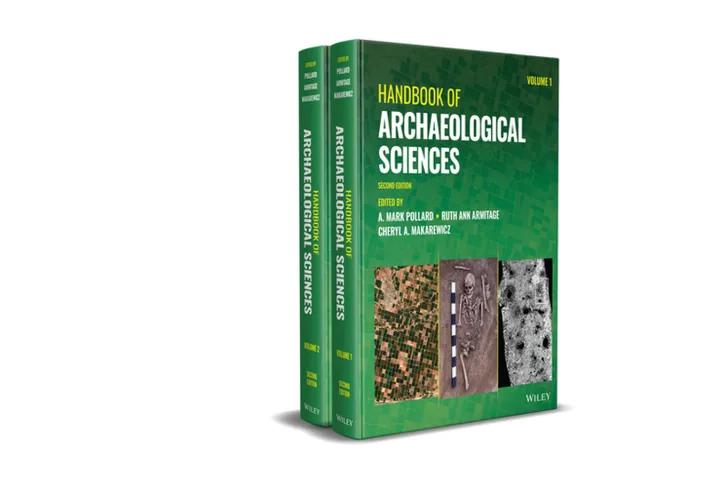
Handbook of Archaeological Sciences, 2 Volume Set
A modern and comprehensive introduction to methods and techniques in archaeology
by A. Mark Pollard, Ruth Ann Armitage, Cheryl A. Makarewicz
2nd Edition
Publisher: Wiley-Blackwell
Book Details
| Print ISBN | 9781119592044 |
| eText ISBN | 9781119592082 |
| Publisher | Wiley-Blackwell |
| Publishing Year | 2023 |
| Edition | 2nd Edition |
| Language | English |
| Pages | 1328 |
The Handbook of Archaeological Sciences, 2 Volume Set, 2nd Edition presents scientific methods and analytical approaches for obtaining and analyzing archaeological data. This handbook provides structured reference material for examining early human lifestyles and societies through physical evidence gathered during field and laboratory investigations.
The thematic scope synthesizes scientific evidence across chronological, environmental, and biological domains. Primary coverage encompasses science-based dating techniques, Quaternary palaeoenvironments, human bioarchaeology, hominin evolution, and paleopathology. The text further addresses biomolecular archaeology, biomolecular analysis of past environments, archaeogenetics, and the exploitation of biological and inorganic resources. Additional thematic units focus on archaeological prospection, specimen decay and conservation, and statistical and computational methods.
Each major subject area opens with an introductory overview chapter, followed by detailed technical studies and empirical application examples contributed by specialists. This consistent structure provides systematic reference support for analyzing material evidence across diverse research settings.
Table of Contents
Section 1: Dating
- • Overview
- • Quaternary geochronological frameworks
- • New developments in Radiocarbon dating
- • Dendrochronology and archaeology
- • Trapped charge dating and archaeology
- • U-series dating
- • Archaeomagnetic dating
- • Obsidian hydration dating with SIMS
- • Amino acid dating
- • An introduction to tephrochronology and the correlation of sedimentary sequences using volcanic ash layers
Section 2: Quaternary Palaeoenvironments
- • Overview
- • Modelling Quaternary Palaeoclimates
- • Ice core and marine sediment records of Quaternary environmental change
- • Insects as palaeoenvironmental and archaeological indicators
- • Non-marine molluscs as palaeoenvironmental indicators
- • Mammals as palaeoenvironmental indicators
- • Lake and peat records of climate change and archaeology
- • Archaeological soil micromorphology
- • Pollen and macroscopic plant remains as indicators of local and regional environments
- • Environmental controls on human dispersal and adaptation
- • Holocene climate changes and human consequences
Section 3: Human Bioarchaeology
- • Overview
- • Hominin evolution
- • Biological distance (normal variation/non-metrical and metrical analysis)
- • Palaeopathology
- • Integrating bioarchaeology and palaeodemography
- • Palaeodiet through stable isotope analysis
- • Palaeomobility through stable isotopes
- • Preserved human bodies
- • Cremated bone
Section 4: Biomolecular Archaeology
- • Overview
- • Zooarchaeology by mass spectrometry (ZooMS)
- • Archaeological proteomics
- • The use of immunological methods in archaeology
- • Lipids in archaeology
- • Archaeological microbiology
- • Dental calculus
- • The biomolecular archaeology of psychoactive substances
Section 5: Archaeogenetics
- • Overview
- • Sex and kinship typing of human archaeological remains
- • Human populations – origins and movement
- • Palaeogenomics of extinct and archaic humans
- • Palaeogenetics and palaeogenomics to study the domestication of animals
- • Domestication of plants
- • Palaeomicrobiology of human infectious diseases
Section 6: Biological Resource Exploitation
- • Overview
- • Archaeobotany
- • Human impact on vegetation
- • Zooarchaeology
- • Coprolites/intestinal contents
- • Invertebrates
- • Secondary animal and plant products
Section 7: Inorganic Resource Exploitation
- • Overview
- • Lithic exploitation and usewear analysis
- • Ancient binders and pigments
- • Materials analysis of ceramics
- • The archaeometry of glass
- • Mining and resource procurement: methods and approaches to the appropriation of mineral raw materials in past societies
- • Making and using metals
- • Provenancing inorganic materials: biography and mutability
Section 8: Archaeological Prospection
- • Overview
- • Approaches to archaeological surface survey
- • Geophysical survey techniques
- • Remote sensing/LIDAR
- • Geochemical prospecting
- • Integrating survey data
Section 9: Burial, Decay and Archaeological Conservation
- • Overview
- • Defining the burial environment
- • Metallic corrosion processes and information from corrosion products
- • Post-depositional changes in archaeological ceramics and glass
- • Deterioration of organic materials
- • Diagenetic alterations to vertebrate mineralized tissues
- • Forensic taphonomy
Section 10: Statistical and Computational Methods
- • Overview
- • Spatial information in archaeology
- • Multivariate analysis in archaeology
- • The Bayesian inferential paradigm in archaeology
- • Quantification in zooarchaeology and palaeoethno(archaeo)botany
- • The use of kernel density estimates on chemical and isotopic data in archaeology
- • Modelling/Simulations in archaeology
- • Big data in archaeology
Customer Reviews
0.0
0 reviews
No reviews yet. Be the first to review this book!
Write a Review
Reviewed by GradeFocus Editorial Team
▶Research Sources (13)
- Handbook of Archaeological Sciences by A. Mark Pollard, Ruth ...
- Handbook of Archaeological Sciences, 2 Volume Set ...
- Handbook of Archaeological Sciences 2 Volume Set 2nd Edition ...
- Sourcebooks, LLC.
- Handbook of Archaeological Sciences (ebook) | Boeken - Bol
- Insects as palaeoenvironmental and archaeological indicators.
- Publications
- Palaeogenomics of Extinct and Archaic Hominins
- Handbook of Archaeological Sciences, 2 Volume Set [2 ed. ...
- Handbook of Archaeological Sciences
- [PDF] Handbook of Archaeological Sciences by A. ...
- (PDF) Handbook of Archaeological Sciences
- Handbook of Archaeological Sciences, 2 Volume Set, 2nd ...