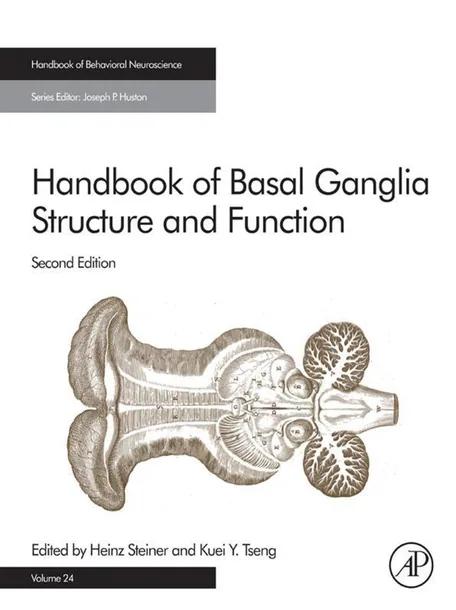
Handbook of Basal Ganglia Structure and Function
by Heinz Steiner, Kuei-Y. Tseng
2nd Edition
Publisher: Academic Press
Book Details
| Print ISBN | 9780128022061 |
| eText ISBN | 9780128025260 |
| Publisher | Academic Press |
| Publishing Year | 2016 |
| Edition | 2nd Edition |
| Language | English |
| Pages | 1036 |
Handbook of Basal Ganglia Structure and Function, 2nd Edition, offers an integrated overview of basal ganglia structural and functional organization, emphasizing clinical relevance. The handbook examines how these forebrain nuclei connect with the cerebral cortex, thalamus, and brainstem to participate in motor control, sensorimotor integration, reward, and cognition.
The text synthesizes dispersed research across cellular, molecular, and physiological domains, addressing basal ganglia dysfunction in conditions such as Parkinson's disease, Huntington's disease, and addiction.
Intended for neuroscience researchers, clinicians studying pathophysiology, and graduate students learning structure and function, the 2016 edition added ten new chapters providing expanded coverage of anatomy, physiology, cellular mechanisms, and clinical dysfunction.
Table of Contents
Chapter 1: History of the Basal Ganglia
Chapter 2: Anatomical Organization of the Basal Ganglia
Chapter 3: Evolution of the Vertebrate Basal Ganglia
Chapter 4: Cell Types in the Basal Ganglia
Chapter 5: Striatal Medium Spiny Projection Neurons and their Connections
Chapter 6: Cholinergic Interneurons of the Striatum
Chapter 7: GABAergic Interneurons of the Striatum
Chapter 8: Dopamine Signaling in Striatal Medium Spiny Neurons
Chapter 9: Endocannabinoid Signaling in the Striatum
Chapter 10: Nitric Oxide Signaling in the Striatum
Chapter 11: Adenosine Signaling in the Basal Ganglia
Chapter 12: The Globus Pallidus
Chapter 13: The Subthalamic Nucleus
Chapter 14: The Substantia Nigra Pars Reticulata
Chapter 15: Subtypes of Midbrain Dopamine Neurons
Chapter 16: Neurophysiology of Substantia Nigra Dopamine Neurons
Chapter 17: Plasticity in Dopamine Neurons
Chapter 18: Regulation of Extracellular Dopamine: Release and Reuptake
Chapter 19: Organization of Corticostriatal Projection Neuron Types
Chapter 20: Organization of Prefrontal-Striatal Connections
Chapter 21: Gating of Cortical Input to the Striatum
Chapter 22: Corticostriatal Synaptic Plasticity in Physiological and Pathological Conditions
Chapter 23: Organization of the Thalamostriatal Systems
Chapter 24: The Rostromedial Tegmental Nucleus: Connections to the Basal Ganglia
Chapter 25: The Rostromedial Tegmental Nucleus: A Modulator of Dopamine Systems
Chapter 26: Integrative Networks Across Basal Ganglia Circuits
Chapter 27: Second-Messenger Cascades
Chapter 28: DARPP32/Phosphatase Signaling
Chapter 29: Transsynaptic Regulation of Basal Ganglia Gene Expression
Chapter 30: Psychostimulant-Induced Gene Regulation in Corticostriatal Circuits
Chapter 31: Epigenetics in Neuropathologies of the Basal Ganglia
Chapter 32: Investigating Basal Ganglia Function with Cell-Type-Specific Manipulations
Chapter 33: Basal Ganglia Re-Entrant Loops: Roles in Action Selection and Reinforcement
Chapter 34: Memory Systems in the Basal Ganglia
Chapter 35: Basal Ganglia Dynamics During Action Sequence (Motor) Learning
Chapter 36: Abnormal Activities in Cortico-Basal Ganglia Circuits in Movement Disorders
Chapter 37: Morphological Plasticity in the Striatum Associated with Dopamine Dysfunction
Chapter 38: Neuroinflammation in Movement Disorders
Chapter 39: Basal Ganglia Disorders Related to Striosome/Matrix Compartments
Chapter 40: Drug Addiction: the Neural and Psychological Basis of a Compulsive Incentive Habit
Chapter 41: Parkinson’s Disease: Cross-Talk Between Environmental Factors and Gene Defects
Chapter 42: Parkinson’s Disease: Molecular Determinants of Vulnerability in Dopamine Neurons
Chapter 43: Parkinson’s Disease: Genetics
Chapter 44: Molecular Mechanisms of L-DOPA-Induced Dyskinesia
Chapter 45: Cell Therapy in Parkinson’s Disease: An Update
Chapter 46: Huntington’s Disease: Molecular Basis
Chapter 47: Huntington’s Disease: Insights from Animal Models
Chapter 48: Dystonia
Chapter 49: Tourette Syndrome
Chapter 50: Deep-Brain Stimulation for Neurologic and Psychiatric Disorders
Customer Reviews
0.0
0 reviews
No reviews yet. Be the first to review this book!
Write a Review
Reviewed by GradeFocus Editorial Team