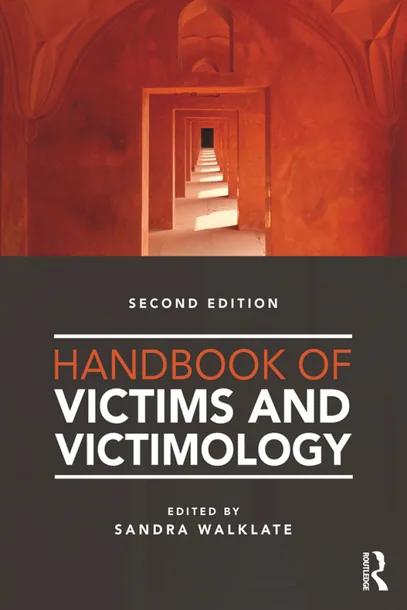
Handbook of Victims and Victimology
by Sandra Walklate
2nd Edition
Publisher: Routledge
Book Details
| Print ISBN | 9781138889460 |
| eText ISBN | 9781317496243 |
| Publisher | Routledge |
| Publishing Year | 2018 |
| Edition | 2nd Edition |
| Language | English |
| Pages | 410 |
The Handbook of Victims and Victimology, 2nd Edition, edited by Sandra Walklate, offers a comprehensive examination of victimological theory, research, and policy. The handbook investigates how victimhood is defined and understood across contemporary scholarship and practitioner settings.
Organized into five thematic parts, the volume addresses enduring theoretical questions alongside the influence of social divisions such as gender, age, ethnicity, and sexuality on victim experiences. It also evaluates evolving policy responses and international approaches to victim support services.
Designed for students, academics, and practitioners in victim support environments, this 2018 edition includes dedicated chapters on intersectionality, child victims, hate crime, and crimes of the powerful.
Table of Contents
Part I: Perspectives on Victims and Victimisation
Chapter 1: A Question of History
Chapter 2: Theoretical Perspectives on Victimisation
Chapter 3: The social epidemiology of crime victimization: The paradox of prevention
Chapter 4: The Impact of Crime: Victimisation, Harm and Resilience
Part II: Victims, Victimology and ‘Difference’
Chapter 5: Feminist Voices, Gender and Victimisation
Chapter 6: Child Victims of Human Rights Violation
Chapter 7: Victims of Hate Crime
Chapter 8: Sexuality and victimisation
Chapter 9: Intersectionality and Victimisation
Part III: Policy Directions and Service Delivery
Chapter 10: Interventions and services for victims of crime
Chapter 11: The victim in court
Chapter 12: Restorative Justice and Victims of Crime: Directions and developments
Chapter 13: Theorising victimisation through the individual and collective reparations programs for Indian Residential School abuse
Part IV: Comparative Perspectives
Chapter 14: A glass half full, or half empty? On the implementation of the EU’s Victims Directive regarding police reception and specialized support
Chapter 15: Victims support in policy and legal process in Australia: Still an ambivalent and contested space
Chapter 16: Looking into Asia: Managing crime through victim policy?
Part V: Other Visions of Victims and Victimology
Chapter 17: Crime as a Social Relation of Power: Reframing the ‘Ideal Victim’ of Corporate Crimes
Chapter 18: We Are All Complicit: Victimization and Crimes of the Powerful
Chapter 19: Cultural Victimology Revisited: Synergies of Risk, Fear and Resilience
Chapter Conclusion: Developing an agenda for a (critical) victimology
Customer Reviews
0.0
0 reviews
No reviews yet. Be the first to review this book!
Write a Review
Reviewed by GradeFocus Editorial Team