Book Details
| Print ISBN | 9780134878102 |
| eText ISBN | 9780134988634 |
| Publisher | Pearson |
| Publishing Year | 2020 |
| Edition | 15th Edition |
| Language | English |
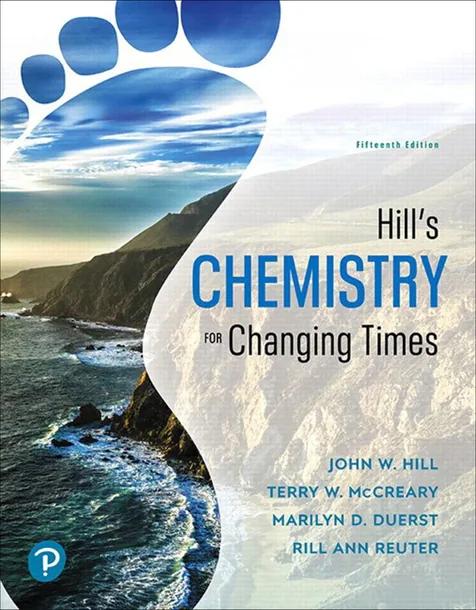
Hill's Chemistry for Changing Times, 15th Edition, is a textbook designed for introductory and liberal arts chemistry courses serving non-science, allied-health, and other non-major students. The text links core chemical concepts to daily life through examples and applications centered on health, wellness, and the environment.
Coverage introduces fundamental principles such as atomic structure, chemical bonds, physical states of matter, and chemical reactions. The textbook balances these introductory ideas with practical explorations in organic chemistry, biochemistry, and earth science.
To guide students across diverse academic paths, the 2020 edition added new examples and a consistent problem-solving model that supports practical skill development.
Table of Contents
Chapter 1: Chemistry
- • 1.1 Science and Technology: The Roots of Knowledge
- • 1.2 Science: Reproducible, Testable, Tentative, Predictive, and Explanatory
- • 1.3 Science and Technology: Risks and Benefit
- • 1.4 Solving Society's Problems: Scientific Research
- • 1.5 Chemistry: A Study of Matter and Its Changes
- • 1.6 Classification of Matter
- • 1.7 The Measurement of Matter
- • 1.8 Density
- • 1.9 Energy: Heat and Temperature
- • 1.10 Critical Thinking
Chapter 2: Atoms
- • 2.1 Atoms: Ideas from the Ancient Greeks
- • 2.2 Scientific Laws: Conservation of Mass and Definite Proportions
- • 2.3 John Dalton and the Atomic Theory of Matter
- • 2.4 The Mole and Molar Mass
- • 2.5 Mendeleev and the Periodic Table
- • 2.6 Atoms and Molecules: Real and Relevant
Chapter 3: Atomic Structure
- • 3.1 Electricity and the Atom
- • 3.2 Serendipity in Science: X-Rays and Radioactivity
- • 3.3 Three Types of Radioactivity
- • 3.4 Rutherford's Experiment: The Nuclear Model of the Atom
- • 3.5 The Atomic Nucleus
- • 3.6 Electron Arrangement: The Bohr Model (Orbits)
- • 3.7 Electron Arrangement: The Quantum Model (Orbitals/Subshells)
- • 3.8 Electron Configurations and the Periodic Table
Chapter 4: Chemical Bonds
- • 4.1 The Art of Deduction: Stable Electron Configurations
- • 4.2 Lewis (Electron-Dot) Symbols
- • 4.3 The Reaction of Sodium with Chlorine
- • 4.4 Using Lewis Symbols for Ionic Compounds
- • 4.5 Formulas and Names of Binary Ionic Compounds
- • 4.6 Covalent Bonds: Shared Electron Pairs
- • 4.7 Unequal Sharing: Polar Covalent Bonds
- • 4.8 Polyatomic Molecules: Water, Ammonia, and Methane
- • 4.9 Polyatomic Ions
- • 4.10 Guidelines for Drawing Lewis Structures
- • 4.11 Molecular Shapes: The VSEPR Theory
- • 4.12 Shapes and Properties: Polar and Nonpolar Molecules
Chapter 5: Chemical Accounting
- • 5.1 Chemical Sentences: Equations
- • 5.2 Volume Relationships in chemical Equations
- • 5.3 Avogadro's Number and the Names
- • 5.4 Molar Mass: Mole-to-Mass and Mass-to-Mole Conversions
- • 5.5 Solutions
Chapter 6: Gases, Liquids, Solids…and Intermolecular Forces
- • 6.1 Solids, Liquids, and Gases
- • 6.2 Comparing Ionic and Molecular Substances
- • 6.3 Forces between Molecules
- • 6.4 Forces in Solutions
- • 6.5 Gases: The Kinetic-Molecular Theory
- • 6.6 The Simple Gas Laws
- • 6.7 The Ideal Gas Law
Chapter 7: Acids and Bases
- • 7.1 Acids and Bases: Experimental Definitions
- • 7.2 Acids, Bases, and Salts
- • 7.3 Acidic and Basic Anhydrides
- • 7.4 Strong and Weak Acids and Bases
- • 7.5 Neutralization
- • 7.6 The pH Scale
- • 7.7 Buffers and Conjugate Acid-Base Pairs
- • 7.8 Acids and Bases in Industry and in Daily Life
Chapter 8: Oxidation and Reduction
- • 8.1 Oxidation and Reduction: Four Views
- • 8.2 Oxidizing Agents and Reducing Agents
- • 8.3 Electrochemistry: Cells and Batteries
- • 8.4 Corrosion and Explosion
- • 8.5 Oxygen: An Abundant and Essential Oxidizing Agent
- • 8.6 Some Common Reducing Agents
- • 8.7 Oxidation, Reduction, and Living Things
Chapter 9: Organic Chemistry
- • 9.1 Organic Chemistry and Compounds
- • 9.2 Aliphatic Hydrocarbons
- • 9.3 Aromatic Compounds: Benzene and Its Relatives
- • 9.4 Halogenated Hydrocarbons: Many Uses, Some Hazards
- • 9.5 Functional and Alkyl Groups
- • 9.6 Alcohols, Phenols, Ethers, and Thiols
- • 9.7 Aldehydes and Ketones
- • 9.8 Carboxylic Acids and Esters
- • 9.9 Nitrogen-Containing Compounds: Amines and Amides
Chapter 10: Polymers
- • 10.1 Polymerization: Making Big Ones Out of Little Ones
- • 10.2 Polyethylene: From the Battle of Britain to Bread Bags
- • 10.3 Addition Polymerization: One + One + One + … Gives One!
- • 10.4 Rubber and Other Elastomers
- • 10.5 Condensation Polymers
- • 10.6 Properties of Polymers
- • 10.7 Plastics and the Environment
Chapter 11: Nuclear Chemistry
- • 11.1 Natural Radioactivity
- • 11.2 Nuclear Equations
- • 11.3 Half-Life and Radioisotopic Dating
- • 11.4 Artificial Transmutation
- • 11.5 Uses of Radioisotopes
- • 11.6 Penetrating Power of Radiation
- • 11.7 Energy from the Nucleus
- • 11.8 Nuclear Bombs
- • 11.9 Uses and Consequences of Nuclear Energy
Chapter 12: Chemistry of Earth
- • 12.1 Spaceship Earth: Structure and Composition
- • 12.2 Silicates and the Shapes of Things
- • 12.3 Carbonates: Caves, Chalk, and Limestone
- • 12.4 Metals and Their Ores
- • 12.5 Salts and "Table Salt"
- • 12.6 Gemstones and Semi-Precious Stones
- • 12.7 Earth's Dwindling Resources
Chapter 13: Air
- • 13.1 Earth's Atmosphere: Divisions and Composition
- • 13.2 Chemistry of the Atmosphere
- • 13.3 Pollution through the Ages
- • 13.4 Automobile Emissions
- • 13.5 Photochemical Smog: Making Haze While the Sun Shines
- • 13.6 Acid Rain: Air Pollution Water Pollution
- • 13.7 The Inside Story: Indoor Air Pollution
- • 13.8 Stratospheric Ozone: Earth's Vital Shield
- • 13.9 Carbon Dioxide and Climate Change
- • 13.10 Who Pollutes? Who Pays?
Chapter 14: Water
- • 14.1 Water: Some Unique Properties
- • 14.2 Water in Nature
- • 14.3 Organic Contamination; Human and Animal Waste
- • 14.4 The World's Water Crisis
- • 14.5 Tap Water and Government Standards for Drinking Water
- • 14.6 Water Consumption: Who Uses It and How Much?
- • 14.7 Making Water Fit to Drink
- • 14.8 Wastewater Treatment
Chapter 15: Energy
- • 15.1 Our Sun, a Giant Nuclear Power Plant
- • 15.2 Energy and Chemical Reactions
- • 15.3 Reaction Rates
- • 15.4 The Laws of Thermodynamics
- • 15.5 Fuels and Energy: People, Horses, and Fossils
- • 15.6 Coal: The Carbon Rock of Ages
- • 15.7 Natural Gas and Petroleum
- • 15.8 Convenient Energy
- • 15.9 Nuclear Energy
- • 15.10 Renewable Energy Sources
Chapter 16: Biochemistry
- • 16.1 Energy and the Living Cell
- • 16.2 Carbohydrates: A Storehouse of Energy
- • 16.3 Carbohydrates in the Diet
- • 16.4 Fats and Other Lipids
- • 16.5 Fats and Cholesterol
- • 16.6 Proteins: Polymers of Amino Acids
- • 16.7 Structure and Function of Proteins
- • 16.8 Protein in the Diet
- • 16.9 Nucleic Acids: Parts, Structure, and Function
- • 16.10 RNA: Protein Synthesis and the Genetic Code
- • 16.11 The Human Genome
Chapter 17: Nutrition, Fitness, and Health
- • 17.1 Calories: Quality and Quantity
- • 17.2 Minerals
- • 17.3 Vitamins
- • 17.4 Fiber, Electrolytes, and Water
- • 17.5 Food Additives
- • 17.6 Starvation and Malnutrition
- • 17.7 Weight Loss, Diet, and Exercise
- • 17.8 Fitness and Muscle
Chapter 18: Drugs
- • 18.1 Drugs from Nature and the Laboratory
- • 18.2 Pain Relievers: From Aspirin to Oxycodone
- • 18.3 Drugs and Infectious Diseases
- • 18.4 Chemicals against Cancer
- • 18.5 Hormones: The Regulators
- • 18.6 Drugs for the Heart
- • 18.7 Drugs and the Mind
- • 18.8 Drugs and Society
Chapter 19: Chemistry Down on the Farm
- • 19.1 Growing Food with Fertilizers
- • 19.2 The War against Pests
- • 19.3 Herbicides and Defoliants
- • 19.4 Sustainable Agriculture
- • 19.5 Looking to the Future: Feeding a Growing, Hungry World
Chapter 20: Household Chemicals
- • 20.1 Cleaning with Soap
- • 20.2 Synthetic Detergents
- • 20.3 Laundry Auxiliaries: Softeners and Bleaches
- • 20.4 All-Purpose and Special-Purpose Cleaning Products
- • 20.5 Solvents, Paints, and Waxes
- • 20.6 Cosmetics: Personal-Care Chemicals
Chapter 21: Poisons
- • 21.1 Natural Poisons
- • 21.2 Poisons and How They Act
- • 21.3 More Chemistry of the Nervous System
- • 21.4 The Lethal Dose
- • 21.5 The Liver as a Detox Facility
- • 21.6 Carcinogens and Teratogens
- • 21.7 Hazardous Wastes
Customer Reviews
0.0
0 reviews
No reviews yet. Be the first to review this book!
Write a Review
Reviewed by GradeFocus Editorial Team