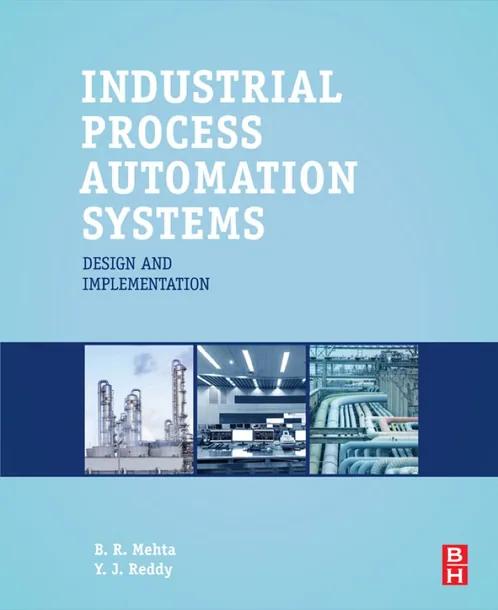
Industrial Process Automation Systems
Design and Implementation
by B.R. Mehta, Y. Jaganmohan Reddy
1st Edition
Publisher: Elsevier Butterworth Heinemann
Book Details
| Print ISBN | 9780128009390 |
| eText ISBN | 9780128009390 |
| Publisher | Elsevier Butterworth Heinemann |
| Publishing Year | 2014 |
| Edition | 1st Edition |
| Language | English |
| Pages | 668 |
Industrial Process Automation Systems: Design and Implementation, 1st Edition, is a reference that offers a practical guide to the operation of modern industrial automation systems. Drawing on direct industrial experience, the text bridges theoretical principles and technician-level coverage.
The volume introduces core control infrastructures, including programmable logic controllers, distributed control systems, and functional safety systems. It also examines industrial communication frameworks and plant asset management practices.
Designed for junior professionals and experienced practitioners alike, the book supports engineers across chemical, petrochemical, power, metals, mining, and pharmaceutical sectors before they consult vendor documentation.
Table of Contents
Chapter 1: Industrial automation
- • 1.1. Introduction
- • 1.2. Innovators
- • 1.3. Industrial revolutions
- • 1.4. Evolution of automation from needs perspectives
- • 1.5. Evolution of automation from technology perspectives
- • 1.6. Challenges three decades back
- • 1.7. Current challenges
- • 1.8. Technology trends
- • 1.9. Device connectivity
- • 1.10. Automation system controllers
- • 1.11. The generic duties of an automation system in hierarchical form
- • 1.12. Functional requirements of an integrated information and automation systems: A generic list
- • 1.13. Conceptual/functional topology of an automation system
Chapter 2: The programmable logic controller
- • 2.1. Introduction to the programmable logic controller
- • 2.2. Hardware
- • 2.3. Internal architecture
- • 2.4. I/O devices
- • 2.5. I/O processing
- • 2.6. Ladder and function block programming
- • 2.7. Function blocks
- • 2.8. IL, SFC, and ST programming methods
Chapter 3: Distributed control system
- • 3.1. Introduction
- • 3.2. Evolution of traditional control systems
- • 3.3. Distributed control systems
- • 3.4. Functional components of DCS
- • 3.5. Diagnostics in IOs
- • 3.6. Controllers
- • 3.7. Workstations
- • 3.8. Functional Features of DCS
Chapter 4: Batch automation systems
- • 4.1. Introduction
Chapter 5: Functional safety and safety instrumented systems
- • 5.1. Functional safety: an introduction
- • 5.2. What is functional safety?
- • 5.3. Safety functions and safety-related systems
- • 5.4. Example of functional safety
- • 5.5. Legislation and standards
- • 5.6. IEC 61508/IEC 61511: an introduction
- • 5.7. Scope of the standard
- • 5.8. The overall safety life cycle (SLS)
- • 5.9. Risk and its analysis and reduction
- • 5.10. Safety requirements and safety functions
- • 5.11. Safety integrity levels (SIL)
- • 5.12. Functional safety management
- • 5.13. Layers of protection
- • 5.14. Risk analysis techniques
- • 5.15. Safety requirement specifications
- • 5.16. General requirements
- • 5.17. Response time
- • 5.18. SIF specification
- • 5.19. Operator interfaces (HMI)
- • 5.20. Safety instrumented systems
- • 5.21. Reliability and diagnostics
- • 5.22. SIS voting principles and methods
- • 5.23. SIS SIL level calculation tools
- • 5.24. SIS communication protocols and field-buses
- • 5.25. FF-SIS: foundation Fieldbus for safety instrumented systems
- • 5.26. PROFISafe
- • 5.27. PROFIsafe protocol
- • 5.28. Black Channel principle
- • 5.29. Integrated Safety data communications
- • 5.30. Selection of safety instrumented system
Chapter 6: Fire and gas detection system
- • 6.1. Introduction to the fire and gas (F&G) detection system
- • 6.2. Understanding industry safety performance standards
- • 6.3. Critical components
- • 6.4. F&G detectors
- • 6.5. F&G network architecture
- • 6.6. Integrated approach for F&G
- • 6.7. Conclusion
Chapter 7: SCADA systems
- • 7.1. Overview of SCADA systems
- • 7.2. Minicomputers and microprocessors
- • 7.3. Remote terminal units
- • 7.4. Communication technologies
- • 7.5. Program development tools
- • 7.6. Operator interface
Chapter 8: Programmable automation controller
- • 8.1. Modern industrial application
Chapter 9: Serial communications
- • 9.1. RS232 overview
- • 9.2. RS232 signal information
- • 9.3. Limitations of RS232 applications
- • 9.4. Overview of EIA-485
- • 9.5. The difference between RS232/RS485/RS422
- • 9.6. Modbus serial communications
- • 9.7. Modbus map
- • 9.8. Error checking methods
- • 9.9. Modbus exception codes
Chapter 10: Industrial networks
- • 10.1. Introduction to industrial networks
- • 10.2. The OSI network model
- • 10.3. TCP/IP
Chapter 11: HART communication
- • 11.1. Introduction
- • 11.2. Technology
- • 11.3. HART technology
- • 11.4. Application environment
Chapter 12: PROFIBUS communication
- • 12.1. Overview
- • 12.2. Supported topology
- • 12.3. Data exchange
- • 12.4. Fail-safe operation
Chapter 13: Foundation fieldbus communication
- • 13.1. Fieldbus technology
Chapter 14: Wireless communication
- • 14.1. Introduction
- • 14.2. Basic concepts of industrial wireless communication
- • 14.3. ISA100 standard
- • 14.4. Networks
- • 14.5. Network configurations
- • 14.6. Gateway, system manager, and security manager
- • 14.7. Applications of wireless instrumentation
- • 14.8. Designing and engineering a wireless system
Chapter 15: OPC communications
- • 15.1. Introduction
Chapter 16: Asset management systems
- • 16.1. Definition of an asset
- • 16.2. Asset management system
- • 16.3. Key goal of asset management system
- • 16.4. Fault models
- • 16.5. Calculation model
- • 16.6. Maintaining work processes
- • 16.7. Unneeded trips to the field – avoided through remote diagnostics
- • 16.8. Life cycle work processes
- • 16.9. Intelligent field devices – data flow
- • 16.10. Integrated asset management
- • 16.11. Use of the tools
- • 16.12. Instrument asset management systems – architecture/subsystems
- • 16.13. Smart field devices
- • 16.14. Asset management system: role-based diagnostics
- • 16.15. Device rendering technologies
- • 16.16. Limitations of DD technology
- • 16.17. Enhanced device description language
- • 16.18. FDT/DTM
- • 16.19. The DTM
- • 16.20. Key benefits to the users
Chapter 17: Calibration management systems
- • 17.1. Introduction
- • 17.2. Need for calibration
- • 17.3. Traceability
- • 17.4. Calibration standards
- • 17.5. Calibration concepts
- • 17.6. Documentation
- • 17.7. Calibration of transmitters
- • 17.8. Calibrating a conventional instrument
- • 17.9. Calibrating a HART instrument
- • 17.10. Calibrating fieldbus transmitters
- • 17.11. Calibration Management System
- • 17.12. Calibration Software
- • 17.13. Benefits of using calibration management system
- • 17.14. Business benefits
Chapter 18: System maintenance
- • 18.1. Overview
- • 18.2. Distributed control system maintenance
- • 18.3. Maintenance software
- • 18.4. Maintenance program implementation and management
- • 18.5. Software and network maintenance
- • 18.6. Computer operating environment
- • 18.7. Network maintenance
Chapter 19: Advanced process control systems
- • 19.1. Introduction and need for advanced process control (APC)
- • 19.2. History of process control
- • 19.3. Advanced process control
- • 19.4. Advantages of APC
- • 19.5. Architecture and technologies
Chapter 20: Training system
- • 20.1. Introduction to process modeling
- • 20.2. Training Systems
- • 20.3. Components of training simulators system
- • 20.4. Architecture of a Typical training simulators
Chapter 21: Alarm management systems
- • 21.1. Introduction
- • 21.2. Conventional and advanced alarm systems
Chapter 22: Database systems
- • 22.1. Historian database
Chapter 23: Manufacturing execution systems
- • 23.1. Introduction
Chapter 24: Cyber security in industrial automation
- • 24.1. Plant Control Network
- • 24.2. Cyber attacks
- • 24.3. Understanding common PCS vulnerabilities
- • 24.4. Common PCS software security weaknesses
- • 24.5. Standards
Chapter 25: Mobile and video systems
- • 25.1. Introduction
- • 25.2. Mobile process monitoring console
- • 25.3. Key benefits of wireless process mobile console
- • 25.4. Handheld mobile device solutions
- • 25.5. Some of the major benefits of field-based mobility solutions
- • 25.6. Mobile device based solutions
- • 25.7. Video system analytics
- • 25.8. Regions of interest
- • 25.9. Minimum object size
- • 25.10. Video system camera server
- • 25.11. DCS
- • 25.12. Operator console
- • 25.13. Video system client
Customer Reviews
0.0
0 reviews
No reviews yet. Be the first to review this book!
Write a Review
Reviewed by GradeFocus Editorial Team