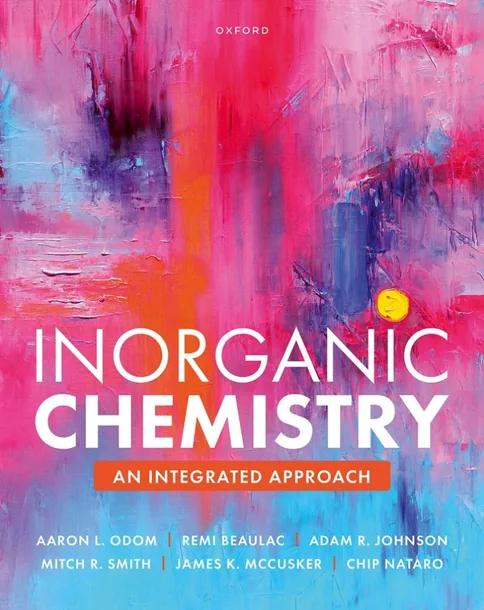
Inorganic Chemistry
An Integrated Approach
by Aaron L. Odom, Remi Beaulac, Adam R. Johnson
1st Edition
Publisher: OUP Oxford
Book Details
| Print ISBN | 9780198905998 |
| eText ISBN | 9780198906018 |
| Publisher | OUP Oxford |
| Publishing Year | 2026 |
| Edition | 1st Edition |
| Language | English |
| Pages | 888 |
Inorganic Chemistry: An Integrated Approach, 1st Edition, offers a unified and contemporary view of inorganic chemistry designed for mid- to upper-level students. The textbook establishes a comprehensive foundation intended to serve learners throughout their academic careers.
The volume combines core models of molecular geometry, symmetry, and bonding with extensive examinations of main group reactivity, transition metal complexes, and bioinorganic systems. Further coverage addresses optical spectroscopy, reaction mechanisms, organometallic chemistry, and solid-state materials.
By linking foundational frameworks like VSEPR, Valence Bond Theory, and Ligand Field Theory to modern research, the text incorporates a robust problem-solving feature to help students interpret complex inorganic phenomena.
Table of Contents
Chapter 1: What is inorganic chemistry, and why study it?
Chapter 2: A brief review of physical chemistry
Chapter 3: Basics of bonding: the 2-Center 2-Electron (2c2e) Bond
Chapter 4: The shapes of main group molecules: the VSEPR Mode
Chapter 5: Symmetry and group theory
Chapter 6: Group theory and molecular orbital theory
Chapter 7: Hybridization-based theories of bonding: applications within the main group
Chapter 8: Main group bonding
Chapter 9: Applying bonding principles to main group reactivity and properties
Chapter 10: Introduction to transition metal chemistry
Chapter 11: Basics of transition metal bonding 1: Simple ligands including olefins, diatomics, phosphines and hydrides
Chapter 12: Basics of transition metal bonding 2: conjugated p-systems, metal-ligand multiple bonds, and other ligand types
Chapter 13: Thermodynamic considerations in reactivity: acid-base theory and redox reactions
Chapter 14: Understanding transition metal complexes using hybridization-based theory
Chapter 15: The one-electron picture of transition metal electronic structure
Chapter 16: Optical spectroscopy and excited state electronic structure
Chapter 17: Kinetics and mechanisms of ligand substitutions
Chapter 18: Some practical aspects of mechanism elucidation
Chapter 19: Reactivity in organometallic chemistry
Chapter 20: Solid-state chemistry
Chapter 21: Bioinorganic chemistry
Chapter 22: f-Element chemistry
Chapter Appendix A: Polar covalence
Chapter Appendix B: Some representative bond distances and bond energies
Chapter Appendix C: Tabulated values for determination of bond order: r0 and b
Chapter Appendix D: Character tables
Chapter Appendix E: Review of matrix manipulations
Chapter Appendix F: Common SALCs and normal modes
Chapter Appendix G: Matrices associated with strong field parameters
Chapter Appendix H: Changes in atomic radius with charge and coordination number
Chapter Appendix I: Imaginary numbers and complex conjugates
Chapter Appendix J: Standard reduction potentials
Chapter Appendix K: Valence orbital energies
Customer Reviews
0.0
0 reviews
No reviews yet. Be the first to review this book!
Write a Review
Reviewed by GradeFocus Editorial Team