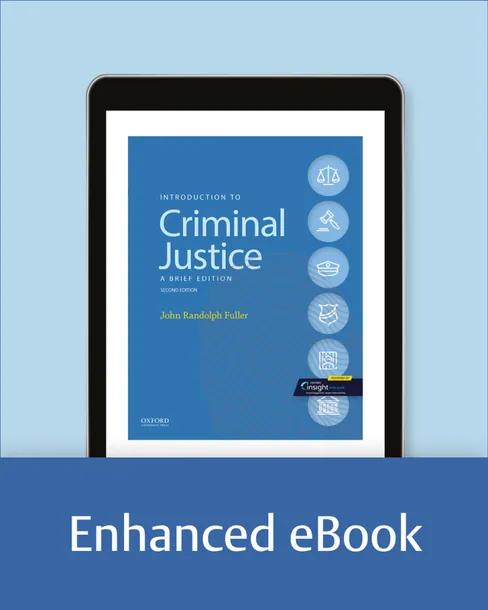
Introduction to Criminal Justice
A Brief Edition
by John Randolph Fuller
2nd Edition
Publisher: Oxford University Press
Book Details
| Print ISBN | 9780197504048 |
| eText ISBN | 9780197504062 |
| Publisher | Oxford University Press |
| Publishing Year | 2021 |
| Edition | 2nd Edition |
| Language | English |
| Pages | 496 |
John Randolph Fuller presents Introduction to Criminal Justice: A Brief Edition, 2nd Edition as a concise textbook for college and university students entering the field. Published by Oxford University Press in 2021, the volume establishes foundational knowledge across criminology and the administration of justice.
The thematic progression moves from initial definitions of crime, measurement methodologies, and statutory law into the history, structure, and operational controversies of police agencies. The coverage then examines judicial procedures, courtroom work groups, plea bargaining, and sentencing. Further sections analyze American penal history, modern prisons and jails, community corrections, and juvenile justice before surveying future systemic challenges.
Student-tested pedagogical tools inside the text focus on critical-thinking skills and concept mastery. This brief print volume of 496 pages offers academic programs a structured framework for examining the criminal justice system.
Table of Contents
Chapter 1: Crime and Criminal Justice
- • 1.1 What is Crime?
- • 1.2 The Criminal Justice System and Process
- • 1.2.1 The Criminal Justice Process
- • Law Enforcement
- • Courts
- • Corrections
- • 1.2.2 The Due Process and Crime Control Models
- • 1.2.3 How Cases Move Through the System
- • 1.2.4 The Perception of Crime and the Wedding-Cake Model of Criminal Justice
- • 1.3 Types of Crime
- • 1.3.1 Street Crime
- • 1.3.2 Corporate Crime and White-Collar Crime
- • 1.4 Offenses and Offenders
- • 1.4.1 Violent Crime
- • 1.4.2 Property Crime
- • 1.4.3 Public-Order Crime
- • 1.5 Summary
- • Features
- • A Closer Look 1.1: A Comparison of Federal, State, and Local Law Enforcement
- • Focus on Ethics: A Balance of Interests
Chapter 2: How Crime Is Measured and Who It Affects
- • 2.1 The Problems of Measuring Crime
- • 2.2 How Crime is Measured
- • 2.2.1 Uniform Crime Reports
- • 2.2.2 National Incident-Based Reporting System
- • 2.2.3 National Crime Victimization Survey
- • 2.2.4 Self-Report Studies
- • 2.3 Victims of Crime
- • 2.3.1 Typologies of Crime Victims
- • 2.3.2 The Incidence of Victimization
- • 2.3.3 Categories of Victims
- • Victims of Violent Crime
- • Victims of Hate Crime
- • Victims of Financial Crime
- • The Elderly and Children
- • 2.3.4 Victims' Rights and Assistance
- • 2.4 Summary
- • Features
- • CJ Reference 2.1: The Hierarchy Rule
- • A Closer Look 2.1: Crime Apps: Reporting Crime or Reporting Fear?
- • Focus on Ethics: To Report or Not to Report
Chapter 3: Criminal Law
- • 3.1 The Development of the Criminal Law
- • 3.1.1 Early Legal Codes
- • 3.1.2 The Magna Carta
- • 3.1.3 Common Law
- • 3.2 Sources of Law
- • 3.2.1 Constitutions
- • 3.2.2 Statutes
- • 3.2.3 Case Law
- • 3.2.4 Administrative Rules and Executive Orders
- • 3.3 Types of Law
- • 3.3.1 Criminal Law and Civil Law
- • 3.3.2 Substantive Law and Procedural Law
- • 3.4 Types of Crime
- • 3.4.1 Felonies
- • 3.4.2 Misdemeanors
- • 3.4.3 Inchoate Offenses
- • 3.4.4 Infractions
- • 3.5 Features of Crime
- • 3.5.1 Actus reus
- • 3.5.2 Mens rea
- • 3.5.3 Strict Liability
- • 3.6 Criminal Responsibility and Criminal Defense
- • 3.6.1 My Client Did Not Do It
- • 3.6.2 My Client Did It, but My Client Is Not Responsible Because of Insanity
- • 3.6.3 My Client Did It but Has a Good Excuse
- • 3.6.4 My Client Did It but Has a Good Reason
- • 3.6.5 My Client Did It but Should Be Acquitted Because the Police or the Prosecutor Cheated
- • 3.6.6 My Client Did It but Was Influenced by Outside Forces
- • 3.7 Summary
- • Features
- • Getting It Right 3.1: Restoring the Vote to Felons
- • CJ Reference 3.1: The Bill of Rights
- • A Closer Look 3.1: Watson Murder
- • Case in Point 3.1: Durham v. United States (1954)
- • Focus on Ethics: Changing the Substantive Law
Chapter 4: The History and Organization of Law Enforcement
- • 4.1 A Brief History of the Police
- • 4.1.1 Early Policing in England
- • 4.1.2 Early Policing in the United States
- • 4.1.3 The Introduction of Police Professionalism
- • 4.1.4 The End of the 20th Century to Today: Crime Control, Communities, and Homeland Security
- • 4.2 Levels of Law Enforcement
- • 4.2.1 Federal Level
- • The Federal Bureau of Investigation
- • The Secret Service
- • 4.2.2 State Level
- • 4.2.3 Local Level
- • Sheriff's Offices
- • Requirements to Become a Police Officer
- • 4.3 Strategies in Policing
- • 4.3.1 Wilson's Three Styles of Policing
- • 4.3.2 Community Policing
- • 4.3.3 Problem-Oriented Policing
- • 4.3.4 Zero-Tolerance Policing and Broken-Windows Perspective
- • 4.4 Summary
- • Features
- • CJ Reference 4.1: Federal Law Enforcement Agencies
- • A Closer Look 4.1: Who Polices the Police?
- • Focus on Ethics: Righteous Vengeance
Chapter 5: Police Organization, Operation, and the Law
- • 5.1 What We Expect of the Police
- • 5.2 How the Police Are Organized
- • 5.3 What the Police Do
- • 5.3.1 Patrol
- • 5.3.2 Investigation
- • 5.3.3 Traffic Enforcement
- • 5.3.4 Peacemaking and Order Maintenance
- • 5.4 The Rules the Police Follow
- • 5.4.1 Police Discretion
- • 5.4.2 The Fourth Amendment
- • Search
- • Special-Needs Searches
- • Seizures
- • Stop-and-Frisk
- • Arrests
- • 5.4.3 Interrogations and Confessions
- • 5.5 Summary
- • Features
- • Getting It Right 5.1: Solving Problems in Problem-Solving Policing
- • CJ Reference 5.1: The Fourth Amendment
- • Case in Point 5.1: Terry v. Ohio (1968)
- • Case in Point 5.2: Miranda v. Arizona (1966)
- • Focus on Ethics: It's Only Marijuana
Chapter 6: Policing: Innovations and Controversies
- • 6.1 Use of Force
- • 6.2 The Militarization of Police
- • 6.2.1 The Evolution of Police Militarization
- • 6.3 Sources of Stress
- • 6.3.1 Dealing with the Stress of Policing
- • 6.3.2 The Police Subculture
- • Police Unions
- • 6.3.3 Alcohol
- • 6.3.4 Family Problems
- • 6.3.5 Suicide
- • 6.3.6 Corruption
- • 6.4 Policing and Technology
- • 6.4.1 Body-Worn Cameras
- • 6.4.2 Police Surveillance
- • 6.4.3 Less-Than-Lethal Weapons
- • 6.4.4 DNA Databases
- • 6.5 Sex and Race
- • 6.5.1 Women as Police Officers
- • 6.5.2 Minorities as Police Officers
- • 6.6 Summary
- • Features
- • CJ Reference 6.1: Police Use of Force
- • Case in Point 6.1: Tennessee v. Garner (1985)
- • Case in Point 6.2: Graham v. Connor (1989)
- • A Closer Look 6.1: Policing is Getting Safer
- • Focus on Ethics: To Trust a Partner
Chapter 7: The Courts
- • 7.1 The Court System in the United States
- • 7.2 The Historical Foundation of Modern U.S. Courts
- • 7.2.1 Courts in England
- • 7.2.2 Courts in Colonial North America
- • 7.3 The Organization of Modern U.S. Criminal Courts
- • 7.3.1 The Nature of Jurisdiction
- • 7.3.2 The Structure of the Federal Courts
- • U.S. District Courts
- • U.S. Courts of Appeals
- • U.S. Supreme Court
- • Specialized Federal Courts
- • 7.3.3 The Structure of State Courts
- • Juvenile Courts
- • State Trial Courts
- • State Intermediate Courts of Appeals
- • State Supreme Courts
- • Local and Community Courts
- • 7.4 Summary
- • Features
- • CJ Reference 7.1: What Makes the Supreme Court Supreme?
- • Case in Point 7.1: Hamdan v. Rumsfeld (2006)
- • Getting It Right 7.1: Marijuana Convictions Going Up in Smoke
- • Focus On Ethics: Modern-Day Blood Feud
Chapter 8: The Courtroom Work Group
- • 8.1 The Courtroom Work Group
- • 8.2 The Prosecutor
- • 8.2.1 The Prosecutor at Work
- • 8.2.2 Prosecution at the Federal Level
- • 8.2.3 Prosecution in State Courts
- • 8.3 The Defense Attorney
- • 8.3.1 The Defense Attorney and the Courtroom Work Group
- • 8.3.2 The Best Defense: Private Attorney or Public Defender?
- • 8.4 The Judge
- • 8.4.1 Judicial Selection: Executive Appointments
- • 8.4.2 Judicial Selection: Election of Judges
- • 8.4.3 Judicial Selection: Merit Selection
- • 8.5 The Participants
- • 8.5.1 Law Enforcement
- • 8.5.2 Court Support Staff
- • 8.5.3 Corrections
- • 8.5.4 The Public
- • 8.6 Defendants, Victims, and Witnesses
- • 8.6.1 Defendants
- • 8.6.2 Victims
- • 8.6.3 Witnesses
- • 8.6.4 Victim-Witness Programs
- • 8.7 Summary
- • Features
- • A Closer Look 8.1: Public Defender Salaries are Indefensible
- • Case in Point 8.1: Argersinger v. Hamlin (1972) and Scott v. Illinois (1979)
- • Case in Point 8.2: Gideon v. Wainwright (1963)
- • Focus on Ethics: Difficult Decisions for the Defense
Chapter 9: The Disposition: Plea Bargaining, Trial, and Sentencing
- • 9.1 The Criminal Court Process
- • 9.2 Pre-trial Release Decisions
- • 9.3 The Plea Bargain
- • 9.3.1 Issues That Affect Plea Bargaining
- • 9.3.2 Types of Plea Bargains
- • 9.3.3 Should Plea Bargaining Be Abolished?
- • 9.4 The Trial
- • 9.4.1 The Pre-trial Phase
- • Pre-trial Motions
- • 9.4.2 Opening Arguments
- • 9.4.3 The Prosecution's Presentation of Witnesses and Evidence
- • 9.4.4 The Case Goes to the Jury
- • 9.4.5 The Defense Doesn't Rest
- • 9.4.6 Appeal
- • 9.5 Sentencing
- • 9.5.1 Indeterminate Sentencing
- • 9.5.2 Determinate Sentencing
- • 9.5.3 Mandatory Minimum Sentences
- • 9.6 Summary
- • Features
- • Getting It Right 9.1: The Role of the Prosecutor and Conviction Review Units
- • CJ Reference 9.1: What Are Grand Juries and How Do They Work?
- • CJ Reference 9.2: The Exclusionary Rule
- • Case in Point 9.1: Batson v. Kentucky (1986)
- • Focus on Ethics: Letting the Big Ones Get Away
Chapter 10: A Brief History of Prisons and the Death Penalty in the United States
- • 10.1 Prisons in the United States
- • 10.1.1 Control in the Colonies and Early United States: 1770-1860
- • The Pennsylvania System
- • The Auburn System
- • 10.1.2 Age of Reform: 1860-1900
- • Alexander Maconochie
- • Sir Walter Crofton
- • Zebulon Brockway
- • 10.1.3 A New Emphasis on Prison Labor: 1900-1930
- • 10.1.4 Age of Rehabilitation: 1930-1970
- • 10.1.5 Retributive Era: 1970s to the Present
- • 10.2 Capital Punishment
- • 10.2.1 Capital Punishment in Historical Perspective
- • 10.2.2 The Search for Humane Execution
- • Electrocution
- • Gas
- • Lethal Injection
- • 10.2.3 Arguments Supporting Capital Punishment
- • 10.2.4 Arguments against Capital Punishment
- • 10.2.5 Is the Death Penalty Dead?
- • 10.3 Summary
- • Features
- • A Closer Look 10.1: Closing Rikers
- • Case in Point 10.1: Furman v. Georgia (1972)
- • Case in Point 10.2: Gregg v. Georgia (1976)
- • CJ Reference 10.1: States/Jurisdictions without a Death Penalty
- • Focus on Ethics: Capital Punishment: Some Immodest Proposals
Chapter 11: Prisons and Jails
- • 11.1 Prison Life
- • 11.1.1 How U.S. Prisons Work
- • 11.1.2 The Pains of Imprisonment
- • 11.1.3 Prison Gangs
- • 11.1.4 Supermax Prisons
- • 11.1.5 Violence and Overcrowding
- • 11.2 Women in Prison
- • 11.2.1 A Short History of Women's Prisons
- • 11.2.2 Life in Women's Prisons
- • 11.3 Courts and the Prison
- • 11.3.1 Eighth Amendment
- • 11.3.2 Fourteenth Amendment: Due Process and Equal Protection
- • 11.4 Working in the Prison
- • 11.5 For-Profit Prisons
- • 11.6 Jails
- • 11.7 Summary
- • Features
- • Getting It Right 11.1: Learning a Lesson
- • CJ Reference 11.1: The Prison Litigation Reform Act
- • Case in Point 11.1: Ross v. Blake (2016)
- • CJ Reference 11.2: The Eighth and Fourteenth Amendments
- • CJ Reference 11.3: What Jails Do
- • Focus on Ethics: Keeping the Condemned Alive
Chapter 12: Community Corrections
- • 12.1 Community Corrections in Context
- • 12.2 Diversion
- • 12.3 Probation
- • 12.3.1 Probation Officers at Work
- • Investigation
- • Supervision
- • Service
- • 12.3.2 For-Profit Probation
- • Advantages
- • Disadvantages
- • 12.4 Parole
- • 12.4.1 When to Parole
- • 12.4.2 Re-entry and “Making It”
- • 12.5 Intermediate Sanctions
- • 12.5.1 Intensive-Supervision Probation
- • 12.5.2 Drug Testing
- • 12.5.3 House Arrest and Electronic Monitoring
- • 12.5.4 Fines
- • 12.5.5 Shock Probation
- • 12.6 Summary
- • Features
- • Getting It Right 12.1: To Bee: Reintegration Programs and Preparing for Life after Prison
- • Focus on Ethics: Going Out on a Limb
Chapter 13: Juvenile Justice
- • 13.1 The Juvenile Justice System
- • 13.1.1 The Pros and Cons of the Modern Juvenile Justice System
- • 13.1.2 Who Enters the Juvenile Justice System?
- • 13.1.3 Entering the System
- • Pre-hearing Detention
- • Intake
- • Diversion
- • Determining Jurisdiction
- • Adjudicatory Hearing
- • Disposition
- • Aftercare
- • 13.2 Issues in Juvenile Justice
- • 13.2.1 Chronic Offenders
- • 13.2.2 Gangs
- • 13.2.3 Types and Conditions of Youth Confinement
- • 13.2.4 Juvenile Waiver: Treating Children as Adults
- • 13.3 Summary
- • Features
- • Getting It Right 13.1: Reading as Punishment
- • CJ Reference 13.1: Waiver to Criminal Court
- • Focus on Ethics: Widening the Net of Social Control
Chapter 14: Criminal Justice in the Future: Issues and Concerns
- • 14.1 The Changing Criminal Justice System
- • 14.2 Technology and Surveillance
- • 14.2.1 The USA PATRIOT Act
- • 14.2.2 Privacy, Anonymity, and the Police
- • 14.3 The High Incarceration Rate
- • 14.3.1 Unintended Consequences of High Incarceration
- • Children and Families
- • Mental and Physical Health
- • Employment and Earnings
- • Communities
- • Society Overall
- • 14.4 The War on Drugs
- • 14.5 The Future of Criminal Justice and You
- • 14.6 Summary
- • Features
- • A Closer Look 14.1: Of Prisons and Pandemics
- • Focus on Ethics: Changing the Law in the Future
Customer Reviews
0.0
0 reviews
No reviews yet. Be the first to review this book!
Write a Review
Reviewed by GradeFocus Editorial Team
▶Research Sources (15)
- D2L-Introduction to Criminal Justice: A Brief Edition Ed. 2
- Introduction to Criminal Justice - Ebook - John Randolph ...
- ISBN 9780197504062 - Introduction to Criminal Justice ...
- Introduction to Criminal Justice - ISBN 9780197504062
- Introduction to Criminal Justice by: John Randolph Fuller
- 9780197504062: Introduction to Criminal Justice
- Introduction to Criminal Justice by John Randolph Fuller
- Introduction to Criminal Justice 2nd Edition – Original PDF ...
- Introduction to Criminal Justice - Paperback - John Randolph Fuller
- Introduction to Criminal Justice | Rent | 9780197504048
- Introduction to Criminal Justice: A Brief Edition, ISBN
- Introduction to Criminal Justice: A Brief Edition - With Access
- CLEAR. CURRENT. CONCISE.
- Introduction to Criminal Justice A Brief Edition - ISBN 9780197504048
- Introduction to Criminal Justice