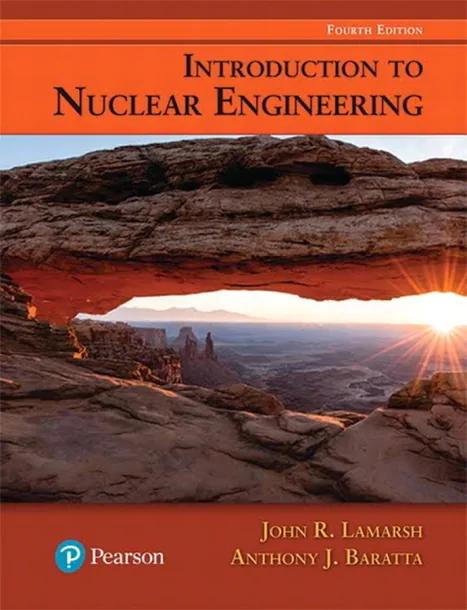
Introduction to Nuclear Engineering
by John R. Lamarsh, Anthony J. Baratta
4th Edition
Publisher: Pearson
Book Details
| Print ISBN | 9780134570051 |
| eText ISBN | 9780134570341 |
| Publisher | Pearson |
| Publishing Year | 2018 |
| Edition | 4th Edition |
| Language | English |
| Pages | 816 |
Introduction to Nuclear Engineering, 4th Edition, is an undergraduate textbook designed for junior- and senior-level nuclear engineering courses. Written by John R. Lamarsh and Anthony J. Baratta, this Pearson volume offers an introduction to core physical principles and reactor systems.
The text covers foundational atomic and nuclear physics, the interaction of radiation with matter, and nuclear reactor theory. It also examines heat removal from reactors, radiation protection and shielding, and reactor licensing, safety, and the environment.
Reflecting industry developments since the 2001 edition, the 2018 edition added revised data alongside expanded discussions of advanced plant designs and the worldwide nuclear renaissance.
Table of Contents
Chapter 1: Nuclear Engineering
Chapter 2: Atomic and Nuclear Physics
- • 2.1 Fundamental Particles
- • 2.2 Atomic and Nuclear Structures
- • 2.3 Atomic and Molecular Weights
- • 2.4 Atomic and Nuclear Radii
- • 2.5 Mass and Energy
- • 2.6 Particle Wavelengths
- • 2.7 Excited States and Radiation
- • 2.8 Nuclear Stability and Radioactive Decay
- • 2.9 Radioactivity Calculations
- • 2.10 Nuclear Reactions
- • 2.11 Binding Energy
- • 2.12 Nuclear Models
- • 2.13 Gases, Liquids, and Solids
- • 2.14 Atom Density
- • References
- • Problems
Chapter 3: Interaction of Radiation with Matter
- • 3.1 Neutron Interactions
- • 3.2 Cross Sections
- • 3.3 Neutron Attenuation
- • 3.4 Neutron Flux
- • 3.5 Neutron Cross Section Data
- • 3.6 Energy Loss in Scattering Collisions
- • 3.7 Fission
- • 3.8 y-Ray Interactions with Matter
- • 3.9 Charged Particles
- • References
- • Problems
Chapter 4: Nuclear Reactors and Nuclear Power
- • 4.1 The Fission Chain Reaction
- • 4.2 Nuclear Reactor Fuels
- • 4.3 Non-Nuclear Components of Nuclear Power Plants
- • 4.4 Components of Nuclear Reactors
- • 4.5 Power Reactors and Nuclear Steam Supply Systems
- • 4.6 Nuclear Cycles
- • 4.7 Isotope Separation
- • 4.8 Fuel Reprocessing
- • 4.9 Radioactive Waste Disposal
- • References
- • Problems
Chapter 5: Neutron Diffusion and Moderation
- • 5.1 Neutron Flux
- • 5.2 Fick’s Law
- • 5.3 The Equation of Continuity
- • 5.4 The Diffusion Equation
- • 5.5 Boundary Conditions
- • 5.6 Solutions of the Diffusion Equation
- • 5.7 The Diffusion Length
- • 5.8 The Group-Diffusion Method
- • 5.9 Thermal Neutron Diffusion
- • 5.10 Two-Group Calculation of Neutron Moderation
- • References
- • Problems
Chapter 6: Nuclear Reactor Theory
- • 6.1 One-Group Reactor Equation
- • 6.2 The Slab Reactor
- • 6.3 Other Reactor Shapes
- • 6.4 The One-Group Critical Equation
- • 6.5 Thermal Reactors
- • 6.6 Reflected Reactors
- • 6.7 Multigroup Calculations
- • 6.8 Heterogeneous Reactors
- • References
- • Problems
Chapter 7: The Time-Dependent Reactor
- • 7.1 Classification of Time Problems
- • 7.2 Reactor Kinetics
- • 7.3 Control Rods and Chemical Shim
- • 7.4 Temperature Effects on Reactivity
- • 7.5 Fission Product Poisoning
- • 7.6 Core Properties During Lifetime
- • References
- • Problems
Chapter 8: Heat Removal from Nuclear Reactors
- • 8.1 General Thermodynamic Considerations
- • 8.2 Heat Generation in Reactors
- • 8.3 Heat Flow by Conduction
- • 8.4 Heat Transfer to Coolants
- • 8.5 Boiling Heat Transfer
- • 8.6 Thermal Design of a Reactor
- • References
- • Problems
Chapter 9: Radiation Protection
- • 9.1 History of Radiation Effects
- • 9.2 Radiation Units
- • 9.3 Some Elementary Biology
- • 9.4 The Biological Effects of Radiation
- • 9.5 Quantitative Effects of Radiation on the Human Species
- • 9.6 Calculations of Radiation Effects
- • 9.7 Natural and Man-Made Radiation Sources
- • 9.8 Standards of Radiation Protection
- • 9.9 Computations of Exposure and Dose
- • 9.10 Standards for Intake of Radionuclides
- • 9.11 Exposure from y-Ray Sources
- • Glossary
- • References
- • Problems
Chapter 10: Radiation Shielding
- • 10.1 Gamma-Ray Shielding: Buildup Factors
- • 10.2 Infinite Planar and Disc Sources
- • 10.3 The Line Source
- • 10.4 Internal Sources
- • 10.5 Multilayered Shields
- • 10.6 Nuclear Reactor Shielding: Principles of Reactor Shielding
- • 10.7 Removal Cross Sections
- • 10.8 Reactor Shield Design: Removal—Attenuation Calculations
- • 10.9 The Removal—Diffusion Method
- • 10.10 Exact Methods
- • 10.11 Shielding y-Rays
- • 10.12 Coolant Activation
- • 10.13 Ducts in Shields
- • References
- • Problems
Chapter 11: Reactor Licensing, Safety, and the Environment
- • 11.1 Governmental Authority and Responsibility
- • 11.2 Reactor Licensing
- • 11.3 Principles of Nuclear Power Plant Safety
- • 11.4 Dispersion of Effluents from Nuclear Facilities
- • 11.5 Radiation Doses from Nuclear Plants
- • 11.6 Reactor Siting
- • 11.7 Reactor Accidents
- • 11.8 Accident Risk Analysis
- • 11.9 Environmental Radiation Doses
- • References
- • Problems
Chapter Appendixes: Appendixes
- • I. Units and Conversion Factors 743
- • II. Fundamental Constants and Data 749
- • III. Vector Operations in Orthogonal Curvilinear Coordinates 759
- • IV. Thermodynamic and Physical Properties 765
- • V. Bessel Functions
Customer Reviews
0.0
0 reviews
No reviews yet. Be the first to review this book!
Write a Review
Reviewed by GradeFocus Editorial Team
▶Research Sources (3)
Related Books
New Directions in Nuclear Energy
Andrew Foss
Advanced Nuclear Fuels and Materials
Rongzheng Liu
Fusion Energy Technology R&D Priorities
Laila El-Guebaly
Nuclear Reactor Physics
Weston M. Stacey
Fundamentals of Nuclear Science and Engineering
J. Kenneth Shultis
Nuclear Engineering Fundamentals
Robert E. Masterson