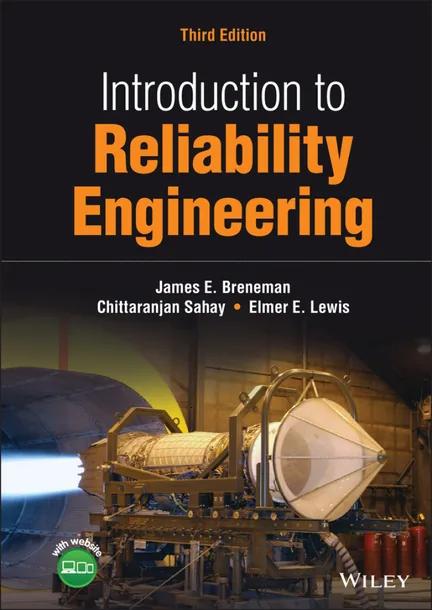
Introduction to Reliability Engineering
by James E. Breneman, Chittaranjan Sahay, Elmer E. Lewis
3rd Edition
Publisher: Wiley-Blackwell
Book Details
| Print ISBN | 9781119640561 |
| eText ISBN | 9781119640653 |
| Publisher | Wiley-Blackwell |
| Publishing Year | 2022 |
| Edition | 3rd Edition |
| Language | English |
| Pages | 640 |
Introduction to Reliability Engineering, 3rd Edition, is a textbook that explains how probability and statistical analysis help predict and evaluate engineering reliability. The text combines foundational theory with practical engineering applications, assuming no prior student background in probability and statistics.
Core subject areas include discrete and continuous probability distributions, failure rate modeling, redundant system configurations, and Weibull analysis. The volume also examines applied engineering methods, including Failure Modes and Effects Analysis (FMEA) and system safety evaluations.
Written for advanced undergraduate and graduate students across engineering and manufacturing technology disciplines, the book teaches students to solve data analysis problems using software tools including Minitab and Excel.
Table of Contents
Chapter 1: INTRODUCTION
- • 1.1 Reliability Defined
- • 1.2 Performance, Cost and Reliability
- • 1.3 Quality, Reliability and Safety Linkage
- • 1.4 Quality, Reliability and Safety Engineering Tasks
- • 1.5 Preview
Chapter 2: PROBABILITY AND DISCRETE DISTRIBUTIONS
- • 2.1 Introduction
- • 2.2 Probability Concepts
- • Sample Space
- • Outcome
- • Event
- • Probability Axioms
- • More than two events
- • Combinations and Permutations
- • 2.3 Discrete Random Variables
- • Properties of Discrete Variables
- • The Binomial Distribution
- • The Poisson Distribution
- • Confidence Intervals
- • Motivation for Confidence Intervals
- • Introduction to Confidence Intervals
- • Binomial Confidence Intervals
- • Cumulative sums of the Poisson Distribution (Thorndike Chart)
Chapter 3: Exponential Distribution and Reliability Basics
- • 3.1 Introduction
- • 3.2 Reliability Characterization
- • Basic definitions
- • The Bathtub curve
- • 3.3 Constant Failure Rate model
- • The Exponential Distribution
- • Demand failures
- • Time determinations
- • 3.4 Time Dependent Failure rates
- • 3.5 Component Failures and Failure Modes
- • Failure mode rates
- • Component counts
- • 3.6 Replacements
- • 3.7 Redundancy
- • Active and Standby Redundancy
- • Active Parallel
- • Standby Parallel
- • Constant Failure Rate Models
- • 3.8 Redundancy limitations
- • Common-mode failures
- • Load sharing
- • Switching & Standby failures
- • Cool, Warm and Hot Standby
- • 3.9 Multiply Redundant Systems
- • 1/N Active Redundancy
- • 1/N Standby Redundancy
- • m/N Active Redundancy
- • 3.10 Redundancy Allocation
- • High and Low level redundancy
- • Fail-safe and Fail-to-Danger
- • Voting Systems
- • 3.11 Redundancy in Complex Configurations
- • Serial-Parallel configurations
- • Linked configurations
Chapter 4: Continuous Distributions- Part 1 Normal & Related Distributions
- • 4.1 Introduction
- • 4.2 Properties of Continuous Random variables
- • Probability Distribution Functions
- • Characteristics of a Probability Distribution
- • Sample Statistics
- • Transformation of Variables
- • 4.3 Empirical Cumulative Distribution Function
- • 4.4 Uniform Distribution
- • 4.5 Normal and Related Distributions
- • The Normal Distribution
- • Central Limit Theorem
- • The Central Limit Theorem in Practice
- • The Log Normal Distribution
- • Log Normal Distribution from a Physics of Failure Perspective
- • 4.6 Confidence Intervals
- • Point & Interval Estimates
- • Estimate of the Mean
- • Normal & Lognormal parameters
Chapter 5: Continuous Distributions- Part 2 Weibull & Extreme Value Distributions
- • 5.1 Introduction
- • The “weakest link” theory from a Physics of Failure point of view
- • Uses of Weibull and Extreme Value Distributions
- • Other Considerations
- • Age parameters and sample sizes
- • Engineering Changes, Maintenance Plan Evaluation and Risk Prediction
- • Weibulls with cusps or curves
- • System Weibulls
- • No failure Weibulls
- • Small sample Weibulls
- • 5.2 Statistics of the Weibull Distribution
- • Weibull “Mathematics”
- • The Weibull Probability Plot
- • Probability Plotting Points—Median Ranks
- • How to do a “Weibull Analysis”
- • Weibull plots and their estimates of b, h
- • The 3-Parameter Weibull didn’t work, what are my choices?
- • The data has a “dogleg” bend or cusp when plotted on Weibull paper.
- • Steep Weibull slopes (β’s) may hide problems.
- • Low Time Failures and close Serial numbers---Batch problems
- • Maximum Likelihood Estimates of β and η
- • Weibayes Analysis
- • Weibayes background
- • Weibull Analysis with failure times only and unknown times on remaining population
- • Shifting Weibull Procedure
- • Confidence bounds and the Weibull Distribution
- • Arbitrary Censored Data
- • The Weibull Distribution in a System of Independent failure modes
- • 5.3 Extreme Value Distributions
- • Smallest & Largest Extreme Value distributions
- • Extreme Value and Weibull Distribution Point Estimates & Confidence Intervals
- • 5.4 Introduction to Risk analysis
- • Risk Analysis “Mathematics”
- • Supplement 1- Weibull derived from weakest link theory
- • Supplement 2: Comparing two distributions using Supersmith™
Chapter 6: RELIABILITY TESTING
- • 6.1 Introduction
- • 6.2 Attribute Testing (Binomial Testing)
- • The Classical Success Run
- • Zero Failure Attribute Tests
- • Non-ZERO Failure Attribute Tests
- • 6.3 Constant Failure Rate Estimates
- • Censoring on the Right
- • MTTF Estimates
- • Confidence Intervals
- • 6.4 Weibull Substantiation and Reliability Testing
- • Zero-Failure Test Plans for Substantiation Testing
- • Weibull Zero-Failure test Plans for Reliability Testing
- • Designing the Test Plan
- • Total Test Time
- • Why not Simply Test to Failure?
- • 6.5 How to Reduce Test Time
- • Run (simultaneously) more test samples than you intend to fail
- • Sudden Death Testing
- • Sequential Testing
- • 6.6 Normal & Lognormal Reliability Testing
- • 6.7 Accelerated Life Testing
- • Compressed Time Testing
- • Advanced Stress Testing-Linear & Acceleration Models
- • Linear Model Stress testing
- • Advanced Stress Testing – Acceleration Models
- • The Arrhenius Model
- • The Inverse Power Law Model
- • Other Acceleration Models
- • 6.8 Reliability Enhancement Procedures
- • Reliability Growth Modeling & Testing
- • Calculation of Reliability Growth parameters
- • Goodness of Fit tests for Reliability Growth Models
- • Environmental Stress Screening
- • What “Screens” are used for ESS?
- • Thermal cycling
- • Random Vibration
- • Other Screens
- • Highly Accelerated Life Tests
- • Highly Accelerated Stress Screening
- • Supplement 1 Substantiation Testing: Characteristic Life multipliers for Zero failure Test at 80%, 90%, 95%, 99% Confidence
- • Supplement 2 Substantiation Testing Tables for Zero failure Test at 80%, 90%, 95%, 99% Confidence
- • Supplement 3 CRITICAL VALUES FOR CRAMER-VON MISES GOODNESS-OF-FIT TEST
- • Supplement 4 Other Reliability Growth Models
- • Supplement 5 Chi-Square Table
Chapter 7: Failure Modes & Effects Analysis (FMEA) – Design & Process
- • 7.1 Introduction
- • 7.2 Functional FMEA
- • 7.3 Design FMEA
- • Design FMEA Procedure
- • 7.4 Process FMEA(PFMEA)
- • 7.5 FMEA Summary
- • FMEA Outputs
- • FMEA Pitfalls that can be prevented
- • Supplement 1 Shortcut tables for stalled FMEA Teams
- • Supplement 2 Future changes in FMEA Approaches
- • Supplement 3 DFMEA and PFMEA Forms
Chapter 8: LOADS, CAPACITY, AND RELIABILITY
- • 8.1 Introduction
- • 8.2 Reliability with a Single Loading
- • Load Application
- • Definitions
- • 8.3 Reliability and Safety Factors
- • Normal Distributions
- • Lognormal Distributions
- • Combined Distributions
- • 8.4 Repetitive Loading
- • Loading Variability
- • Variable Capacity
- • 8.5 The Bathtub Curve—Reconsidered
- • Single Failure Modes
- • Combined Failure Modes
- • Supplement 1: The Dirac Delta Distribution
Chapter 9: MAINTAINED SYSTEMS
- • 9.1 Introduction
- • 9.2 Preventive Maintenance
- • Idealized Maintenance
- • Imperfect Maintenance
- • Redundant Components
- • 9.3 Corrective Maintenance
- • Availability
- • Maintainability
- • 9.4 Repair: Revealed Failures
- • Constant Repair Rates
- • Constant Repair Times
- • 9.5 Testing and Repair: Unrevealed Failures
- • Idealized Periodic Tests
- • Real Periodic Tests
- • 9.6 System Availability
- • Revealed Failures
- • Unrevealed Failures
Chapter 10: FAILURE INTERACTIONS
- • 10.1 Introduction
- • 10.2 Markov Analysis
- • Two Independent Components
- • Load-Sharing Systems
- • 10.3 Reliability with Standby Systems
- • Idealized System
- • Failures in the Standby State
- • Switching Failures
- • Primary System Repair
- • 10.4 Multicomponent Systems
- • Multicomponent Markov Formulations
- • Combinations of Subsystems
- • 10.5 Availability
- • Standby Redundancy
- • Shared Repair Crews
- • Markov Availability-Advantages & Disadvantages
Chapter 11: SYSTEM SAFETY ANALYSIS
- • 11.1 Introduction
- • 11.2 Product and Equipment Hazards
- • 11.3 Human Error
- • Routine Operations
- • Emergency Operations
- • 11.4 Methods of Analysis
- • Failure Modes Effects and Criticality Analysis (FMECA)
- • Event Trees
- • 11.5 Fault Trees
- • Fault-Tree Construction
- • Nomenclature
- • Fault Classification
- • Fault Tree Examples
- • Direct Evaluation of Fault Trees
- • Qualitative Evaluation
- • Quantitative Evaluation
- • Fault-Tree Evaluation by Cut Sets
- • Qualitative Analysis
- • Quantitative Analysis
- • 11.6 Reliability/Safety Risk Analysis
Chapter A: USEFUL MATHEMATICAL RELATIONSHIPS
Chapter B: BINOMIAL CONFIDENCE CHARTS
Chapter C: STANDARD NORMAL CDF
Chapter D: NONPARAMETRIC METHODS AND PROBABILITY PLOTTING
- • D1 Introduction
- • D2 Nonparametric Methods for Probability Plotting
- • D3 Parametric Methods
- • D4 Goodness-of-Fit
- • Supplement 1 Further Details of Weibull Probability plotting
- • Supplement 2 Median Rank adjustment for SUSPENDED TEST ITEMS
- • Supplement 3 Generating a Probability Plot in MINITAB
Chapter ANSWERS TO ODD-NUMBERED EXERCISES: ANSWERS TO ODD-NUMBERED EXERCISES
Customer Reviews
0.0
0 reviews
No reviews yet. Be the first to review this book!
Write a Review
Reviewed by GradeFocus Editorial Team
Related Books

Architecting Resilient Systems
Scott Jackson
Distributed Time-Sensitive Systems
Tanupriya Choudhury
Control Systems Engineering (CSE) Study Guide
International Society of Automation (ISA)

Digital Twins in Action
Greg Biegel
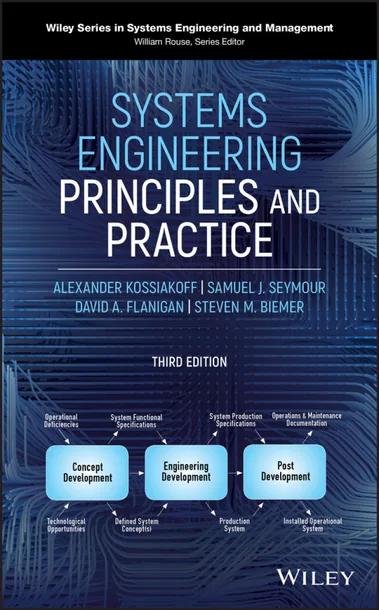
Systems Engineering Principles and Practice
Alexander Kossiakoff
Reliability Engineering
Mangey Ram