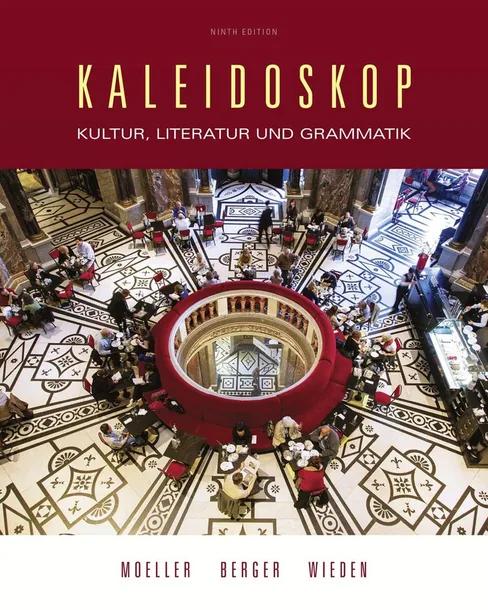
Kaleidoskop
by Jack Moeller, Simone Berger, Anja Wieden
9th Edition
Publisher: Cengage Learning
Book Details
| Print ISBN | 9781305629530 |
| eText ISBN | 9781337026048 |
| Publisher | Cengage Learning |
| Publishing Year | 2017 |
| Edition | 9th Edition |
| Language | English |
| Pages | 464 |
Kaleidoskop, 9th Edition, is a German language textbook designed around a student-centered, four-skills approach that emphasizes communication alongside the literature and culture of the German-speaking world.
Structured as two books in one, the program combines a cultural and literary reader organized around ten themes with a comprehensive grammar review. Core reading selections anchor activities across listening, speaking, and writing, addressing cultural themes such as communication and multicultural society.
The self-contained grammar section allows instructors to teach grammatical topics in any order, either independently or alongside corresponding reading units. Real-world scenarios illustrate how grammatical forms serve everyday communicative functions.
Table of Contents
PART I: ERSTER TEIL. LEKTÜRE.
Chapter 1: Freizeit
- • Kulturlesestücke
- • Tabelle: Was machen Sie üblicherweise in Ihrer Freizeit?
- • Online-Interview: Wie verbringst du deine Freizeit?
- • Reiseführer: München
- • Literarische Werke
- • Gedicht: Vergnügungen, Bertolt Brecht
- • Kurzgeschichte: „Kräftig essen", Helga M. Novak
Chapter 2: Kommunikation
- • Kulturlesestücke
- • Online-Zeitungsartikel: Unicum-Online: „Sind wir alle abhängig?"
- • Reiseführer: Hamburg
- • Kurzfilm: Das Puzzle
- • Literarische Werke
- • Gedicht: Sachliche Romanze, Erich Kästner
- • Kurzgeschichte: Eine Postkarte für Herrn Altenkirch, Barbara Honigmann
Chapter 3: Deutschland im 21. Jahrhundert
- • Kulturlesestücke
- • Interview: Was das Wort ,,DDR" fur mich bedeutet
- • Zeitschriftenartikel: Kontinent im Kleinformat: Die Europäische Schule in München
- • Reiseführer: Dresden
- • Literarische Werke
- • Gedicht: Nach dem Umsturz, Heinz Czechowski
- • Drehbuch: Good-Bye Lenin! Bernd Lichtenberg; CoAutor Wolfgang Becker
Chapter 4: Familie
- • Kulturlesestücke
- • Interview: Einstellungen zur Familie
- • Kolumne: Michael Kneissler: Ich muß für meinen Sohn nachsitzen
- • Reiseführer: Bremen
- • Kurzfilm: Familienrevier
- • Literarische Werke
- • Gedicht: Dich, Erich Fried
- • Märchen: Die sieben Raben Jakob und Wilhelm Grimm
Chapter 5: Musik
- • Kulturlesestücke
- • Übersicht: Die Stars livehaftig erleben
- • Biografie: Clara Schumann
- • Artikel: Clueso, Casper und Cro: Neue Töne bei den Deutschrappern
- • Anzeigen: Veranstaltungen
- • Reiseführer: Wien
- • Literarische Werke
- • Gedicht/Lied: Der Erlkönig, Johann Wolfgang von Goethe (Musik von Franz Schubert)
Chapter 6: Die Welt der Arbeit
- • Kulturlesestücke
- • Tabelle: Produkt gut – alles gut
- • Artikel: „Einmal im Ausland arbeiten"
- • Übersicht: Das Schulsystem in Deutschland
- • Reiseführer: Frankfurt am Main
- • Kurzfilm: Dufte
- • Literarische Werke
- • Gedicht; Arbeits-Los, Johann Sziklai
- • Tagebuchaufzeichnung: „Anekdote zur Senkung der Arbeitsmoral", Heinrich Böll
Chapter 7: Multikulturelle Gesellschaft
- • Kulturlesestücke
- • Interviews: Max Scharnigg, Friederike Knüpling: Pinar Erincin, Schauspielerin
- • Ursula Kiausch: ,,Integration statt Assimilation"
- • Reiseführer: Berlin
- • Literarische Werke
- • Gedicht: Ich habe zwei Heimatländer Sabri Cakir
- • Erzählung: Geschäftstarnungen, Wladimir Kaminer
Chapter 8: Junge Erwachsene
- • Kulturlesestücke
- • Schaubilder: Werte und Befürchtungen der Jugendlichen
- • Artikel: Schule & Job ,,was werden"
- • Artikel: Eine Frage der Existenz
- • Reiseführer: Zürich
- • Kurzfilm: tbd
- • Literarische Werke
- • Gedicht: Ein Jüngling liebt ein Mädchen, Heinrich Heine
- • Kurzgeschichte: Brief aus Amerika, Johannes Bobrowski
Chapter 9: Andere Länder, andere Sitten
- • Kulturlesestücke
- • Umfrage: Die Deutschen über sich selbst
- • Feature: Randy Kaufman: „Unser Ausland!"
- • Berichte: Tübinger Austauschstudenten berichten
- • Reiseführer: Köln
- • Literarische Werke
- • Gedicht: Anders II, Rose Ausländer
- • Kurzgeschichte: Die grüne Krawatte, Arthur Schnitzler
Chapter 10: Umwelt
- • Kulturlesestücke
- • Zeitschriftenartikel: Die Kunst der Mülltrennung
- • Zeitschriftenartikel: Ganz neue Töne
- • Umfrage: „Umweltschutz geht jeden an"
- • Reiseführer: Freiburg
- • Kurzfilm: tbd
- • Literarische Werke
- • Gedicht: Ruß Sarah Kirsch
- • Kurzgeschichte: Der Bergarbeiter, Heinrich Böll
PART II: ZWEITER TEIL. GRAMMATIK.
Chapter 1: Infinitive stems and endings
- • Basic present-tense endings
- • Present tense of stem-changing verbs
- • Haben, sein, werden, and wissen in the present tense
- • Uses of the present tense
- • Imperative forms
- • Separable-prefix verbs
- • Present tense of modal auxiliaries
- • Use of modal auxiliaries
- • Meaning of the modal auxiliaries
- • The möchte –forms
- • Negative of müssen and dürfen
- • Wollen, dass and möchten, dass
- • Meanings of lassen
- • Future time: present tense
- • Future time: future tense
- • Future tense of modals
- • Other uses of the future tense
Chapter 2: Simple past tense
- • Weak verbs in the simple past
- • Modals in the simple past
- • Irregular weak verbs
- • Strong verbs in the simple past
- • Sein and werden in the simple past tense
- • The present perfect tense
- • Past participles of regular weak verbs
- • Past participles of irregular weak verbs + haben
- • Past participles of strong verbs
- • Past participles of separable-prefix verbs
- • Past participle without ge- prefix
- • Use of the auxiliary haben
- • Use of the auxiliary sein
- • The present perfect versus simple past
- • The past perfect tense
- • infinitives without zu
- • Double infinitive construction with modals, hören, sehen, lassen
Chapter 3: Position of the finite verb in statements
- • Position of the finite verb in questions
- • Word order: time, manner, place
- • Position of nicht
- • Independent clauses and coordinating conjunctions
- • Two-part conjunctions
- • The conjunctions aber and sondern
- • Dependent clauses and subordinating conjunctions
- • Uses of als, wenn, and wann
- • Dependent clauses: indirect statements and questions
- • Infinitives with zu
- • Expressions um … zu, (an)statt … zu, ohne … zu
Chapter 4: Uses of the nominative case
- • Uses of the accusative case
- • Direct object
- • Definite article, nominative and accusative
- • Der-words, nominative and accusative
- • Meanings and uses of der-words
- • The indefinite article ein and kein, nominative and accusative
- • Possessive adjectives
- • Nouns indicating nationalities and professions
- • Masculine N-nouns in the accusative case
- • Personal pronouns, nominative and accusative
- • Demonstrative pronouns, nominative and accusative
- • The indefinite pronoun man
- • The interrogative pronouns wer and was
- • Prepositions
- • Prepositions with the accusative case
- • Time expressions with the accusative case
- • Accusative of measure
- • Units of measurement and quantity
- • The expression es gibt
Chapter 5: Forms of the dative case
- • Nouns in the dative plural
- • Masculine N-nouns in the dative case
- • Personal pronouns in the dative case
- • Demonstrative pronouns in the dative case
- • The interrogative pronoun wer in the dative
- • Uses of the dative case
- • Indirect object
- • Word order of direct and indirect objects
- • Dative verbs
- • Prepositions with the dative case
- • Contractions of dative prepositions
- • Adjectives with the dative case
Chapter 6: Hin and her
- • Two-way prepositions
- • Contractions of tw-way prepositions
- • The verbs legen/liegen, setzen/sitzen, stellen/stehen, hängen, stecken
- • Verb and preposition combinations
- • Time expressions with the dative case
- • Da-compounds
- • Wo-compounds
- • Forms of the genitive case
- • Nouns in the genitive
- • Masculine N-nouns in the genitive
- • Proper names in the genitive
- • The interrogative pronoun- wessen
- • Uses of the genitive case
- • Possession and other close relationships
- • Prepositions with the genitive case
- • Expressions of indefinite time
- • Special expressions
- • Dative as substitute for the genitive
Chapter 7: Predicate adjectives
- • Attributive adjectives
- • Adjectives preceded by the definite article or der-words
- • Adjectives preceded by the indefinite article or ein-words
- • Ommision of the noun
- • Summary of preceded adjectives
- • Unpreceded adjectives
- • Adjectives following indefinite adjectives
- • Adjectives used as nouns
- • The adjective hoch and adjectives ending in –el or –er
- • Ordinal numbers
- • Present participles as adjectives
- • Past participles as adjectives
- • Comparison of adjectives and adverbs
- • Expressing comparisons
Chapter 8: Indicative and subjunctive
- • Subjunctive II
- • Verb endings in present-time subjunctive II
- • The wurde-construction
- • Present –time subjunctive II of sein and haben
- • Modals in present-time subjunctive II
- • present-time subjunctive II of strong verbs
- • Present-time subjunctive II of regular weak verbs
- • Past-time subjunctive II
- • Modals in past-time subjunctive II
- • Conditional sentences
- • Omission of wenn in conditional sentences
- • Uses of the wurde-construction and subjunctive II
- • Clauses introduced by als ob and als wenn
- • The würde-construction versus the subjunctive II of the main verb
Chapter 9: Reflexive pronouns
- • Accusative reflexive pronouns
- • Dative reflexive pronouns
- • Verbs with either accusative or dative reflexive pronouns
- • Reflexive verbs and verbs used reflexively
- • Reflexive with parts of body and clothing
- • Intensifiers selbst and selber
- • Reciprocal use of reflexives and einander
- • Relative clauses
- • Forms of relative pronouns
- • The relative pronouns was
- • The relative pronouns wer and was with no antecedent
- • Extended modifiers
- • Objective and subjective use of modals
- • Subjective statements in present time
- • Subjective statements in past time
- • objective and subjective meanings of modals
Chapter 10: The passive voice
- • Tenses in the passive voice
- • Expressing agent and means
- • Modals and the passive infinitive
- • Impersonal passive construction
- • Dative verbs in the passive voice
- • Past participle in passive vs. past participle as predicate adjective
- • Summary of uses of werden
- • Alternatives to the passive voice
- • Indirect discourse: Statements
- • Subjunctive II
- • Subjunctive I
- • Present-time subjunctive I
- • Subjunctive I of sein
- • Past-time subjunctive I
- • Future-time subjunctive I
- • Subjunctive I in wishes, commands, and requests
- • Indirect discourse: Tenses
- • Indirect yes-no questions
- • Indirect informational questions
- • Indirect commands
- • Summary: Indirect discourse
Chapter Reference Section: Reference Section
Chapter Appendix A: German Grammatical Terms
Chapter Appendix B: Grammatical Tables
Chapter Appendix C: Kurzfilme
Chapter German-English Vocabulary: German-English Vocabulary
Chapter English-German Vocabulary: English-German Vocabulary
Customer Reviews
0.0
0 reviews
No reviews yet. Be the first to review this book!
Write a Review
Reviewed by GradeFocus Editorial Team