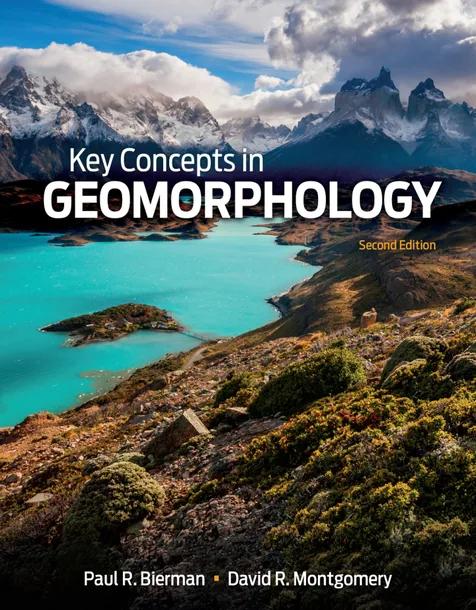
Key Concepts in Geomorphology
by Paul R. Bierman, David R. Montgomery
2nd Edition
Publisher: W.H. Freeman & Company
Book Details
| Print ISBN | 9781319059804 |
| eText ISBN | 9781319312527 |
| Publisher | W.H. Freeman & Company |
| Publishing Year | 2020 |
| Edition | 2nd Edition |
| Language | English |
| Pages | 592 |
Key Concepts in Geomorphology, 2nd Edition, serves as an introductory textbook for college and university students studying Earth's dynamic surface. The volume integrates perspectives from physics, chemistry, biology, and mathematics to examine surface mechanisms and topographic development across both short and long timescales.
Rather than detailing regional or local descriptions, coverage focuses on foundational principles that govern landform change. The text addresses surface processes across hillslopes, river channels, and coastal settings, while evaluating large-scale drivers such as climate cycles, volcanism, and tectonic activity.
Instructional features such as worked problems provide practice with quantitative methods, helping students apply analytical techniques to Earth surface problems.
Table of Contents
Chapter 1: Earth's Dynamic Surface
- • Introduction
- • Geosphere
- • Hydrosphere
- • Biosphere
- • Landscapes
- • Unifying Concepts
- • Applications
- • Digging Deeper: Why is Earth Habitable?
- • Case Study: Geomorphic Effects of Human-Induced Climate Change
- • Worked Problem
- • Knowledge Assessment
Chapter 2: A Brief History of Geomorphology
- • Introduction
- • Geomythology
- • Classical and Natural Philosophers
- • Nineteenth Century
- • Twentieth Century
- • Modern Geomorphology
- • Digging Deeper: Theories of Earth
- • Case Study: Portraying the Land
- • Worked Problem
- • Knowledge Assessment
Chapter 3: Geomorphologist's Tool Kit
- • Introduction
- • Characterizing Earth's Surface
- • Relative Dating Methods
- • Numerical Dating Methods
- • Measuring Rates of Geomorphic Processes
- • Experiments
- • Proxy Records
- • Applications
- • Digging Deeper: How Does a Dating Method Work?
- • Case Study: Surface Indications of a Vanished Civilization
- • Worked Problem
- • Knowledge Assessment
Chapter 4: Geomorphic Hydrology
- • Introduction
- • Precipitation
- • Evapotranspiration
- • Groundwater Hydrology
- • Surface Water Hydrology
- • Hydrologic Landforms
- • Applications
- • Digging Deeper: Humans, Hydrology, and Landscape Change--What's the Connection?
- • Case Study: Houston Under Water
- • Worked Problem
- • Knowledge Assessment
Chapter 5: Weathering and Geomorphology
- • Introduction
- • Interactions of Weathering Processes
- • Physical Weathering
- • Chemical Weathering
- • Weathering-Dominated Landforms
- • Applications
- • Digging Deeper: How Do Geomorphologists Determine Chemical Weathering Rates?
- • Case Study: Rock Weathering Leads to Acid Rock Drainage
- • Worked Problem
- • Knowledge Assessment
Chapter 6: Soils and Geomorphology
- • Introduction
- • Soil Production
- • Soil Development
- • Soil Profiles and Description
- • Soils and Landscapes
- • Digging Deeper: How Fast Do Soils Form?
- • Case Study: Soil Erosion and the Downfall of Civilizations
- • Worked Problem
- • Knowledge Assessment
Chapter 7: Hillslopes
- • Introduction
- • Slope-Farming Materials
- • Mass Movements
- • Slope Stability
- • Diffusion-like Processes
- • Slope Morphology
- • Applications
- • Digging Deeper: How Much Do Roots Contribute to Slope Stability?
- • Case Study: The Oso Landslide
- • Worked Problem
- • Knowledge Assessment
Chapter 8: Channels
- • Introduction
- • External Controls on Fluvial Processes and Form
- • Fluvial Processes
- • Sediment Transport
- • Channel Patterns
- • Channel-Reach Morphology
- • Floodplains
- • Channel Response
- • Applications
- • Digging Deeper: What Controls Rates of Bedrock River Incision?
- • Case Study: The Fluvial Legacy of the Gold Rush
- • Worked Problem
- • Knowledge Assessment
Chapter 9: Drainage Basins
- • Introduction
- • Basin-Scale Processes
- • Channel Networks/Basin Morphology
- • Uplands to Lowlands
- • Drainage Basin Landforms
- • Applications
- • Digging Deeper: When Erosion Happens, Where Does the Sediment Go?
- • Case Study: Urbanization and Stream Response
- • Worked Problem
- • Knowledge Assessment
Chapter 10: Coastal and Submarine Geomorphology
- • Introduction
- • Coastal Settings and Drivers
- • Coastal Landforms and Processes
- • Marine Settings and Drivers
- • Marine Landforms and Processes
- • Applications
- • Digging Deeper: What Is Happening to the World's Deltas?
- • Case Study: Superstorm Sandy
- • Worked Problem
- • Knowledge Assessment
Chapter 11: Wind as a Geomorphic Agent
- • Introduction
- • Air as a Fluid
- • Spatial Distribution of Wind-Driven Geomorphic Processes
- • Aeolian Processes
- • Aeolian Features, Landforms, and Deposits
- • Applications
- • Selected References and Further Reading
- • Digging Deeper: Desert Pavements--The Wind Connection
- • Worked Problem
- • Knowledge Assessment
Chapter 12: Volcanic Geomorphology
- • Introduction
- • Distribution and Styles of Volcanism
- • Eruptive Mechanisms and Products
- • Eruption Sizes and Types
- • Volcanic Landscapes
- • Processes of Volcanic Landform Evolution
- • Applications
- • Digging Deeper: Geomorphic Effects of Volcano Sector Collapse
- • Case Study: The 2018 Rift Eruption and Summit Collapse of Kilauea
- • Worked Problem
- • Knowledge Assessment
Chapter 13: Glacial and Periglacial Geomorphology
- • Introduction
- • Glaciers
- • Subglacial Processes and Glacial Erosion
- • Glacial Sediment Transport and Deposition
- • Glacial Landscapes, Landforms, and Deposits
- • Periglacial Environments and Landforms
- • Applications
- • Selected References and Further Reading
- • Digging Deeper: How Much and Where Do Glaciers Erode?
- • Worked Problem
- • Knowledge Assessment
Chapter 14: Geomorphology and Climate
- • Introduction
- • Records of a Changing Climate
- • Climate Cycles
- • Geomorphic Boundary Conditions
- • Climatic Geomorphology
- • Landscape Response to Climate
- • Landscape Controls on Climate
- • Applications
- • Selected References and Further Reading
- • Digging Deeper: Do Climate-Driven Giant Floods Do Significant Geomorphic Work?
- • Worked Problem
- • Knowledge Assessment
Chapter 15: Tectonic Geomorphology
- • Introduction
- • Tectonic Processes
- • Tectonic Settings
- • Landscape Response to Tectonics
- • Applications
- • Digging Deeper: When and Where Did That Fault Last Move?
- • Case Study: Geomorphic Effects of the 2018 Alaska Earthquake
- • Worked Problem
- • Knowledge Assessment
Chapter 16: Landscape Evolution
- • Introduction
- • Factors of Landscape Evolution
- • Models of Landscape Evolution
- • Landscape Types
- • Rates of Landscape Processes
- • Applications
- • Digging Deeper: Is This Landscape in Steady State?
- • Case Study: The Anthropocene
- • Worked Problem
- • Knowledge Assessment
Customer Reviews
0.0
0 reviews
No reviews yet. Be the first to review this book!
Write a Review
Reviewed by GradeFocus Editorial Team