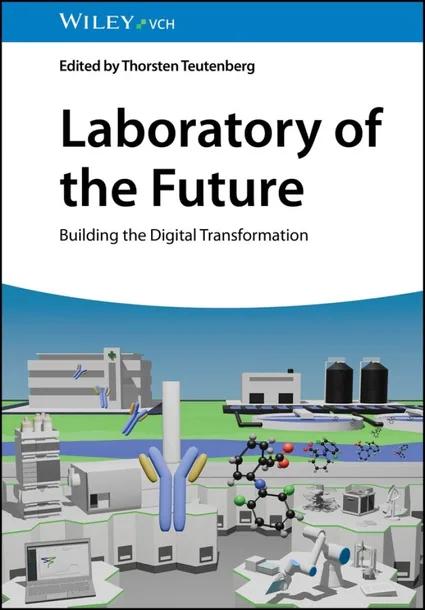
Laboratory of the Future
Building the Digital Transformation
by Thorsten Teutenberg
1st Edition
Publisher: Wiley-VCH
Book Details
| Print ISBN | 9783527352654 |
| eText ISBN | 9783527843756 |
| Publisher | Wiley-VCH |
| Publishing Year | 2025 |
| Edition | 1st Edition |
| Language | English |
| Pages | 288 |
Laboratory of the Future: Building the Digital Transformation, 1st Edition, provides laboratory managers, scientists, and research leaders with a systematic guide to modernizing analytical facilities. Published by Wiley-VCH, this 288-page textbook outlines how contemporary laboratories transition toward automated operations, standardized digital workflows, and integrated software platforms.
The text organizes key developments into clear thematic areas. It addresses physical setup adjustments including miniaturization, flexible laboratory automation, and sustainable laboratory practices. Furthermore, it explores the implementation of Electronic Laboratory Notebooks, mobile laboratory robotics, and digital instrument logs while analyzing methods for ensuring data integrity and applying FAIR data principles across laboratory systems.
To aid technical leadership, each chapter concludes with expert insights that highlight real-world implementation complexities and encourage informed debate. The material prepares digital transformation leaders and decision-makers in research and development environments to evaluate automated technologies and execute structured digital transitions.
Table of Contents
Chapter 1: The Lab of the Future
- • 1.1 Presentation of the FutureLab.NRW Concept
- • 1.1.1 The Inspiration
- • 1.1.2 The Starting Point
- • 1.1.2.1 Instrumental Analysis for Small Molecule Quantification
- • 1.1.2.2 Effect-based Analysis for Identifying Relevant Compounds of Interest
- • 1.1.3 The Transformation of the Lab: New Concepts for the FutureLab. Nrw
- • 1.1.3.1 Instrumental Analysis for Large Molecule Quantification
- • 1.1.3.2 Direct Coupling of Instrumental and Effect-based Analysis
- • 1.1.3.3 Miniaturization
- • 1.1.3.4 Digitalization
- • 1.2 Presentation of the FutureLab.NRW Software Platform
- • 1.2.1 Introductory Remarks
- • 1.2.2 Overall Specifications
- • 1.2.3 Inclusion of the FAIR Data Principles
- • 1.3 The Center for Life Science Automation (CELISCA) – An Interview with Prof. Dr. Kerstin Thurow from the University of Rostock
- • 1.3.1 Personal Introduction
- • 1.3.2 CELISCA’s Approach to Automation
- • 1.3.3 Mobile Robots in the Lab
- • 1.3.4 The Limits of Automation
- • 1.3.5 The Future of Training
Chapter 2: Electronic Laboratory Notebooks
- • 2.1 Introductory Remarks – FAIR Data and the Reproduction Crisis
- • 2.2 ELN Without LIMS?
- • 2.2.1 A Brief and Not Comprehensive Definition of the Nature of an ELN
- • 2.2.2 Some Important Functionalities of an ELN
- • 2.2.2.1 Introductory Remarks
- • 2.2.2.2 Metadata
- • 2.2.2.3 Accessibility
- • 2.2.2.4 Standardization
- • 2.2.2.5 Data Protection
- • 2.2.2.6 Versioning
- • 2.2.2.7 Data Quality
- • 2.2.2.8 Collaboration
- • 2.2.2.9 Long-term Archiving
- • 2.2.2.10 Data Security
- • 2.2.2.11 Conclusion
- • 2.3 Use-case: Digital Instrument Logs
- • 2.3.1 Introductory Remarks
- • 2.3.2 Implementation
- • 2.4 Chemotion: Developing an Open-source Platform for Data Acquisition and Storage – An Interview with Dr. Patrick Hodapp from the Karlsruhe Institute of Technology
- • 2.4.1 Personal Introduction
- • 2.4.2 Motivation for Developing Chemotion
- • 2.4.3 Meeting the Specific Needs of an Organic Chemistry Laboratory
- • 2.4.4 Overcoming Barriers of Adoption
- • 2.4.5 Improving the Quality and the Output of Publications
- • 2.4.6 Long-term Maintenance of the Platform
- • 2.4.7 Arguments Against Using an ELN
- • 2.5 ELNs Are Dead! Long Live ELNs! – An Interview with Dr. Samantha Pearman-Kanza from the University of Southampton
- • 2.5.1 Personal Introduction
- • 2.5.2 Replacing Paper Notebooks
- • 2.5.3 Choosing an Appropriate ELN
- • 2.5.4 Data Privacy
- • 2.5.5 Continuity of Platform
- • 2.5.6 Further Research on ELNs – Overcoming Current Technical Limitations
- • 2.5.7 Using Advanced AI Tools to Retrieve Valuable Information from the Data Lake
Chapter 3: Digital Transformation, But How?
- • 3.1 Introduction
- • 3.2 Existing Problems Calling for a Digital Solution
- • 3.2.1 Introductory Remarks
- • 3.2.2 Stringent Standards
- • 3.2.3 Manual Documentation
- • 3.2.4 Data Integrity
- • 3.2.5 Reproducibility
- • 3.3 Challenges on the Road to a Digital Transformed Lab
- • 3.3.1 Missing Guidance
- • 3.3.2 Moon-shot Thinking
- • 3.3.3 Legacy Devices
- • 3.3.4 Heterogeneous Device Landscape
- • 3.4 Digitization Versus Digital Transformation
- • 3.5 Existing Approaches for Digitized Laboratory Environment
- • 3.6 Methodical Approach
- • 3.6.1 Introduction
- • 3.6.2 Stakeholder Acquisition
- • 3.6.3 Defining the Objective
- • 3.6.3.1 Introduction
- • 3.6.3.2 Tier One: Explorative Laboratory
- • 3.6.3.3 Tier Two: Remote Controlled Laboratory
- • 3.6.3.4 Tier Three: Semi-automatic Laboratory
- • 3.6.3.5 Tier Four: Automatic Laboratory
- • 3.6.3.6 Tier Five: AI Laboratory
- • 3.6.3.7 Conclusion
- • 3.6.4 Workflow Analysis
- • 3.6.5 Workflow Abstraction
- • 3.6.5.1 Introduction
- • 3.6.5.2 Digitization of Measured Values
- • 3.6.5.3 Automation
- • 3.6.5.4 Process Control Commands
- • 3.6.5.5 Process Control Variables
- • 3.6.6 Gateway and Cybersecurity
- • 3.6.7 Gateway Connector
- • 3.6.8 Choosing the Middleware
- • 3.6.8.1 Introduction
- • 3.6.8.2 Commercial IoT Platform
- • 3.6.8.3 Software Ecosystem
- • 3.6.9 Choosing Network Protocols
- • 3.6.10 Driver Development
- • 3.6.11 IoT Server
- • 3.6.12 Integrating Inter-Process Software
- • 3.6.13 Workflow Implementation
- • 3.6.14 Functional Integration
- • 3.6.14.1 Introduction
- • 3.6.14.2 Hardware Layer
- • 3.6.14.3 Software Layer
- • 3.7 Final Conclusion
- • 3.8 Lessons Learned: An Interview with Dr. Jochen Tuerk, Head of the Cooperation Laboratory of Ruhrverband and Emschergenossenschaft / Lippeverband
- • 3.8.1 Personal Introduction
- • 3.8.2 Moon-shot Thinking
- • 3.8.3 The Role of Digital Natives
- • 3.8.4 Requirements of Guidelines
- • 3.8.5 LIMS, ELN, or LES, That Is the Question
- • 3.9 The Digital Transformation in the Chemical Industry – An interview with Dr. Joachim Richert from Technical University of Darmstadt
- • 3.9.1 Personal Introduction
- • 3.9.2 The Digital Transformation in Industry
- • 3.9.3 Commitment of Users and Vendors to Achieve the Digital Transformation
- • 3.9.4 Core Stakeholders
- • 3.9.5 Shortcomings of Academic Research in Student Education
Chapter 4: Communication Standards
- • 4.1 Introduction to Device Communication
- • 4.2 What Is a Communication Layer?
- • 4.3 SiLA 2 and LADS OPC UA
- • 4.3.1 Origins and Development
- • 4.3.2 Communication Paradigms
- • 4.4 SiLA – An Interview with Daniel Juchli from Wega Informatik AG
- • 4.4.1 Personal Introduction
- • 4.4.2 Plug-and-Play Connectivity
- • 4.4.3 The Status Quo of SiLA
- • 4.4.4 There are Many Standards – So Let’s Try to Harmonize, Using a New Standard
- • 4.4.5 The Chicken and Egg Problem
- • 4.4.6 The Role of Open Source in Lab Automation Standards
- • 4.4.7 The Future of Lab Standardization: Trends and Challenges
- • 4.5 LADS – An Interview with Dr. Matthias Arnold
- • 4.5.1 Personal Introduction
- • 4.5.2 Why Another Standard?
- • 4.5.2.1 “Plug-and-Play Connectivity” – Revisited
- • 4.5.2.2 OPC UA Companion Specifications and “Machine Plug and Play”
- • 4.5.2.3 “Human Versus Machine Plug and Play” – LADS OPC UA Example
- • 4.5.2.4 The Role of Ontologies and Taxonomies – FAIR Data and AI Enablement
- • 4.5.3 The Future Perspective of LADS
- • 4.5.4 Tackling Cybersecurity Challenges
- • 4.5.5 Coexistence of the Two Standards
- • 4.6 Digitalization at Roche – An Interview with Tom Kissling from F. Hoffmann – La Roche Ltd.
- • 4.6.1 Personal Introduction
- • 4.6.2 The Role of Standardization
- • 4.6.3 Money Can Buy Everything, Can’t It?
- • 4.6.4 The Concept of Digital Transformation at Roche
- • 4.6.5 Academic Versus Industrial Research
- • 4.7 Summary from the Perspective of a Device Integrator – A Brief Comment from Julian Luebke, Chief Business Officer at Labforward GmbH
Chapter 5: Data and Data Processing Standards
- • 5.1 Introduction
- • 5.2 Data Standards
- • 5.2.1 Introduction
- • 5.2.2 The Basics of Data Standards
- • 5.2.3 Use Cases for Open Data Standards
- • 5.2.3.1 Introduction
- • 5.2.3.2 Basic Parameters
- • 5.2.3.3 Multidimensional Analytical Data
- • 5.2.4 Software to Read, Write, and Process Open Data Standards
- • 5.3 Data Processing
- • 5.3.1 Introductory Remarks
- • 5.3.2 Data Competences
- • 5.3.3 Vendor Versus Open-source Processing Software
- • 5.3.4 Reproducible Workflows with StreamFind
- • 5.3.5 Automated Use of Results in Broader Smart Laboratory Workflows
- • 5.4 An Overview About Important Data Standards: AnIML, ASM, and ADF – An Interview with Dr. Philip Wenig from Lablicate GmbH
- • 5.4.1 Personal Introduction
- • 5.4.2 Open-Source Versus Proprietary Software
- • 5.4.3 A Brief and General Overview about AnIML, ASM, and ADF
- • 5.4.4 The Future Perspective of Data Standards
- • 5.5 Data Processing with a Focus on Advanced Data Analysis and Quality Assurance – An Interview with Dr. Gerrit Renner from University of Duisburg-Essen
- • 5.5.1 Personal Introduction
- • 5.5.2 Challenges of Data Processing with Vendor Software
- • 5.5.3 Quality Assurance in Vendor and Open-source Software
- • 5.5.4 Transparency in Data Processing
- • 5.5.5 Opportunities from Advances in Data Science
Chapter 6: Smart Digital Workflows
- • 6.1 General Introduction
- • 6.2 Temperature Monitoring
- • 6.2.1 Introduction
- • 6.2.2 First Approach: Off-the-shelf Software
- • 6.2.3 Second Approach: DIY Low Cost
- • 6.2.4 Notifications and Alarms
- • 6.2.5 Conclusion
- • 6.3 Labeling Workflow
- • 6.3.1 Introduction
- • 6.3.2 Implementation
- • 6.3.3 Conclusion
- • 6.4 Stock Solution Workflow
- • 6.4.1 Introduction
- • 6.4.2 Implementation
- • 6.4.2.1 Digital SOP
- • 6.4.2.2 Device Integration and Communication
- • 6.4.2.3 Process Comparison and Efficiency Gains
- • 6.4.3 Conclusion
- • 6.5 Automation and Orchestration of Atline Analysis
- • 6.5.1 Introduction
- • 6.5.2 Implementation
- • 6.5.2.1 Orchestration
- • 6.5.2.2 Dataflow
- • 6.5.2.3 Device Integration
- • 6.5.3 Conclusion
- • 6.6 Inventing the Smartlab – An Interview with Prof. Dr. Sascha Beutel from the Institute of Technical Chemistry at the Leibniz University of Hannover
- • 6.6.1 Personal Introduction
- • 6.6.2 A Look Back at the Beginning of the Digital Transformation
- • 6.6.3 Promoting Interdisciplinary Education of Students
- • 6.6.4 The Transformative Power of Machine Learning and Artificial Intelligence
- • 6.6.5 The Future of Academic Research
Chapter 7: Flexible Automation
- • 7.1 Introduction
- • 7.1.1 History of Laboratory Automation
- • 7.1.2 Market Data
- • 7.1.3 Flexible Laboratory Automation in the Context of FutureLab.NRW
- • 7.2 Automation Components
- • 7.2.1 Collaborative Robots
- • 7.2.2 End Effectors
- • 7.2.2.1 Introduction
- • 7.2.2.2 Handling End Effectors
- • 7.2.2.3 Process Tools
- • 7.2.2.4 Sensors
- • 7.2.2.5 Tool Changer
- • 7.2.3 Cobot Programming
- • 7.2.4 External Instruments
- • 7.2.5 Monitoring Systems
- • 7.2.6 Control Unit
- • 7.3 Considerations for Implementation
Customer Reviews
0.0
0 reviews
No reviews yet. Be the first to review this book!
Write a Review
Reviewed by GradeFocus Editorial Team
▶Research Sources (15)
- Laboratory of the Future, eBook by Thorsten Teutenberg
- Laboratory of the Future - ISBN: 9783527843756 - (ebook)
- Laboratory of the Future - - e-bok (9783527843756)
- 9783527843756 - Laboratory of the Future - Thorsten Teutenberg
- Please verify you are human - Captcha
- Laboratory of the Future: Building the Digital Transformation
- Thompson Learn.
- Sourcebooks, LLC.
- Laboratory of the Future - - e-bok (9783527843756)
- The Lab of the Future
- TBD Catalog - Near Future Laboratory
- Laboratory of the Future
- Laboratories of the Future: The Facility of the Future - YouTube
- Introducing the Lab of the Future - Technology Networks
- The Future Laboratory Blog