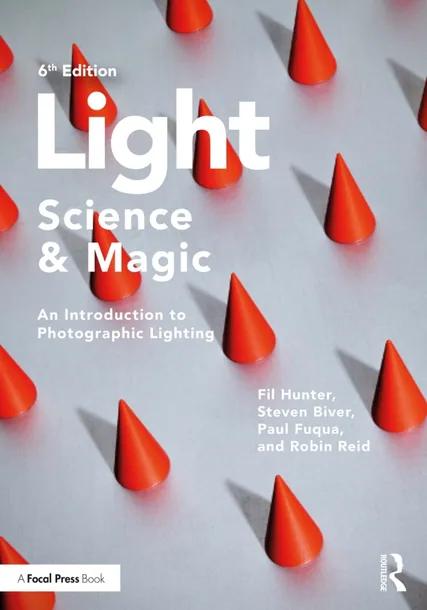
Light — Science & Magic
An Introduction to Photographic Lighting
by Fil Hunter, Steven Biver, Paul Fuqua
6th Edition
Publisher: Routledge
Book Details
| Print ISBN | 9780367860271 |
| eText ISBN | 9781000342673 |
| Publisher | Routledge |
| Publishing Year | 2021 |
| Edition | 6th Edition |
| Language | English |
| Pages | 336 |
Light — Science & Magic: An Introduction to Photographic Lighting, 6th Edition, provides photographers with a theoretical foundation in the nature and principles of light alongside practical guidance. The text teaches the underlying physics of lighting so photographers can adapt core concepts across different styles and assignments.
Coverage addresses reflection management, the family of angles, surface appearances, and methods for defining shape and contour. The book also details setups for challenging subjects, including glass, metal, liquids, extreme tonal contrasts, and portraits.
Designed for photographers of varying skill levels, this edition combines step-by-step instructions, diagrams, and illustrative photographs to connect technical principles with applied practice.
Table of Contents
Chapter 1: How to Learn lighting
- • Lighting Is the Language of Photography
- • What Are the "Principles?" Why Are the Principles Important?
- • How Did We Choose the Examples for This Book?
- • To Do or Not to Do?What Kind of Camera Do I Need?A Word of Caution
- • What Lighting Equipment Do I Need?What Else Do I Need to Know to Use This Book?
- • What Is the Magic Part of This Book?
Chapter 2: Light: The Raw Material of Photography
- • What is light?
- • How Photographers Describe Light
- • Brightness
- • Color
- • Contrast
- • "Light" Versus "Lighting"
- • How the Subject Affects Lighting
- • Transmission
- • "Direct" Versus "Diffuse" Transmission
- • AbsorptionReflection
Chapter 3: The Management of Reflection and the Family of Angles
- • Types of Reflections
- • Diffuse Reflections
- • The Inverse Square LawDirect Reflections
- • The Family of AnglesPolarized Direct Reflection
- • Is It Polarized Reflection or Ordinary Direct Reflection?Turning Ordinary Direct Reflection into Polarized Reflection
- • Applying the Theory
Chapter 4: Surface Appearances
- • The Photographer as an Editor
- • Capitalizing on Diffuse ReflectionsThe Angle of Light
- • The Success and Failure of the General RuleThe Distance of LightDoing the Impossible
- • Using Diffuse Reflection and Shadow to Reveal Texture
- • Capitalizing on Direct ReflectionComplex Surfaces
Chapter 5: Revealing Shape and Contour
- • Depth Clues
- • Perspective Distortion
- • Distortion as a Clue to Depth
- • Manipulating Distortion
- • Total Variation
- • The Size of the Light
- • Large Lights Versus Small Lights
- • Distance from the Subject
- • The Direction of the Light
- • Light on the Side
- • Light Above the Subject
- • Fill Light
- • Adding Depth to the Background
- • How Much Total Variation is Ideal?
- • Photographing Cylinders: Increasing Total Variation
- • The Glossy Box
- • Use a Dark- to Medium-toned Background
- • Eliminate Direct Reflection from the Box Top
- • Eliminate Direct Reflection From the Box Top
- • Move the Light Source Toward the Camera
- • Raise or Lower the Camera
- • Use Falloff
- • Eliminate Direct Reflection from the Box’s Sides
- • Put a Black Card on the Tabletop Tip the Box
- • Use a Longer Lens
- • Finish with Other Resources
- • Try a Polarizer
- • Use Dulling Spray
- • Use Direct Reflection
Chapter 6: Metal
- • Flat Metal
- • Bright or Dark
- • Finding the Family of Angles
- • Position a White Target Where You Think the Family of Angles Will Be
- • Place a Test Light at the Camera Lens
- • Aim the Test Light
- • Study the Position and Shape of the Area Marked on the Test Surface
- • Lighting the MetalKeeping the Metal BrightWhat is a "Normal" Exposure for Metal?Keeping the Metal Dark
- • The Elegant Compromise
- • Controlling the Effective Size of the Light
- • Keeping the Metal Square
- • Use a View Camera or Perspective Control LensAim the Camera Through a Hole in the Light Source
- • Photograph the Metal at an AngleRetouch the Reflection
- • Metal Boxes
- • A Light BackgroundA Transparent BackgroundA Glossy Background
- • Round Metal
- • Camouflage
- • Keeping the Light Off the CameraUsing a Tent
- • Other Resources
- • Polarizing FiltersBlack MagicDulling Spray
- • Where Else Do These Techniques Apply?
Chapter 7: The Case of the Disappearing Glass
- • Principles
- • ProblemsSolutions
- • Two Attractive Opposites
- • Bright-field Lighting
- • Choose the Background
- • Position the Light
- • Position the Camera
- • Position the Subject and Focus the Camera
- • Shoot the Picture
- • Dark-field Lighting
- • Set Up a Large Light Source
- • The Best of Both Worlds
- • Some Finishing Touches
- • Defining the Surface of Glassware
- • Illuminating the Background
- • Minimizing the Horizon
- • Stopping Flare
- • Eliminating Extraneous Reflections
- • Complications from Nonglass Subjects
- • Liquids in Glass
- • Liquids as a Lens
- • Keeping True Color
- • Secondary Opaque Subjects
- • Recognizing the Principal Subject
Chapter 8: Making Portraits
- • The Single-light Portrait Setup
- • The Basic Setup
- • Light Size
- • Skin Texture
- • Where to Put the Main Light
- • The Key Triangle
- • Key Triangle Too Large: Main Light Too Near the Camera
- • Key Triangle Too Low: Main Light Too High
- • Key Triangle Too Narrow: Main Light Too Far to Side
- • Left Side? Right Side?
- • Broad Lighting or Short Lighting?
- • Eyeglasses
- • Additional Lights
- • Fill Lights
- • Reflector Cards as Fill Lights
- • Background
- • Lights
- • Hair Lights
- • Kickers
- • Rim Lights
- • Mood and Key
- • Low-key Lighting
- • High-key Lighting
- • Staying in Key
- • Dark Skin
- • The Unfocused Spot
- • More Than One Person
- • Using Colored Gels
Chapter 9: The Extremes
- • The Characteristic Curve
- • The Perfect "Curve"
- • A "Bad" Camera
- • Overexposure
- • Underexposure
- • Using Every Resource
- • White-on-White
- • Exposing White-on-White Scenes
- • Lighting White-on-White Scenes
- • Subject and Background
- • Using an Opaque White Background
- • Light the Subject From Above
- • Use a Gobo Above the Subject
- • Add Dimension
- • Using a Translucent White Background
- • Using a Mirror Background
- • In Any Case, Keep the Background Small
- • Black-on-Black
- • Exposing Black-on-Black Scenes
- • Lighting Black-on-Black Scenes
- • Using an Opaque Black Background
- • Using a Glossy Black Surface
- • Keeping the Subject Away from the Background
- • Histograms
- • Preventing Problems
- • Overmanipulation
- • CurvesNew Principles
Chapter 10: Working on Location
- • The Lights We Use
- • Heavy-Duty Portable Strobes
- • "Hot Shoe" Flashes
- • LED Panels
- • Getting the Exposure Right
- • Letting Your Flash Do the Figuring
- • Using a Meter
- • Meters and LEDs
- • Getting More Light
- • Multiple, or "Ganged" Flashes
- • Battery Packs
- • Flash Extenders
- • Getting Better-quality Light
- • The Problems
- • Take It Off
- • Bouncing From Hard to Soft
- • The Omni-Bounce – A Big Help for a Little Money
- • "Raccoon Eyes"
- • Feathering Your Light
- • Forcing the Shadow
- • Lights of Different Colors
- • Why Is the Color of the Light Important?
- • Tungsten
- • Daylight
- • Nonstandard Light Sources
- • Do the Colors Mix?
- • The Remedies
- • Correcting Mixed Colors
- • Correcting Unmixed Colors
- • Filtering Daylight
- • Correcting Errors in Reproduction
- • Lights of Different Duration
- • Different Approaches
- • Other Useful Gear
Chapter 11: Setting Up Your First Studio
- • Lights: An Early Issue
- • Getting Your Lights Right
- • What Kind of Lights?
- • Flash
- • Continuous Lights
- • How Many Lights?
- • Light Stands
- • Booms
- • Light Modifiers – Which Do I Need?
- • Diffusers
- • Reflectors
- • Snoots, Grids and Barn Doors
- • Gobos and Flags
- • Backgrounds
- • Computers and Associated Gear
- • Miscellaneous Equipment
- • What About Space?
Customer Reviews
0.0
0 reviews
No reviews yet. Be the first to review this book!
Write a Review
Reviewed by GradeFocus Editorial Team