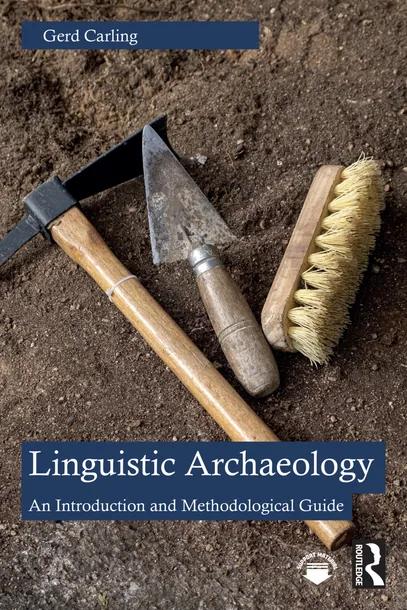
Linguistic Archaeology
An Introduction and Methodological Guide
by Gerd Carling
1st Edition
Publisher: Routledge
Book Details
| Print ISBN | 9781032271767 |
| eText ISBN | 9781040009291 |
| Publisher | Routledge |
| Publishing Year | 2024 |
| Edition | 1st Edition |
| Language | English |
| Pages | 200 |
Linguistic Archaeology: An Introduction and Methodological Guide, 1st Edition, introduces students to linguistic archaeology as both a theoretical framework and a practical toolkit. The volume addresses how researchers reconstruct human language prior to the written period by expanding beyond traditional boundaries.
Coverage outlines core linguistic concepts, the comparative method, typological inquiry, and computational phylogenetics. The text connects reconstructed speech with material evidence, exploring how language prehistory intersects with archaeology, ancient DNA, and prehistoric human migrations.
Prepared for students in historical linguistics, linguistic anthropology, language evolution, and cultural geography, the book offers step-by-step guidance for empirical data mining alongside links to open access resources.
Table of Contents
Chapter 1: Setting the field: what is linguistic archaeology?
- • 1.1. What is linguistic archaeology?
- • 1.2. Defining the field: an overview of the content and organization of this book
- • 1.3. Theoretical preconditions for reconstructing language prehistory
- • 1.3.1. Placing language reconstruction in the discipline of general linguistics
- • 1.3.2. Controversies on the nature and origin of human language
- • 1.4. Core concepts in models and methods of language reconstruction
- • 1.4.1. Defining and explaining pattern similarity
- • 1.4.2. The tree and wave models
- • 1.4.3. Family-based and deep reconstruction: ancestral nodes, proto-languages, and early language
- • Further reading
Chapter 2: Basics: Structures and components of human language
- • 2.1. Phonemes: the smallest units of speech
- • 2.2. Words and word classes
- • 2.3. Morphemes: the smallest meaning-bearing unit of a language
- • 2.4. How words are glued together in grammar
- • Further reading
Chapter 3: The diversity and origin of human language
- • 3.1. Linguistic diversity and language population size
- • 3.2. Origin of human language: why, when, and how?
- • 3.3. How to investigate linguistic diversity
- • Further reading
Chapter 4: The comparative method
- • 4.1. Basics of the comparative method
- • 4.1.1. The comparative method and language classification
- • 4.1.2. The problem of etymology and semantic change
- • 4.1.3. Reconstructing grammar by the comparative method
- • Further reading
- • 4.2. Philology
- • 4.2.1. Understanding the nature of writing and interpreting writing systems
- • 4.2.2. Interpreting the linguistic value of writing
- • 4.2.3. Understanding the meaning of words and texts
- • Useful resources
- • 4.3. Historical linguistics
- • 4.3.1. Historical linguistics: using the comparative method to observe language change
- • 4.3.2. Sound change
- • 4.3.3. Reconstructing lexical change: replacement, meaning change, and borrowing
- • 4.3.4. Analogy
- • 4.3.4. Grammaticalization
Chapter 5: The typological method
- • 5.1. Basics of the typological method
- • Further reading
- • Useful resources
- • 5.2. Data mining for typology: language documentation
- • 5.3. Applying the typological method
- • 5.3.1. Reconstructing early language
- • 5.3.2. Observing the evolution of language types
- • 5.3.3. Diachronic typology: reconstructing the typology of proto-languages
Chapter 6: The phylogenetic method
- • 6.1. Phylogenetic and computational methods: a survey
- • Further reading
- • 6.2. Data mining for phylogenetic methods
- • Useful resources
- • 6.3. Reconstruction of features of grammar, syntax, and phonology
Chapter 7: Archaeolinguistics: words, artefacts, and ancient DNA
- • 7.1. Basics of the archaeolinguistic approach
- • 7.2. Methods in archaeolinguistic approach
- • 7.2.1. Reconstructing the vocabulary of a proto-language
- • Further reading
- • 7.2.2. Reconstructing the culture and beliefs of proto-language communities through language
- • 7.2.3. Reconstructing language contact and substrate influence
- • 7.3. Connecting reconstructed language to archaeology, ancient DNA, and prehistoric migrations
Chapter 8: Linguistic anthropology: relativist approaches to reconstructing language prehistory
- • 8.1. The linguistic relativity approach: reconstructing diversity
- • 8.2. Methods in linguistic relativity research
- • 8.2.1. Observing small-scale societies
- • 8.2.3. Designing experiments and stimuli for observing diversity of language-cognition-culture
- • 8.3. Contrasting results of small-scale societies cross-linguistically
- • Further reading
Chapter 9: The cultural evolutionary approach
- • 9.1. Overview of the cross-disciplinary field of cultural evolution
- • 9.2. Methodologies of the cultural evolutionary approach
- • 9.2.1. Data design and base concepts for compiling data
- • 9.2.2. Models and methods: phylogenetic inference
- • 9.2.3. Models and methods: experimental design
- • 9.3. Triangulation
- • Further reading
Chapter 10: Conclusion: linguistic archaeology in the past, present, and future
Customer Reviews
0.0
0 reviews
No reviews yet. Be the first to review this book!
Write a Review
Reviewed by GradeFocus Editorial Team