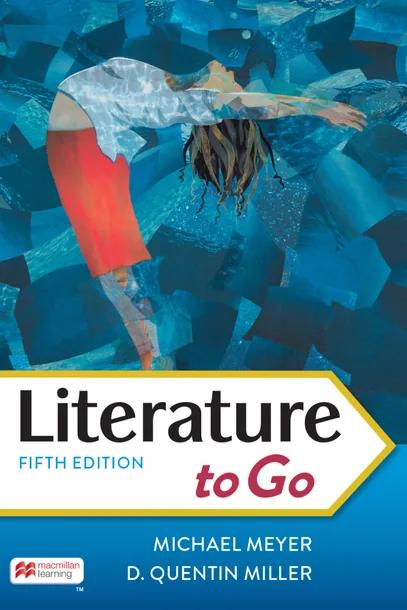
Literature to Go
by Michael Meyer, D. Quentin Miller
5th Edition
Publisher: Bedford/St. Martin's
Book Details
| Print ISBN | 9781319332143 |
| eText ISBN | 9781319527051 |
| Publisher | Bedford/St. Martin's |
| Publishing Year | 2024 |
| Edition | 5th Edition |
| Language | English |
| Pages | 1136 |
Literature to Go, 5th Edition, is an anthology that provides critical thinking, reading, and writing support for literature students. Published by Bedford/St. Martin's in 2024, this compact collection assists both learners and instructors in mastering key techniques for interpreting imaginative literature across introductory college courses.
The book structures broad selections of fiction, poetry, drama, and essays into clear analytical categories. Short fiction units examine core mechanics such as plot, character, setting, point of view, symbolism, theme, style, tone, and irony. Poetry sections systematically address word choice, word order, images, figures of speech, symbol, allegory, sound effects, rhythm patterns, and traditional poetic forms.
A defining feature is the inclusion of dedicated cultural modules, such as a focused case study on Harlem Renaissance poets Claude McKay, Georgia Douglas Johnson, Langston Hughes, and Countee Cullen. This clear genre framework provides practical writing and reading practice tailored to foundational literature curricula.
Table of Contents
Chapter Introduction: Reading Imaginative Literature
- • The Nature of Literature
- • Danusha Laméris, “Feeding the Worms”
- • The Value of Literature
- • The Changing Literary Canon
- • Approaching Sensitive Subjects
Chapter 1: Reading Fiction
- • Reading Fiction Responsively
- • Kate Chopin, “The Story of an Hour”
- • A SAMPLE CLOSE READING: An Annotated Section of “The Story of an Hour”
- • A SAMPLE PAPER: Differences in Responses to Kate Chopin’s “The Story of an Hour”
- • Explorations and Formulas
- • Ann Beattie, “Janus”
Chapter 2: Plot
- • T.C. Boyle, “The Hit Man”
- • Joy Harjo, “The Reckoning”
- • William Faulkner, “A Rose for Emily”
- • A SAMPLE CLOSE READING: An Annotated Section of “A Rose for Emily”
- • A SAMPLE STUDENT RESPONSE: Conflict in the Plot of William Faulkner’s “A Rose for Emily”
Chapter 3: Character
- • Tobias Wolff, “Powder”
- • Zadie Smith, “Martha, Martha”
- • James Baldwin, “Sonny’s Blues”
Chapter 4: Setting
- • Ernest Hemingway, “Soldier’s Home”
- • Ursula K. LeGuin, “The Ones Who Walk Away from Omelas”
- • Charlotte Perkins Gilman, “The Yellow Wallpaper”
Chapter 5: Point of View
- • Third-Person Narrator (Nonparticipant)
- • First-Person Narrator (Participant)
- • John Updike, “A & P”
- • Manuel Muñoz, “Zigzagger”
- • Lorrie Moore, “How to Become a Writer”
Chapter 6: Symbolism
- • Louise Erdrich, “The Red Convertible”
- • Zora Neale Hurston, "Sweat"
- • Cynthia Ozick, “The Shawl”
- • A SAMPLE STUDENT RESPONSE: Layers of Symbol in Cynthia Ozick’s “The Shawl”
Chapter 7: Theme
- • Adrian Tomine, “Intruders” (graphic short story)
- • A SAMPLE STUDENT RESPONSE: Danger among Us: Distilling the Theme in “Intruders”
- • Shirley Jackson, “The Lottery”
- • Carmen Maria Machado, “Eight Bites”
Chapter 8: Style, Tone, and Irony
- • Style
- • Tone
- • Irony
- • George Saunders, “I Can Speak ™”
- • Flannery O’Connor, “A Good Man is Hard to Find”
- • Mark Twain, “The Story of the Good Little Boy”
Chapter 9: A Collection of Stories
- • John Cheever, “The Enormous Radio”
- • Judith Ortiz Cofer, “Volar”
- • Edwidge Danticat, “The Missing Peace”
- • N. K. Jemisin, “Sinners, Saints, Dragons, and Haints, in the City Beneath the Still Waters”
- • James Joyce, “Eveline”
- • Jamaica Kincaid, “Girl”
- • Alice Munro, “Silence”
- • Joyce Carol Oates, “Tick”
- • Edgar Allen Poe, “The Cask of Amontillado”
- • Kurt Vonnegut, “Happy Birthday, 1951”
Chapter 10: Reading Poetry
- • Reading Poetry Responsively
- • Lisa Parker, “Snapping Beans”
- • Linda Pastan, “Jump Cabling”
- • John Updike, “Dog’s Death”
- • The Pleasure of Words
- • Gregory Corso, “I am 25”
- • A SAMPLE CLOSE READING: An Explication of “I am 25”
- • Robert Francis, “Catch”
- • A SAMPLE STUDENT ANALYSIS: Tossing Metaphors in Robert Francis’s “Catch”
- • Jane Hirschfield, “This Morning, I Wanted Four Legs”
- • Robert Morgan, “Mountain Graveyard”
- • E. E. Cummings, “l(a”
- • Anonymous, “Western Wind”
- • Regina Barreca, “Nighttime Fires”
- • SUGGESTIONS FOR APPROACHING POETRY
- • Poetic Definitions of Poetry
- • Marianne Moore, “Poetry”
- • Billy Collins, “Introduction to Poetry”
- • Ruth Forman, “Poetry Should Ride the Bus”
- • Charles Bukowski, “A poem is a city”
- • Ada Limón, “The End of Poetry”
- • Recurrent Poetic Figures: Five Ways of Looking at Roses
- • Robert Burns, “A Red, Red Rose”
- • Edmund Waller, “Go, Lovely Rose”
- • William Blake, “The Sick Rose”
- • Dorothy Parker, “One Perfect Rose”
- • H.D. (Hilda Doolittle), “Sea Rose”
- • Poems for Further Study
- • Mary Oliver, “The Poet with His Face in His Hands”
- • Alberto Ríos, “Seniors”
- • Robert Frost, “Design”
- • Edgar Allan Poe, “Sonnet – To Science”
- • Cornelius Eady, “The Supremes”
Chapter 11: Word Choice, Word Order, and Tone
- • Word choice
- • Diction
- • Denotations and Connotations
- • Randall Jarrell, “The Death of the Ball Turret Gunner”
- • Allusion
- • Word Order
- • Tone
- • Marilyn Nelson, “How I Discovered Poetry”
- • Katharyn Howd Machan, “Hazel Tells LaVerne”
- • A SAMPLE STUDENT RESPONSE: Tone in Katharyn Howd Machan’s “Hazel Tells LaVerne”
- • Martín Espada, “Latin Night at the Pawnshop”
- • Joy Harjo, “Granddaughters”
- • Diction and Tone in Four Love Poems
- • Shamim Azad, “First Love”
- • Elizabeth Barrett Browning, “Sonnet XLIII”
- • John Frederick Nims, “Love Poem”
- • Pablo Neruda, “Drunk as drunk on turpentine”
- • Poems for Further Study
- • Walt Whitman, “The Dalliance of the Eagles”
- • Kwame Dawes, “History Lesson at Eight a.m.”
- • Robert Frost, “The Road Not Taken”
- • Alice Jones, “The Lungs”
- • Louis Simpson, “In the Suburbs”
Chapter 12: Images
- • Poetry’s Appeal to the Senses
- • William Carlos Williams, “Poem”
- • Walt Whitman, “Cavalry Crossing a Ford”
- • Matthew Arnold, “Dover Beach”
- • Poems for Further Study
- • Adelaide Crapsey, “November Night”
- • Ruth Fainlight, “Crocuses”
- • William Blake, “London”
- • Kwame Dawes, “The Habits of Love”
- • Charles Simic, “House of Cards”
- • Sally Croft, “Home-Baked Bread”
Chapter 13: Figures of Speech
- • William Shakespeare, from Macbeth
- • Simile and Metaphor
- • Langston Hughes, “Harlem”
- • Jane Kenyon, “The Socks”
- • Anne Bradstreet, “The Author to Her Book”
- • Other Figures
- • Edmund Conti, “Pragmatist”
- • Dylan Thomas, “The Hand that Signed the Paper”
- • Janice Townley Moore, “To a Wasp”
- • Poems for Further Study
- • William Carlos Williams, “To Waken an Old Lady”
- • Ernest Slyman, “Lightning Bugs”
- • Martín Espada, “The Mexican Cabdriver’s Poem for His Wife, Who Has Left Him”
- • Judy Page Heitzman, “The Schoolroom on the Second Floor of the Knitting Mill”
- • Robert Pinsky, “Icicles”
- • Kay Ryan, “Learning”
Chapter 14: Symbol, Allegory, and Irony
- • Symbol
- • Robert Frost, “Acquainted with the Night”
- • Allegory
- • James Baldwin, “Guilt, Desire and Love”
- • Irony
- • Edwin Arlington Robinson, “Richard Cory”
- • Gwendolyn Brooks, “Sadie and Maud”
- • E. E. Cummings, “next to of course god america i”
- • Stephen Crane, “A Man Said to the Universe”
- • Poems for Further Study
- • Christina Rossetti, “Goblin Market”
- • Jane Kenyon, “The Thimble”
- • Kevin Pierce, “Proof of Origin”
- • Carl Sandburg, “A Fence”
- • Julio Marzán, “Ethnic Poetry”
- • Mark Halliday, “Graded Paper”
- • Robert Browning, “My Last Duchess”
- • William Blake, “A Poison Tree”
Chapter 15: Sounds
- • Listening to Poetry
- • Kamau Brathwaite, “Ogun”
- • John Updike, “Player Piano”
- • Emily Dickinson, “A Bird came down the Walk –”
- • A SAMPLE STUDENT RESPONSE: Sound in Emily Dickinson’s “A Bird came down the Walk—”
- • Rhyme
- • Richard Armour, “Going to Extremes”
- • Robert Southey, from “The Cataract of Lodore”
- • Sound and Meaning
- • Gerard Manley Hopkins, “God’s Grandeur”
- • Poems for Further Study
- • Lewis Carroll, “Jabberwocky”
- • William Heyen, “The Trains”
- • Alfred, Lord Tennyson, “Break, Break, Break”
- • Kay Ryan, “Dew”
- • Andrew Hudgins, “The Ice-Cream Truck”
- • Robert Francis, “The Pitcher”
- • Helen Chasin, “The Word Plum”
- • Major Jackson, “Autumn Landscape”
Chapter 16: Patterns of Rhythm
- • Some Principles of Meter
- • Walt Whitman, from “Song of the Open Road”
- • William Wordsworth, “My Heart Leaps Up”
- • SUGGESTIONS FOR SCANNING A POEM
- • Timothy Steele, “Waiting for the Storm”
- • A SAMPLE STUDENT RESPONSE: The Rhythm of Anticipation in Timothy Steele’s “Waiting for the Storm”
- • William Butler Yeats, “That the Night Come”
- • Poems for Further Study
- • John Maloney, “Good!”
- • Alice Jones, “The Foot”
- • Robert Herrick, “Delight in Disorder”
- • E. E. Cummings, “O sweet spontaneous”
- • William Blake, “The Lamb”
- • William Blake, “The Tyger”
- • Robert Frost, “Stopping by Woods on a Snowy Evening”
Chapter 17: Poetic Forms
- • Some Common Poetic Forms
- • A.E. Housman, “Loveliest of trees, the cherry now”
- • Robert Herrick, “Upon Julia’s Clothes”
- • Sonnet
- • John Keats, “On First Looking into Chapman’s Homer”
- • William Shakespeare, “Shall I compare thee to a summer’s day?”
- • Countee Cullen, “Yet Do I Marvel”
- • Mark Jarman, “Unholy Sonnet”
- • R.S. Gwynn, “Shakespearean Sonnet”
- • Villanelle
- • Dylan Thomas, “Do Not Go Gentle into That Good Night”
- • Denise Duhamel, “Please Don’t Sit Like a Frog, Sit Like a Queen”
- • Sestina
- • Florence Cassen Mayers, “All-American Sestina”
- • Julia Alvarez, “Bilingual Sestina”
- • Epigram
- • Samuel Taylor Coleridge, “What Is an Epigram?”
- • David McCord, “Epitaph on a Waiter”
- • Paul Laurence Dunbar, “Theology”
- • Limerick
- • Arthur Henry Reginald Buller, “There was a young Lady named Bright”
- • Laurence Perrine, “The limerick’s never averse”
- • Haiku
- • Matsuo Bashō, “Under cherry trees”
- • Carolyn Kizer, “After Bashō”
- • Amy Lowell, "Last night it rained"
- • Gary Snyder, “A Dent in a Bucket”
- • Ghazal
- • Mirza Asadullah Khan Ghalib, “Ghazal 4”
- • Patricia Smith, “Hip-Hop Ghazal”
- • Elegy
- • Ben Jonson, “On My First Son”
- • Kate Hanson Foster, “Elegy of Color”
- • Ode
- • Alexander Pope, “Ode on Solitude”
- • John Keats, “Ode on a Grecian Urn”
- • Parody
- • Gwendolyn Brooks, “We Real Cool”
- • Joan Murray, “We Old Dudes”
- • Picture Poem
- • Michael McFee, “In Medias Res”
- • Open Form
- • Walt Whitman, from “I Sing the Body Electric”
- • A SAMPLE STUDENT RESPONSE: The Power of Walt Whitman’s Open Form Poem “I Sing the Body Electric”
- • William Carlos Williams, “The Red Wheelbarrow”
- • Major Jackson, “The Chase”
- • Julio Marzán, “The Translator at the Reception for Latin American Writers”
- • PERSPECTIVE: Elaine Mitchell, “Form”
Chapter 18: A Cultural Case Study: Harlem Renaissance Poets Claude McKay, Georgia Douglas Johnson, Langston Hughes, Countee Cullen
- • Claude McKay
- • If We Must Die
- • The Lynching
- • America
- • Georgia Douglas Johnson
- • Youth
- • Foredoom
- • Prejudice
- • Langston Hughes
- • The Negro Speaks of Rivers
- • Jazzonia
- • The Weary Blues
- • Countee Cullen
- • Incident
- • Heritage
Chapter 19: Case Study: Song Lyrics as Poetry
- • Frederic Weatherly, “Danny Boy”
- • Bessie Smith, “Careless Love Blues”
- • Woody Guthrie, “Pretty Boy Floyd”
- • Hank Williams, “I’m So Lonesome I Could Cry”
- • Bob Dylan, “It’s Alright, Ma (I’m Only Bleeding)”
- • John Lennon and Paul McCartney, “I Am the Walrus”
- • Ani DiFranco, “Not a Pretty Girl”
- • Tom Waits and Kathleen Brennan, “Alice”
- • Adrianne Lenker, “Not”
Chapter 20: A Thematic Case Study: Our Fragile Planet
- • Eileen Cleary, “The Way We Fled”
- • Tess Gallagher, “Choices”
- • Joy Harjo, “Singing Everything”
- • J. Estanislao Lopez, “Meditation on Beauty”
- • Gail White, “Dead Armadillos”
- • Allen Ginsberg, “Sunflower Sutra”
- • Mary Oliver, “Wild Geese”
- • Sylvia Plath, “Pheasant”
- • Teresa Mei Chuc, “Rainforest”
- • Jennifer Franklin “Memento Mori: Apple Orchard”
- • SUGGESTED TOPICS FOR LONGER PAPERS
Chapter 21: A Study of Emily Dickinson
- • A Brief Biography
- • An Introduction to Her Work
- • Emily Dickinson
- • PERSPECTIVES
- • QUESTIONS FOR WRITING ABOUT AN AUTHOR IN DEPTH
- • A Sample In-Depth Study
- • SUGGESTED TOPICS FOR LONGER PAPERS
Chapter 22: Poems for Further Reading
Chapter 23: Reading Drama
- • Reading Drama Responsively
- • Susan Glaspell, Trifles
- • A SAMPLE CLOSE READING: An Annotated Section of Trifles
- • Elements of Drama
Chapter 24: A Study of Sophocles
- • Theatrical Conventions of Greek Drama
- • Tragedy
- • Sophocles, Oedipus the King (trans. by David Grene)
Chapter 25: A Study of William Shakespeare
- • Shakespeare’s Theater
- • The Range of Shakespeare’s Drama: History, Comedy, and Tragedy
- • A Note on Reading Shakespeare
- • William Shakespeare, Othello, the Moor of Venice
- • SUGGESTED TOPICS FOR LONGER PAPERS
Chapter 26: Modern Drama
- • Realism
- • Naturalism
- • Theatrical Conventions of Modern Drama
- • Oscar Wilde, The Importance of Being Earnest
Chapter 27: Contemporary Drama
- • Beyond Realism
- • Musical Theater
- • Drama in Popular Forms
- • Quiara Alegría Hudes, Water by the Spoonful
- • A SAMPLE STUDENT PAPER: Water by the Spoonful: Exploring the Internet’s Role in Bettering the Self
Chapter 28: A Collection of Contemporary Plays
- • Lynn Nottage, POOF!
- • Suzan-Lori Parks: A Collection of Six Very Short Plays
Chapter 29: Critical Strategies for Reading
- • Critical Thinking
- • Formalist Strategies
- • Biographical Strategies
- • Psychological Strategies
- • Historical Strategies
- • Marxist Criticism
- • New Historicist Criticism
- • Cultural Criticism
- • Gender Strategies
- • Feminist Criticism
- • LGBTQ+ Criticism
- • Mythological Strategies
- • Reader-Response Strategies
- • Deconstructionist Strategies
- • Affect Theory Approaches
Chapter 30: Writing about Literature
- • Why Am I Being Asked to Do This?
- • From Reading and Discussion to Writing
- • Reading the Work Closely
- • Prewriting
- • Annotating the Text and Journal Note Taking
- • Choosing a Topic
- • More Focused Prewriting
- • Arguing about Literature
- • Writing
- • Writing a First Draft
- • Textual Evidence: Using Quotations, Summarizing, and Paraphrasing
Customer Reviews
0.0
0 reviews
No reviews yet. Be the first to review this book!
Write a Review
Reviewed by GradeFocus Editorial Team
▶Research Sources (11)
- Literature to Go, 5th Edition
- ISBN 9781319527051 - Literature to Go 5th Edition ...
- Literature to Go by: Michael Meyer - 9781319527051
- Literature to Go - ISBN 9781319527051
- Literature to Go 5th Edition | Michael Meyer
- Literature to Go by Michael Meyer
- Literature to Go | Rent | 9781319332143
- Literature Textbook Support
- Literature to go : Meyer, Michael, 1945- author : Free Download, Borrow, and ...
- Literature To Go 5th Edition Pdf
- Literature to Go