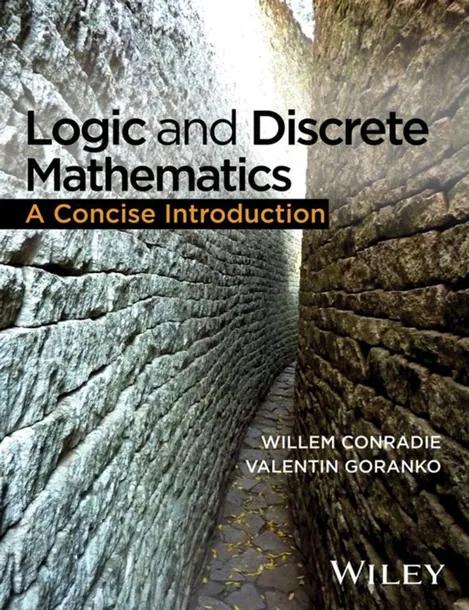
Logic and Discrete Mathematics
A Concise Introduction
by Willem Conradie, Valentin Goranko
1st Edition
Publisher: Wiley-Blackwell
Book Details
| Print ISBN | 9781118751275 |
| eText ISBN | 9781118762653 |
| Publisher | Wiley-Blackwell |
| Publishing Year | 2015 |
| Edition | 1st Edition |
| Language | English |
| Pages | 464 |
Logic and Discrete Mathematics: A Concise Introduction, 1st Edition, provides a rigorous foundation in formal logic alongside core topics in discrete mathematics. Drawn from course material tested over more than a decade of university teaching, the textbook supports coursework in mathematics and computer science.
The volume covers propositional and first-order logic, set theory, number theory, combinatorics, and graph theory. Theoretical principles are paired with practical applications, including cryptographic systems and network algorithms.
Designed primarily for undergraduate study, the work also accommodates graduate modules and self-study. Each section concludes with an extensive set of exercises, with most complete solutions available in an accompanying solutions manual.
Table of Contents
Chapter 1: Preliminaries
- • 1.1 Sets
- • 1.1.1 Exercises
- • 1.2 Basics of logical connectives and expressions
- • 1.2.1 Propositions, logical connectives, truth tables, tautologies
- • 1.2.2 Individual variables and quantifiers
- • 1.2.3 Exercises
- • 1.3 Mathematical induction
- • 1.3.1 Exercises
Chapter 2: Sets, Relations, Orders
- • 2.1 Set inclusions and equalities
- • 2.1.1 Properties of the set theoretic operations
- • 2.1.2 Exercises
- • 2.2 Functions
- • 2.2.1 Functions and their inverses
- • 2.2.2 Composition of mappings
- • 2.2.3 Exercises
- • 2.3 Binary relations and operations on them
- • 2.3.1 Binary relations
- • 2.3.2 Matrix and graphical representations of relations on finite sets
- • 2.3.3 Boolean operations on binary relations
- • 2.3.4 Inverse and composition of relations
- • 2.3.5 Exercises
- • 2.4 Special binary relations
- • 2.4.1 Properties of binary relations
- • 2.4.2 Functions as relations
- • 2.4.3 Reflexive, symmetric and transitive closures of a relation
- • 2.4.4 Exercises
- • 2.5 Equivalence relations and partitions
- • 2.5.1 Equivalence relations
- • 2.5.2 Quotient sets and partitions
- • 2.5.3 The kernel equivalence of a mapping
- • 2.5.4 Exercises
- • 2.6 Ordered sets
- • 2.6.1 Pre-orders and partial orders
- • 2.6.2 Graphical representing posets: Hasse diagrams
- • 2.6.3 Lower and upper bounds. Minimal and maximal elements
- • 2.6.4 Well-ordered sets
- • 2.6.5 Exercises
- • 2.7 An introduction to cardinality
- • 2.7.1 Equinumerosity and cardinality
- • 2.7.2 Exercises
- • 2.8 Isomorphisms of ordered sets. Ordinal numbers
- • 2.8.1 Exercises
- • 2.9 Application: relational databases
- • 2.9.1 Exercises
Chapter 3: Propositional Logic
- • 3.1 Propositions, logical connectives, truth tables, tautologies
- • 3.1.1 Propositions and propositional connectives. Truth tables
- • 3.1.2 Some remarks on the meaning of the connectives
- • 3.1.3 Propositional formulae
- • 3.1.4 Construction and parsing tree of a propositional formula
- • 3.1.5 Truth tables of propositional formulae
- • 3.1.6 Tautologies
- • 3.1.7 A better idea: search for a falsifying truth assignment
- • 3.1.8 Exercises
- • 3.2 Propositional logical consequence. Valid and invalid propositional inferences
- • 3.2.1 Propositional logical consequence
- • 3.2.2 Logically sound rules of propositional inference. Logically correct propositional arguments
- • 3.2.3 Fallacies of the implication
- • 3.2.4 Exercises
- • 3.3 The concept and use of deductive systems
- • 3.4 Semantic tableaux
- • 3.4.1 Exercises
- • 3.5 Logical equivalences. Negating propositional formulae
- • 3.5.1 Logically equivalent propositional formulae
- • 3.5.2 Some important equivalences
- • 3.5.3 Exercises
- • 3.6 Normal forms. Propositional resolution
- • 3.6.1 Conjunctive and disjunctive normal forms of propositional formulae
- • 3.6.2 Clausal form. Clausal resolution
- • 3.6.3 Resolution-based derivations
- • 3.6.4 Optimizing the method of resolution
- • 3.6.5 Exercises
Chapter 4: First-Order Logic
- • 4.1 Basic concepts of first-order logic
- • 4.1.1 First-order structures
- • 4.1.2 First-order languages
- • 4.1.3 Terms and formulae
- • 4.1.4 The semantics of first-order logic: an informal outline
- • 4.1.5 Translating first-order formulae to natural language
- • 4.1.6 Exercises
- • 4.2 The formal semantics of first–order logic
- • 4.2.1 Interpretations
- • 4.2.2 Variable assignment and term evaluation
- • 4.2.3 Truth evaluation games
- • 4.2.4 Exercises
- • 4.3 The language of first-order logic: a deeper look
- • 4.3.1 Translations from natural language into first-order languages
- • 4.3.2 Restricted quantification
- • 4.3.3 Free and bound variables. Scope of a quantifier
- • 4.3.4 Renaming of a bound variable in a formula. Clean formulae
- • 4.3.5 Substitution of a term for a variable in a formula. Capture of a variable
- • 4.3.6 Exercises
- • 4.4 Truth, logical validity, equivalence and consequence in first-order logic
- • 4.4.1 More on truth of sentences in structures. Models and countermodels
- • 4.4.2 Satisfiability and validity of first-order formulae
- • 4.4.3 Logical equivalence in first-order logic
- • 4.4.4 Some logical equivalences involving quantifiers
- • 4.4.5 Negating first-order formulae
- • 4.4.6 Logical consequence in first-order logic
- • 4.4.7 Exercises
- • 4.5 Semantic tableaux for first-order logic
- • 4.5.1 Some derivations using first-order semantic tableau
- • 4.5.2 Semantic tableaux for first-order logic with equality
- • 4.5.3 Discussion on the quantifier rules and on termination of semantic tableaux
- • 4.5.4 Exercises
- • 4.6 Prenex and clausal normal forms
- • 4.6.1 Prenex normal forms
- • 4.6.2 Skolemization
- • 4.6.3 Clausal forms
- • 4.6.4 Exercises
- • 4.7 Resolution in first-order logic
- • 4.7.1 Propositional resolution rule in first-order logic
- • 4.7.2 Substitutions of terms for variables revisited
- • 4.7.3 Unification of terms
- • 4.7.4 Resolution with unification in first-order logic
- • 4.7.5 Examples of resolution-based derivations
- • 4.7.6 Resolution for first-order logic with equality
- • 4.7.7 Optimizations of the resolution method for first-order logic
- • 4.7.8 Exercises
- • 4.8 Applications of first-order logic to mathematical reasoning and proofs
- • 4.8.1 Proof strategies: direct and indirect proofs
- • 4.8.2 Tactics for logical reasoning
- • 4.8.3 Exercises
Chapter 5: Number Theory
- • 5.1 The principle of mathematical induction revisited
- • 5.1.1 Exercises
- • 5.2 Divisibility
- • 5.2.1 Basic properties of divisibility
- • 5.2.2 Division with a remainder
- • 5.2.3 Greatest common divisor
- • 5.2.4 Exercises
- • 5.3 Computing greatest common divisors. Least common multiples
- • 5.3.1 Euclid’s algorithm for computing greatest common divisors
- • 5.3.2 Least common multiple
- • 5.3.3 Exercises
- • 5.4 Prime numbers. The fundamental theorem of arithmetic
- • 5.4.1 Relatively prime numbers
- • 5.4.2 Prime numbers
- • 5.4.3 The fundamental theorem of arithmetic
- • 5.4.4 On the distribution of prime numbers
- • 5.4.5 Exercises
- • 5.5 Congruence relations
- • 5.5.1 Exercises
- • 5.6 Equivalence classes and residue systems modulo n
- • 5.6.1 Equivalence relations and partitions
- • 5.6.2 Equivalence classes modulo n. Modular arithmetic
- • 5.6.3 Residue systems
- • 5.6.4 Multiplicative inverses in ℤn
- • 5.6.5 Exercises
- • 5.7 Linear Diophantine equations and linear congruences
- • 5.7.1 Linear Diophantine equations
- • 5.7.2 Linear congruences
- • 5.7.3 Exercises
- • 5.8 Chinese remainder theorem
- • 5.8.1 Exercises
- • 5.9 Euler’s function. Theorems of Euler and Fermat
- • 5.9.1 Theorems of Euler and Fermat
- • 5.9.2 Exercises
- • 5.10 Wilson’s theorem. Order of an integer
- • 5.10.1 Wilson’s theorem
- • 5.10.2 Order of an integer
- • 5.10.3 Exercises
- • 5.11 Application: public key cryptography
- • 5.11.1 About cryptography
- • 5.11.2 The idea of public key cryptography
- • 5.11.3 The method RSA
- • 5.11.4 Exercises
Chapter 6: Combinatorics
- • 6.1 Two basic counting principles
- • 6.1.1 Exercises
- • 6.2 Combinations. The binomial theorem
- • 6.2.1 Counting sheep and combinations
- • 6.2.2 Some important properties
- • 6.2.3 Pascal’s triangle
- • 6.2.4 The binomial theorem
- • 6.2.5 Exercises
- • 6.3 The principle of inclusion–exclusion
- • 6.3.1 Exercises
- • 6.4 The Pigeonhole Principle
- • 6.4.3 Exercises
- • 6.5 Generalized permutations, distributions and the multinomial theorem
- • 6.5.1 Arranging nondistinct objects
- • 6.5.2 Distributions
- • 6.5.3 The multinomial theorem
- • 6.5.4 Summary
- • 6.5.5 Exercises
- • 6.6 Selections and arrangements with repetition; distributions of identical objects
- • 6.6.1 Selections with repetition
- • 6.6.2 Distributions of identical objects
- • 6.6.3 Arrangements with repetition
- • 6.6.4 Summary
- • 6.6.5 Exercises
- • 6.7 Recurrence relations and their solution
- • 6.7.1 Recurrence relations. Fibonacci numbers
- • 6.7.2 Catalan numbers
- • 6.7.3 Solving homogeneous linear recurrence relations
- • 6.7.4 Exercises
- • 6.8 Generating functions
- • 6.8.1 Introducing generating functions
- • 6.8.2 Computing coefficients of generating functions
- • 6.8.3 Exercises
- • 6.9 Recurrence relations and generating functions
- • 6.9.1 Exercises
- • 6.10 Application: classical discrete probability
- • 6.10.1 Common sense probability
- • 6.10.2 Sample spaces
- • 6.10.3 Discrete probability
- • 6.10.4 Properties of probability measures
- • 6.10.5 Conditional probability and independent events
- • 6.10.6 Exercises
Chapter 7: Graph Theory
- • 7.1 Introduction to graphs and digraphs
- • 7.1.1 Graphs
- • 7.1.2 Digraphs
- • 7.1.3 Exercises
- • 7.2 Incidence and adjacency matrices
- • 7.2.1 Exercises
- • 7.3 Weighted graphs and path algorithms
- • 7.3.1 Dijkstra’s algorithm
- • 7.3.2 The Floyd–Warshall algorithm
- • 7.3.3 Exercises
- • 7.4 Trees
- • 7.4.1 Undirected trees
- • 7.4.2 Computing spanning trees: Kruskal’s algorithm
- • 7.4.3 Rooted trees
- • 7.4.4 Traversing rooted trees
- • 7.4.5 Exercises
- • 7.5 Eulerian graphs and Hamiltonian graphs
- • 7.5.1 Eulerian graphs and digraphs
- • 7.5.2 Hamiltonian graphs and digraphs
- • 7.5.3 Exercises
- • 7.6 Planar graphs
- • 7.6.1 Exercises
- • 7.7 Graph colourings
- • 7.7.1 Colourings
- • 7.7.2 The four- and five-colour theorems
- • 7.7.3 Exercises
Customer Reviews
0.0
0 reviews
No reviews yet. Be the first to review this book!
Write a Review
Reviewed by GradeFocus Editorial Team