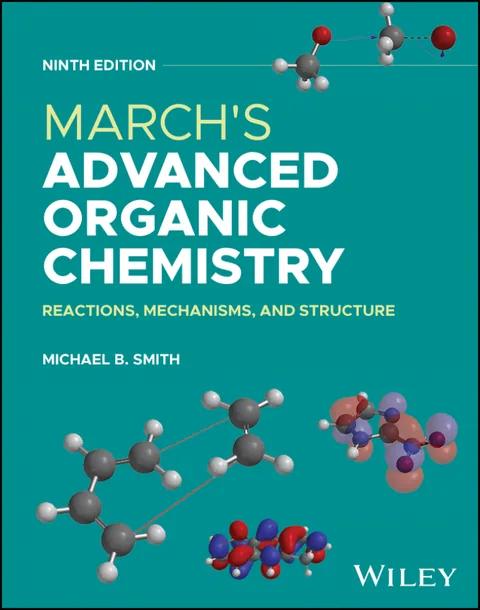
March's Advanced Organic Chemistry
Reactions, Mechanisms, and Structure
by Michael B. Smith
9th Edition
Publisher: Wiley-Blackwell
Book Details
| Print ISBN | 9781394242993 |
| eText ISBN | 9781394243020 |
| Publisher | Wiley-Blackwell |
| Publishing Year | 2025 |
| Edition | 9th Edition |
| Language | English |
| Pages | 1680 |
March's Advanced Organic Chemistry: Reactions, Mechanisms, and Structure, 9th Edition, offers a comprehensive reference on chemical reactivity, molecular structure, and reaction mechanisms for students and professionals in organic chemistry. Authored by Michael B. Smith and published by Wiley-Blackwell, this 1,680-page reference work connects fundamental theoretical principles with systematic mechanistic analysis.
The text divides its thematic scope into structural foundations and mechanistic pathways. Early sections establish concepts of localized chemical bonding, delocalized chemical bonding, stereochemistry, and non-covalent interactions. Subsequent sections cover specific reaction types, examining substitution, addition, elimination, rearrangement, oxidation, and reduction processes alongside reactive intermediates including carbenes and nitrenes.
This updated release integrates specialized reaction techniques such as microwave chemistry, ultrasound, mechanochemistry, and flow chemistry. Covering recent advances from organic chemistry literature published between 2018 and 2023, the volume supports advanced inquiry and literature research across academic and professional settings.
Table of Contents
Chapter 1: Localized Chemical Bonding
- • 1.A. Covalent Bonding
- • 1.B. Multiple Valence
- • 1.C. Hybridization
- • 1.D. Multiple Bonds
- • 1.E. Photoelectron Spectroscopy
- • 1.F. Electronic Structures of Molecules
- • 1.G. Electronegativity
- • 1.H. Dipole Moment
- • 1.I. Inductive and Field Effects
- • 1.J. Bond Distances
- • 1.K. Bond Angles
- • 1.L. Bond Energies
Chapter 2: Delocalized Chemical Bonding
- • 2.A. Molecular Orbitals
- • 2.B. Bond Energies and Distances in Compounds Containing Delocalized Bonds
- • 2.C. Molecules that have Delocalized Bonds
- • 2.D. Cross-Conjugation
- • 2.E. The Rules of Resonance
- • 2.F. The Resonance Effect
- • 2.G. Steric Inhibition of Resonance and the Influences of Strain
- • 2.H. pπ–dπ Bonding. Ylids
- • 2.I. Aromaticity
- • 2.I.i. Six-Membered Rings
- • 2.I.ii. Five-, Seven-, and Eight-Membered Rings
- • 2.I.iii. Other Systems Containing Aromatic Sextets
- • 2.J. Alternant and Nonalternant Hydrocarbons
- • 2.K. Aromatic Systems with Electron Numbers other than Six
- • 2.K.i. Systems of Two Electrons
- • 2.K.ii. Systems of Four Electrons: Antiaromaticity
- • 2.K.iii. Systems of Eight Electrons
- • 2.K.iv. Systems of Ten Electrons
- • 2.K.v. Systems of More than Ten Electrons: 4n + 2 Electrons
- • 2.K.vi. Systems of More than Ten Electrons: 4n Electrons
- • 2.L. Other Aromatic Compounds
- • 2.M. Hyperconjugation
- • 2.N. Tautomerism
- • 2.N.i. Keto-Enol Tautomerism
- • 2.N.ii. Other Proton-Shift Tautomerism
Chapter 3: Bonding Weaker Than Covalent
- • 3.A. Hydrogen Bonding
- • 3.B. π–π Interactions
- • 3.C. Addition Compounds
- • 3.C.i. Electron Donor–Acceptor Complexes
- • 3.C.ii. Crown Ether Complexes and Cryptates
- • 3.C.iii. Inclusion Compounds
- • 3.C.iv. Cyclodextrins
- • 3.D. Catenanes and Rotaxanes
- • 3.E. Cucurbit[n]Uril-Based Gyroscane
Chapter 4: Stereochemistry and Conformation
- • 4.A. Optical Activity and Chirality
- • 4.B. Dependence of Rotation on Conditions of Measurement
- • 4.C. What kinds of Molecules Display Optical Activity?
- • 4.D. The Fischer Projection
- • 4.E. Absolute Configuration
- • 4.E.i. The Cahn–Ingold–Prelog System
- • 4.E.ii. Methods of Determining Configuration
- • 4.F. Optical Purity
- • 4.G. The Cause of Optical Activity
- • 4.H. Molecules with more than One Stereogenic Center
- • 4.I. Asymmetric Synthesis
- • 4.J. Methods of Resolution
- • 4.K. Cis–Trans Isomerism
- • 4.K.i. Cis–Trans Isomerism Resulting from Double Bonds
- • 4.K.ii. Cis–Trans Isomerism of Monocyclic Compounds
- • 4.K.iii. Cis–Trans Isomerism of Fused and Bridged Ring Systems
- • 4.L. Out–In Isomerism
- • 4.M. Enantiotopic and Diastereotopic Atoms, Groups, and Faces
- • 4.N. Stereospecific and Stereoselective Syntheses
- • 4.O. Conformational Analysis
- • 4.O.i. Conformation in Open-Chain Systems
- • 4.O.ii. Conformation in Six-Membered Rings
- • 4.O.iii. Conformation in Six-Membered Rings Containing Heteroatoms
- • 4.O.iv. Conformation in Other Rings
- • 4.P. Molecular Mechanics
- • 4.Q. Strain
- • 4.Q.i. Strain in Small Rings
- • 4.Q.ii. Strain in Other Rings
- • 4.Q.iii. Unsaturated Rings
- • 4.Q.iv. Strain Due to Unavoidable Crowding
Chapter 5: Carbocations, Carbanions, Free Radicals, Carbenes, and Nitrenes
- • 5.A. Carbocations
- • 5.A.i. Nomenclature
- • 5.A.ii. Stability and Structure of Carbocations
- • 5.A.iii. The Generation and Fate of Carbocations
- • 5.B. Carbanions
- • 5.B.i. Stability and Structure
- • 5.B.ii. The Structure of Grignard Reagents and Organolithium Reagents
- • 5.B.iii. The Generation and Fate of Carbanions
- • 5.C. Free Radicals
- • 5.C.i. Stability and Structure
- • 5.C.ii. The Generation and Fate of Free Radicals
- • 5.C.iii. Radical Ions
- • 5.D. Carbenes
- • 5.D.i. Stability and Structure
- • 5.D.ii. The Generation and Fate of Carbenes
- • 5.D.iii. N-Heterocyclic Carbenes
- • 5.E. Nitrenes
Chapter 6: Mechanisms and Methods of Determining Them
- • 6.A. Types of Mechanism
- • 6.B. Types of Reaction
- • 6.C. Thermodynamic Requirements for Reaction
- • 6.D. Kinetic Requirements for Reaction
- • 6.E. The Baldwin Rules for Ring Closure
- • 6.F. Kinetic and Thermodynamic Control
- • 6.G. The Hammond Postulate
- • 6.H. Microscopic Reversibility
- • 6.I. Marcus Theory
- • 6.J. Methods of Determining Mechanisms
- • 6.J.i. Identification of Products
- • 6.J.ii. Determination of the Presence of an Intermediate
- • 6.J.iii. The Study of Catalysis
- • 6.J.iv. Isotopic Labeling
- • 6.J.v. Stereochemical Evidence
- • 6.J.vi. Kinetic Evidence
- • 6.J.vii. Isotope Effects
- • 6.K. Catalyst Development
Chapter 7: Irradiation Processes and Techniques that Influence Reactions in Organic Chemistry
- • 7.A. Photochemistry
- • 7.A.i. Excited States and the Ground State
- • 7.A.ii. Singlet and Triplet States: “Forbidden” Transitions
- • 7.A.iii. Types of Excitation
- • 7.A.iv. Nomenclature and Properties of Excited States
- • 7.A.v. Photolytic Cleavage
- • 7.A.vi. The Fate of the Excited Molecule: Physical Processes
- • 7.A.vii. The Fate of the Excited Molecule: Chemical Processes
- • 7.A.viii. The Determination of Photochemical Mechanisms
- • 7.B. Sonochemistry
- • 7.C. Microwave Chemistry
- • 7.D. Flow Chemistry
- • 7.E. Mechanochemistry
Chapter 8: Acids and Bases
- • 8.A. Brønsted Theory
- • 8.A.i. Brønsted Acids
- • 8.A.ii. Brønsted Bases
- • 8.B. The Mechanism of Proton Transfer Reactions
- • 8.C. Measurements of Solvent Acidity
- • 8.D. Acid and Base Catalysis
- • 8.E. Lewis Acids and Bases
- • 8.E.i. Hard–Soft Acids–Bases
- • 8.F. The Effects of Structure on the Strengths of Acids and Bases
- • 8.G. The Effects of the Medium on Acid and Base Strength
Chapter 9: Effects of Structure and Medium on Reactivity
- • 9.A. Resonance and Field Effects
- • 9.B. Steric Effects
- • 9.C. Quantitative Treatments of the Effect of Structure on Reactivity
- • 9.D. Effect of Medium on Reactivity and Rate
- • 9.E. High Pressure
- • 9.F. Water and other Nonorganic Solvents
- • 9.G. Ionic Liquid Solvents
- • 9.H. Solventless Reactions
Chapter 10: Aliphatic Substitution: Nucleophilic and Organometallic
- • 10.A. Mechanisms
- • 10.A.i. The SN2 Mechanism
- • 10.A.ii. The SN1 Mechanism
- • 10.A.iii. Ion Pairs in the SN1 Mechanism
- • 10.A.iv. Mixed SN1 and SN2 Mechanisms
- • 10.B. Set Mechanisms
- • 10.C. The Neighboring-Group Mechanism
- • 10.C.i. Neighboring-Group Participation by π and σ Bonds: Nonclassical Carbocations
- • 10.D. The SNi Mechanism
- • 10.E. Nucleophilic Substitution at an Allylic Carbon: Allylic Rearrangements
- • 10.F. Nucleophilic Substitution at an Aliphatic Trigonal Carbon: The Tetrahedral Mechanism
- • 10.G. Reactivity
- • 10.G.i. The Effect of Substrate Structure
- • 10.G.ii. The Effect of the Attacking Nucleophile
- • 10.G.iii. The Effect of the Leaving Group
- • 10.G.iv. The Effect of the Reaction Medium
- • 10.G.v. Phase-Transfer Catalysis
- • 10.G.vi. Influencing Reactivity by External Means
- • 10.G.vii. Ambident (Bidentant) Nucleophiles: Regioselectivity
- • 10.G.viii. Ambident Substrates
- • 10.H. Reactions
Chapter 11: Aromatic Substitution: Electrophilic
- • 11.A. Mechanisms
- • 11.A.i. The Arenium Ion Mechanism
- • 11.B. Orientation and Reactivity
- • 11.B.i. Orientation and Reactivity in Monosubstituted Benzene Rings
- • 11.B.ii. The Ortho/Para Ratio
- • 11.B.iii. Ipso Attack
- • 11.B.iv. Orientation in Benzene Rings with more than one Substituent
- • 11.B.v. Orientation in Other Ring Systems
- • 11.C. Quantitative Treatments of Reactivity in the Substrate
- • 11.D. A Quantitative Treatment of Reactivity of the Electrophile: The Selectivity Relationship
- • 11.E. The Effect of the Leaving Group
- • 11.F. Reactions
Chapter 12: Aliphatic, Alkenyl, and Alkynyl Substitution: Electrophilic and Organometallic
- • 12.A. Mechanisms
- • 12.A.i. Bimolecular Mechanisms: SE2 and SEi
- • 12.A.ii. The SE1 Mechanism
- • 12.A.iii. Electrophilic Substitution Accompanied by Double-Bond Shifts
- • 12.A.iv. Other Mechanisms
- • 12.B. Reactivity
- • 12.C. Reactions
Chapter 13: Aromatic Substitution: Nucleophilic and Organometallic
- • 13.A. Mechanisms
- • 13.A.i. The SNAr Mechanism
- • 13.A.ii. The SN1 Mechanism
- • 13.A.iii. The Benzyne Mechanism
- • 13.A.iv. The SRN1 Mechanism
- • 13.A.v. Other Mechanisms
- • 13.B. Reactivity
- • 13.B.i. The Effect of Substrate Structure
- • 13.B.ii. The Effect of the Leaving Group
- • 13.B.iii. The Effect of the Attacking Nucleophile
- • 13.C. Reactions
Chapter 14: Radical Reactions
- • 14.A. Mechanisms
- • 14.A.i. Radical Mechanisms in General
- • 14.A.ii. Free-Radical Substitution Mechanisms
- • 14.A.iii. Mechanisms at an Aromatic Substrate
- • 14.A.iv. Neighboring-Group Assistance in Free-Radical Reactions
- • 14.B. Reactivity
- • 14.B.i. Reactivity for Aliphatic Substrates
- • 14.B.ii. Reactivity at a Bridgehead
- • 14.B.iii. Reactivity in Aromatic Substrates
- • 14.B.iv. Reactivity in the Attacking Radical
- • 14.B.v. The Effect of Solvent on Reactivity
- • 14.C. Reactions
Chapter 15: Addition to Carbon–Carbon Multiple Bonds
- • 15.A. Mechanisms
- • 15.A.i. Electrophilic Addition
- • 15.A.ii. Nucleophilic Addition
- • 15.A.iii. Free-Radical Addition
- • 15.A.iv. Cyclic Mechanisms
- • 15.A.v. Addition to Conjugated Systems
- • 15.B. Orientation and Reactivity
- • 15.B.i. Reactivity
- • 15.B.ii. Orientation
- • 15.B.iii. Stereochemical Orientation
- • 15.B.iv. Addition to Cyclopropane Rings
- • 15.C. Reactions
Chapter 16: Addition to Carbon–Heteroatom Multiple Bonds
- • 16.A. Mechanism and Reactivity
- • 16.A.i. Nucleophilic Substitution at an Aliphatic Trigonal Carbon: The Tetrahedral Mechanism
- • 16.B. Reactions
Chapter 17: Elimination Reactions
- • 17.A. Mechanisms and Orientation
- • 17.A.i. The E2 Mechanism
- • 17.A.ii. The E1 Mechanism
- • 17.A.iii. The E1cB Mechanism
- • 17.A.iv. The E1–E2–E1cB Spectrum
- • 17.A.v. The E2C Mechanism
- • 17.B. Regiochemistry of the Double Bond
- • 17.C. Stereochemistry of the Double Bond
- • 17.D. Reactivity
- • 17.D.i. Effect of Substrate Structure
- • 17.D.ii. Effect of the Attacking Base
- • 17.D.iii. Influence of the Leaving Group
- • 17.D.iv. Influence of the Medium
- • 17.E. Mechanisms and Orientation in Pyrolytic Eliminations
- • 17.E.i. Mechanisms
- • 17.E.ii. Orientation in Pyrolytic Eliminations
- • 17.F. Reactions
Chapter 18: Rearrangements
- • 18.A. Mechanisms
- • 18.A.i. Nucleophilic Rearrangements
- • 18.A.ii. The Actual Nature of the Migration
- • 18.A.iii. Migratory Aptitudes
- • 18.A.iv. Memory Effects
- • 18.B. Longer Nucleophilic Rearrangements
- • 18.C. Free-Radical Rearrangements
- • 18.D. Carbene Rearrangements
- • 18.E. Electrophilic Rearrangements
- • 18.F. Reactions
Chapter 19: Oxidations and Reductions
- • 19.A. Mechanisms
- • 19.B. Reactions
- • 19.B.i. Oxidations
- • 19.B.ii. Reductions
Chapter APPENDIX A: THE LITERATURE OF ORGANIC CHEMISTRY
Customer Reviews
0.0
0 reviews
No reviews yet. Be the first to review this book!
Write a Review
Reviewed by GradeFocus Editorial Team
▶Research Sources (16)
- eBook: March's Advanced Organic Chemistry von Michael ...
- March's Advanced Organic Chemistry - Michael B. Smith
- March's Advanced Organic Chemistry
- March's Advanced Organic Chemistry | Rent
- March's Advanced Organic Chemistry
- Catalogs
- New & Coming Soon
- https://us.macmillan.com/search?dFR%5Bcollections....
- BookFinder.com: Search Results
- Thompson Learn.
- March's Advanced Organic Chemistry: Reactions, Mechanisms ...
- March's Advanced Organic Chemistry: Reactions, Mechanisms ...
- Advanced Organic Chemistry March 4 | PDF | Chemical Reactions - Scribd
- March's Advanced Organic Chemistry — Michael B. Smith - Readino
- March's Advanced Organic Chemistry - Google Books
- March's Advanced Organic Chemistry (8th ed.) - eBooks.com