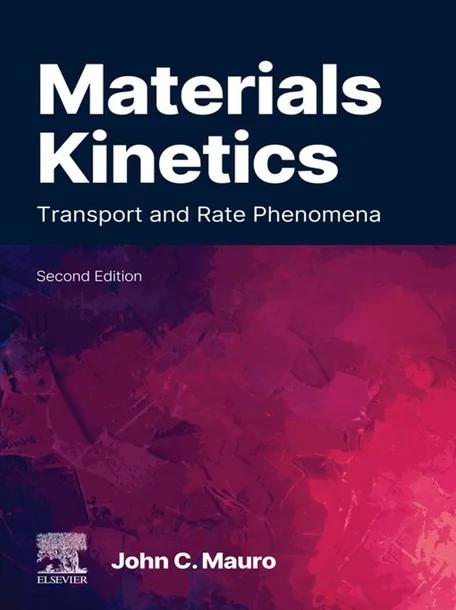
Materials Kinetics
Transport and Rate Phenomena
by John C. Mauro
2nd Edition
Publisher: Elsevier
Book Details
| Print ISBN | 9780443301742 |
| eText ISBN | 9780443301759 |
| Publisher | Elsevier |
| Publishing Year | 2026 |
| Edition | 2nd Edition |
| Language | English |
| Pages | 618 |
Author John C. Mauro presents Materials Kinetics: Transport and Rate Phenomena, 2nd Edition, an academic textbook addressing transport mechanisms and rate processes. The volume links physical-chemical principles directly to modern computational approaches, providing analytical framework tools for practical materials design.
Broad thematic coverage spans primary physical relationships alongside structured computational modeling techniques. Key topics incorporate thermodynamic principles, Fick's law, interfacial motion, and the kinetics of phase separation. To enhance computational modeling of kinetic phenomena, the text provides detailed attention to energy landscapes and Monte Carlo simulation techniques across material systems.
Reflecting recent technical advances in materials research, this second edition incorporates five brand new chapters. These dedicated additions provide specialized treatments of sintering, topological constraint theory, ab initio molecular dynamics, thermal conduction, and electrical conduction. Together, these updated topics deliver expanded analytical perspectives for investigating rate processes in modern materials science.
Table of Contents
Chapter 1: Thermodynamics vs. Kinetics
- • 1.1 What is Equilibrium?
- • 1.2 Thermodynamics vs. Kinetics
- • 1.3 Spontaneous and Non-Spontaneous Processes
- • 1.4 Microscopic Basis of Entropy
- • 1.5 Introduction to Statistical Mechanics
- • 1.6 First Law of Thermodynamics
- • 1.7 Second Law of Thermodynamics
- • 1.8 Third Law of Thermodynamics
- • 1.9 Zeroth Law of Thermodynamics
- • 1.10 Summary Exercises References
Chapter 2: Irreversible Thermodynamics
- • 2.1 Reversible and Irreversible Processes
- • 2.2 Affinity
- • 2.3 Fluxes
- • 2.4 Entropy Production
- • 2.5 Purely Resistive Systems
- • 2.6 Linear Systems
- • 2.7 Onsager Reciprosity Theorem
- • 2.8 Thermophoresis
- • 2.9 Thermoelectric Materials
- • 2.10 Electromigration
- • 2.11 Piezoelectric Materials
- • 2.12 Thermomagnetic Materials
- • 2.13 Galvanomagnetic Materials
- • 2.14 Beyond Onsager’s Approach
- • 2.15 Summary Exercises References
Chapter 3: Fick’s Laws of Diffusion
- • 3.1 Fick’s First Law
- • 3.2 Fick’s Second Law
- • 3.3 Driving Forces for Diffusion
- • 3.4 Nernst-Planck Equation
- • 3.5 Temperature Dependence of Diffusion
- • 3.6 Interdiffusion
- • 3.7 Kirkendall Effect
- • 3.8 Measuring Concentration Profiles
- • 3.9 Tracer Diffusion
- • 3.10 Summary Exercises References
Chapter 4: Analytical Solutions of the Diffusion Equation
- • 4.1 Fick’s Second Law with Constant Diffusivity
- • 4.2 Plane Source in One Dimension
- • 4.3 Method of Reflection and Superposition
- • 4.4 Solution for an Extended Source
- • 4.5 Bounded Initial Distribution
- • 4.6 Method of Separation of Variables
- • 4.7 Method of Laplace Transforms
- • 4.8 Anisotropic Diffusion
- • 4.9 Concentration-Dependent Diffusivity
- • 4.10 Time-Dependent Diffusivity
- • 4.11 Diffusion in a Cylinder
- • 4.12 Diffusion in a Sphere
- • 4.13 Summary Exercises References
Chapter 5: Multicomponent Diffusion
- • 5.1 Introduction
- • 5.2 Matrix Formulation of Diffusion in a Ternary System
- • 5.3 Solution by Matrix Diagonalization
- • 5.4 Uphill Diffusion
- • 5.5 Examples of Multicomponent Diffusion
- • 5.6 Summary Exercises References
Chapter 6: Numerical Solutions of the Diffusion Equation
- • 6.1 Introduction
- • 6.2 Dimensionless Variables
- • 6.3 Physical Interpretation of the Finite Difference Method
- • 6.4 Finite Differences Solution
- • 6.5 Considerations for Numerical Solutions
- • 6.6 Software for Numerical Solutions
- • 6.7 Summary Exercises References
Chapter 7: Atomic Models for Diffusion
- • 7.1 Introduction
- • 7.2 Thermally Activated Atomic Jumping
- • 7.3 Square Well Potential
- • 7.4 Parabolic Well Potential
- • 7.5 Generalized Formula for Particle Jump Frequency
- • 7.6 Particle Escape Probability
- • 7.7 Mean Squared Displacement of Particles
- • 7.8 Einstein Diffusion Equation
- • 7.9 Moments of a Function
- • 7.10 Diffusion and Random Walks
- • 7.11 Summary Exercises References
Chapter 8: Diffusion in Crystals
- • 8.1 Atomic Mechanisms for Diffusion
- • 8.2 Diffusivity in Metals
- • 8.3 Correlated Walks
- • 8.4 Defects in Ionic Crystals
- • 8.5 Schottky and Frenkel Defects
- • 8.6 Equilibrium Constants for Defect Reactions
- • 8.7 Diffusion in Ionic Crystals
- • 8.8 Diffusion Along Dislocations
- • 8.9 Summary Exercises References
Chapter 9: Diffusion in Polycrystalline Materials
- • 9.1 Defects in Polycrystalline Materials
- • 9.2 Diffusion Mechanisms in Polycrystalline Materials
- • 9.3 Regimes of Grain Boundary Diffusion
- • 9.4 Diffusion Along Stationary vs. Moving Grain Boundaries
- • 9.5 Atomic Mechanisms of Fast Grain Boundary Diffusion
- • 9.6 Modeling of Grain Boundary Diffusion
- • 9.7 Diffusion Along Free Surfaces
- • 9.8 Summary Exercises References
Chapter 10: Motion of Dislocations and Interfaces
- • 10.1 Driving Forces for Dislocation Motion
- • 10.2 Dislocation Glide and Climb
- • 10.3 Driving Forces for Interfacial Motion
- • 10.4 Motion of Crystal-Vapor Interfaces
- • 10.5 Entropy-Stabilized Oxides
- • 10.6 Crystalline Interface Motion
- • 10.7 Summary Exercises References
Chapter 11: Morphological Evolution in Polycrystalline Materials
- • 11.1 Driving Forces for Surface Morphological Evolution
- • 11.2 Morphological Evolution of Isotropic Surfaces
- • 11.3 Grooving
- • 11.4 Plateau-Rayleigh Instability
- • 11.5 Evolution of Anisotropic Surfaces
- • 11.6 Particle Coarsening: Ostwald Ripening
- • 11.7 Grain Growth in Two Dimensions
- • 11.8 Grain Growth in Three Dimensions
- • 11.9 Diffusional Creep
- • 11.10 Summary Exercises References
Chapter 12: Sintering
- • 12.1 Introduction
- • 12.2 Stages of Sintering
- • 12.3 Sintering Mechanisms
- • 12.4 Solid-State Sintering
- • 12.5 Liquid Phase Sintering
- • 12.6 Spark Plasma Sintering
- • 12.7 Cold Sintering
- • 12.8 Summary Exercises References
Chapter 13: Diffusion in Polymers and Glasses
- • 13.1 Introduction
- • 13.2 Stokes-Einstein Relation
- • 13.3 Freely Jointed Chain Model of Polymers
- • 13.4 Reptation
- • 13.5 Polymer Chain Kinetics
- • 13.6 Chemically Strengthened Glass by Ion Exchange
- • 13.7 Ion-Exchanged Glass Waveguides
- • 13.8 Anti-Microbial Glass
- • 13.9 Proton Conducting Glasses
- • 13.10 Summary Exercises References
Chapter 14: Kinetics of Phase Separation
- • 14.1 Thermodynamics of Mixing
- • 14.2 Immiscibility and Spinodal Domes
- • 14.3 Phase Separation Kinetics
- • 14.4 Cahn-Hilliard Equation
- • 14.5 Phase-Field Modeling
- • 14.6 Applications of Phase-Field Modeling
- • 14.7 Summary Exercises References
Chapter 15: Nucleation and Crystallization
- • 15.1 Kinetics of Crystallization
- • 15.2 Classical Nucleation Theory
- • 15.3 Homogeneous Nucleation
- • 15.4 Heterogeneous Nucleation
- • 15.5 Nucleation Rate
- • 15.6 Crystal Growth Rate
- • 15.7 Johnson-Mehl-Avrami Equation
- • 15.8 Time-Temperature-Transformation Diagram
- • 15.9 Glass-Ceramics
- • 15.10 Nucleating Agents
- • 15.11 Summary Exercises References
Chapter 16: Advanced Nucleation Theories
- • 16.1 Limitations of Classical Nucleation Theory
- • 16.2 Statistical Mechanics of Nucleation
- • 16.3 Diffuse Interface Theory
- • 16.4 Applications of Diffuse Interface Theory
- • 16.5 Density Functional Theory
- • 16.6 Applications of Density Functional Theory
- • 16.7 Implicit Glass Model
- • 16.8 Toy Landscape Model
- • 16.9 Summary Exercises References
Chapter 17: Viscosity of Liquids
- • 17.1 Introduction
- • 17.2 Viscosity Reference Points
- • 17.3 Viscosity Measurement Techniques
- • 17.4 Liquid Fragility
- • 17.5 Vogel-Fulcher-Tammann (VFT) Equation for Viscosity
- • 17.6 Avramov-Milchev (AM) Equation for Viscosity
- • 17.7 Adam-Gibbs Entropy Model
- • 17.8 Mauro-Yue-Ellison-Gupta-Allan (MYEGA) Equation for Viscosity
- • 17.9 Infinite Temperature Limit of Viscosity
- • 17.10 Fragile-to-Strong Transition
- • 17.11 Non-Newtonian Viscosity
- • 17.12 Models of Non-Newtonian Viscosity
- • 17.13 Volume Viscosity
- • 17.14 Summary Exercises References
Chapter 18: Nonequilibrium Viscosity and the Glass Transition
- • 18.1 Introduction
- • 18.2 The Glass Transition
- • 18.3 Ideal Glass Transition and the Kauzmann Paradox
- • 18.4 Thermal History Dependence of Viscosity
- • 18.5 Modeling of Nonequilibrium Viscosity
- • 18.6 Nonequilibrium Viscosity and Fragility
- • 18.7 Viscosity of Medieval Cathedral Glass
- • 18.8 Summary Exercises References
Chapter 19: Topological Constraint Theory
- • 19.1 Introduction
- • 19.2 Constraint Counting
- • 19.3 Rigidity Percolation Threshold
- • 19.4 Temperature-Dependent Constraints
- • 19.5 Calculation of Glass Transition Temperature
- • 19.6 Calculation of Fragility Index
- • 19.7 Composition Dependence of Viscosity
- • 19.8 Beyond Mean-Field Theory
- • 19.9 Summary Exercises References
Chapter 20: Energy Landscapes
- • 20.1 Potential Energy Landscapes
- • 20.2 Enthalpy Landscapes
- • 20.3 Landscape Kinetics
- • 20.4 Disconnectivity Graphs
- • 20.5 Eigenvector-Following Technique
- • 20.6 Activation-Relaxation Technique
- • 20.7 Nudged Elastic Band Method
- • 20.8 ExplorerPy
- • 20.9 Minimalist Landscape Model
- • 20.10 Summary Exercises References
Chapter 21: Broken Ergodicity
- • 21.1 What is Ergodicity?
- • 21.2 Deborah Number
- • 21.3 Broken Ergodicity
- • 21.4 Continuously Broken Ergodicity
- • 21.5 Hierarchical Master Equation Approach
- • 21.6 Thermodynamic Implications of Broken Ergodicity
- • 21.7 Examples of Broken Ergodicity
- • 21.8 Summary Exercises References
Chapter 22: Master Equations
- • 22.1 Transition State Theory
- • 22.2 Master Equations
- • 22.3 Degenerate Microstates
- • 22.4 Metabasin Approach
- • 22.5 Partitioning of the Landscape
- • 22.5 Accessing Long Time Scales
- • 22.6 KineticPy
- • 22.7 Applications of the Master Equation Approach
- • 22.8 Summary Exercises References
Chapter 23: Relaxation of Glasses and Polymers
- • 23.1 Introduction
- • 23.2 Fictive Temperature
- • 23.3 Tool’s Equation
- • 23.4 Ritland Crossover Experiment
- • 23.5 Fictive Temperature Distributions
- • 23.6 Property Dependence of Fictive Temperature
- • 23.7 Kinetic Interpretation of Fictive Temperature
- • 23.8 Stretched Exponential Relaxation
- • 23.9 Prony Series Description
- • 23.10 Relaxation Kinetics
- • 23.11 RelaxPy
- • 23.12 Stress vs. Structural Relaxation
- • 23.13 Maxwell Relation
- • 23.14 Frequency Domain Descriptions of Relaxation
- • 23.15 Secondary Relaxation
- • 23.16 Summary Exercises References
Chapter 24: Molecular Dynamics
- • 24.1 Multiscale Materials Modeling
- • 24.2 Principles of Molecular Dynamics
- • 24.3 Interatomic Potentials
- • 24.4 Ensembles
- • 24.5 Integrating the Equations of Motion
- • 24.6 Boundary Conditions and Neighbor Lists
- • 24.7 Performing Molecular Dynamics Simulations
- • 24.8 Thermostats
- • 24.9 Barostats
- • 24.10 Reactive Force Fields
- • 24.11 Accelerated Molecular Dynamics Techniques
- • 24.12 Tools of the Trade
- • 24.13 Summary Exercises References
Chapter 25: Monte Carlo Techniques
- • 25.1 Introduction
- • 25.2 Monte Carlo Integration
- • 25.3 Monte Carlo in Statistical Mechanics
- • 25.4 Markov Processes
- • 25.5 The Metropolis Method
- • 25.6 Molecular Dynamics vs. Monte Carlo
- • 25.7 Sampling in Different Ensembles
- • 25.8 Kinetic Monte Carlo
- • 25.9 Applications of Kinetic Monte Carlo
- • 25.10 Inherent Structure Density of States
- • 25.11 Random Number Generators
- • 25.12 Summary Exercises References
Chapter 26: Ab Initio Molecular Dynamics
- • 26.1 Introduction
- • 26.2 The Schrödinger Equation
- • 26.3 The Variational Principle
- • 26.4 The Born-Oppenheimer Equation
- • 26.5 Hartree-Fock Theory
- • 26.6 Rayleigh-Schrödinger Perturbation Theory
- • 26.7 The Kohn-Sham Formulation
- • 26.8 Exchange-Correlation Energy
- • 26.9 Pseudopotentials
- • 26.10 Car-Parrinello Molecular Dynamics
- • 26.11 Applications of Ab Initio Molecular Dynamics
- • 26.12 Summary Exercises References
Chapter 27: Fluctuations in Condensed Matter
- • 27.1 What are Fluctuations?
- • 27.2 Statistical Mechanics of Fluctuations
- • 27.3 Fluctuations in Broken Ergodic Systems
- • 27.4 Time Correlation Functions
- • 27.5 Green-Kubo Relations
- • 27.6 Dynamical Heterogeneities
- • 27.7 Nonmonotonic Relaxation of Fluctuations
- • 27.8 Industrial Example: Fluctuations in High Performance Display Glass
- • 27.9 Summary Exercises References
Chapter 28: Chemical Reaction Kinetics
- • 28.1 Rate of Reactions
- • 28.2 Order of Reactions
- • 28.3 Equilibrium Constants
- • 28.4 First-Order Reactions
- • 28.5 Higher Order Reactions
- • 28.6 Reactions in Series
- • 28.7 Temperature Dependence of Reaction Rates
- • 28.8 Catalysts
- • 28.9 Heterogeneous Reactions
- • 28.10 Solid State Transformation Kinetics
- • 28.11 Experimental Methods
- • 28.12 Summary Exercises References
Chapter 29: Thermal Conduction
- • 29.1 Fourier’s Law
- • 29.2 The Heat Equation
- • 29.3 Thermal Conductivity
- • 29.4 Mechanisms of Thermal Conduction
- • 29.5 Thermal Conductivity of Non-Crystalline Materials
- • 29.6 Summary Exercises References
Chapter 30: Electrical Conduction
- • 30.1 Ohm’s Law
- • 30.2 Electrical Resistivity and Conductivity
- • 30.3 Electrical Conduction in Metals
- • 30.4 Semiconductors and Insulators
- • 30.5 Solid-State Electrolytes
- • 30.6 Superconductors
- • 30.7 Summary Exercises References
Customer Reviews
0.0
0 reviews
No reviews yet. Be the first to review this book!
Write a Review
Reviewed by GradeFocus Editorial Team
▶Research Sources (15)
- Materials Kinetics - 2nd Edition
- Materials Kinetics, eBook by John C. Mauro
- [PDF] Materials Kinetics by John C. Mauro, 2nd edition
- MATERIALS KINETICS : transport and rate phenomena
- Materials Kinetics - John C. Mauro - e-bok (9780443301759)
- Materials Kinetics: Transport and Rate Phenomena
- Thompson Learn.
- Please verify you are human - Captcha
- Psychology & Personal Growth Archives
- Materials Kinetics
- Materials Kinetics John C Mauro - Nalda
- Materials Kinetics: Transport and Rate Phenomena
- Thermodynamics vs. Kinetics (Chapter 1, Materials Kinetics)
- Materials Kinetics - 9780443301742
- MTEN 311-002: Kinetics of Matierals
Related Books
Elastomer-Based Composites and Nanocomposites
Hamid Essabir

Piezoelectric Materials
Christopher R. Bowen
Functionalized Biopolymers
Swati Sharma

Inorganic Biomaterials for Drug Delivery
Amit Kumar Nayak

Hydrogels for Wound Healing
Sabu Thomas
Nanobiomaterials and Nanomedicines for Metabolic Disorders
Subhash C. Mandal