GradeFocus
BooksCategoriesAuthorsAboutContact
GradeFocus

Find textbooks and academic resources at competitive prices. Compare listings from VitalSource, Amazon, and more to save money on your course materials.

Browse

  • Books
  • Categories
  • Authors

Company

  • About
  • Contact
  • FAQ

Legal

  • Privacy
  • Terms
  • DMCA

© 2026 GradeFocus. All rights reserved.

PrivacyTermsSitemap
  1. Home
  2. /Engineering
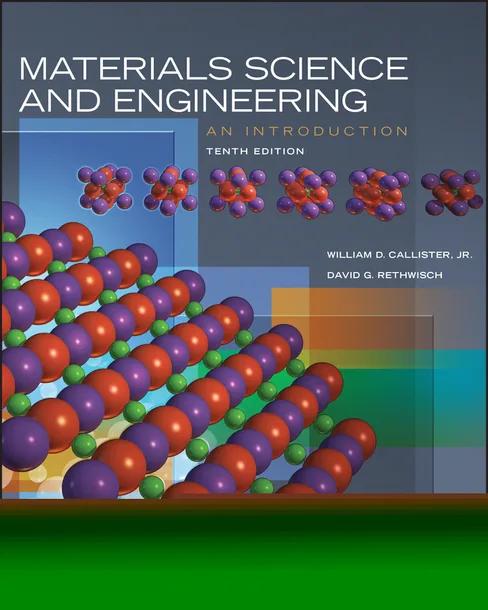
Materials Science and Engineering cover

Materials Science and Engineering

An Introduction

by William D. Callister Jr., David G. Rethwisch

10th Edition

Publisher: Wiley

(0 reviews)

Compare Prices

VitalSourceReflowable Layout$134.95Amazon KindleKindle$62.96Best PriceeTextShelfPDF$38.00

Book Details

Print ISBN9781119278566
eText ISBN9781119405498
PublisherWiley
Publishing Year2018
Edition10th Edition
LanguageEnglish
Pages990

Modern engineering demands a deep, intuitive grasp of how material structures dictate macroscopic properties. Materials Science and Engineering: An Introduction 10th Edition addresses this critical need by providing a clear, logical framework that connects the microscopic world of atoms to the macroscopic world of structural design. As technology advances with additive manufacturing and smart materials, this textbook serves as an indispensable guide for students seeking to master the fundamental principles of materials behavior. By focusing on the relationships between processing, structure, properties, and performance, it prepares future engineers to make informed decisions in a rapidly evolving technological landscape where material selection can determine the success or failure of an entire project.

The authors structure their exploration around the four primary classes of materials, namely metals, ceramics, polymers, and composite systems. Through a balanced and rigorous approach, the text demystifies complex topics such as crystalline structures, diffusion, phase transformations, and mechanical failure mechanisms. Readers are introduced to the materials paradigm, which emphasizes how structural elements at various length scales influence electrical, thermal, magnetic, and optical properties. This holistic perspective ensures that students do not merely memorize facts but instead develop a conceptual toolkit for solving real-world engineering challenges. By examining the degradation and corrosion of these materials, the authors provide a realistic view of how environmental factors impact engineering designs over time.

Engineered for introductory undergraduate courses, Materials Science and Engineering: An Introduction 10th Edition incorporates highly effective pedagogical features, including integrated learning objectives, interactive simulations, and practical design examples. This updated volume introduces fresh content on three-dimensional printing, biomaterials, and environmental recycling issues. Instructors around the globe adopt this text for its clarity, comprehensive homework sets, and robust digital support. For students seeking a flexible, fully searchable digital alternative, the Materials Science and Engineering: An Introduction 10th Edition PDF offers an invaluable resource that enhances study efficiency and supports offline learning across multiple devices, making complex engineering concepts more accessible than ever before.

Table of Contents

  1. Chapter 1: Introduction

  2. Chapter 2: Atomic Structure and Interatomic Bonding

    • • Atomic Structure
    • • Atomic Bonding in Solids
  3. Chapter 3: The Structure of Crystalline Solids

    • • Crystal Structures
    • • Crystallographic Points, Directions, and Planes
    • • Crystalline and Noncrystalline Materials
  4. Chapter 4: Imperfections in Solids

    • • Point Defects
    • • Miscellaneous Imperfections
    • • Microscopic Examination
  5. Chapter 5: Diffusion

  6. Chapter 6: Mechanical Properties of Metals

    • • Elastic Deformation
    • • Plastic Deformation
    • • Property Variability and Design/Safety Factors
  7. Chapter 7: Dislocations and Strengthening Mechanisms

    • • Dislocations and Plastic Deformation
    • • Mechanisms of Strengthening in Metals
    • • Recovery, Recrystallization, and Grain Growth
  8. Chapter 8: Failure

    • • Fatigue
    • • Creep
  9. Chapter 9: Phase Diagrams

    • • Definitions and Basic Concepts
    • • Binary Phase Diagrams
    • • The Iron-Carbon System
  10. Chapter 10: Phase Transformations: Development of Microstructure and Alteration of Mechanical Properties

    • • Phase Transformations
    • • Microstructural and Property Changes in Iron-Carbon Alloys
  11. Chapter 11: Applications and Processing of Metal Alloys

    • • Types of Metal Alloys
    • • Fabrication of Metals
    • • Thermal Processing of Metals
  12. Chapter 12: Structures and Properties of Ceramics

    • • Ceramic Structures
    • • Mechanical Properties
  13. Chapter 13: Applications and Processing of Ceramics

    • • Types and Applications of Ceramics
    • • Fabrication and Processing of Ceramics
  14. Chapter 14: Polymer Structures

  15. Chapter 15: Characteristics, Applications, and Processing of Polymers

    • • Mechanical Behavior of Polymers
    • • Mechanisms of Deformation and for Strengthening of Polymers
    • • Crystallization, Melting, and Glass-Transition Phenomena in Polymers
    • • Polymer Types
    • • Polymer Synthesis and Processing
  16. Chapter 16: Composites

    • • Particle-Reinforced Composites
    • • Fiber-Reinforced Composites
    • • Structural Composites
  17. Chapter 17: Corrosion and Degradation of Materials

    • • Corrosion of Metals
    • • Corrosion of Ceramic Materials
    • • Degradation of Polymers
  18. Chapter 18: Electrical Properties

    • • Electrical Conduction
    • • Semiconductivity
    • • Electrical Conduction in Ionic Ceramics and in Polymers
    • • Dielectric Behavior
    • • Other Electrical Characteristics of Materials
  19. Chapter 19: Thermal Properties

  20. Chapter 20: Magnetic Properties

  21. Chapter 21: Optical Properties

    • • Basic Concepts
    • • Optical Properties of Metals
    • • Optical Properties of Nonmetals
    • • Applications of Optical Phenomena
  22. Chapter 22: Environmental, and Societal Issues in Materials Science and Engineering

Customer Reviews

0.0

0 reviews

5 stars
0
4 stars
0
3 stars
0
2 stars
0
1 stars
0

No reviews yet. Be the first to review this book!

Write a Review

Select rating

0/20 characters minimum

By submitting a review, you agree that it may be published after moderation.

Reviewed by GradeFocus

▶Research Sources (12)
  • [PDF] Materials Science and Engineering An Introduction by William D ...
  • [PDF] Materials Science and Engineering
  • [PDF] MATERIALS SCIENCE andENGINEERING
  • Materials Science and Engineering: An Introduction - 10th Edition
  • Materials Science and Engineering by: William D. Callister, Jr.
  • Materials Science And Engineering 10th Edition Textbook Solutions
  • Materials Science and Engineering: An Introduction, 10th Edition
  • Materials Science by William D. Callister - is the 10th ...
  • Introduction | Chapter 1 - Materials Science and Engineering
  • Materials Science and Engineering: An Introduction, 10th ...
  • Materials Science and Engineering: An Introduction (10e)
  • Materials Science and Engineering An Introduction 10th

Related Books

Fluid Mechanics

Fluid Mechanics

Russell Hibbeler

The Norton Field Guide to Writing

The Norton Field Guide to Writing

Richard Bullock

Design of Machinery

Design of Machinery

Robert Norton

Refrigeration and Air Conditioning Technology

Refrigeration and Air Conditioning Technology

Eugene Silberstein

Elementary Principles of Chemical Processes

Elementary Principles of Chemical Processes

Richard M. Felder

Machinery's Handbook Guide

Machinery's Handbook Guide

John Milton Amiss