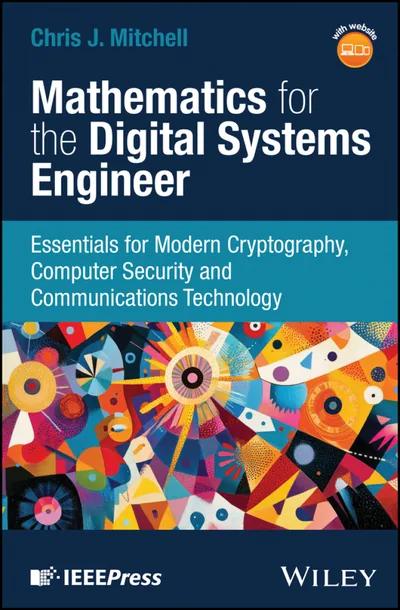
Mathematics for the Digital Systems Engineer
Essentials for Modern Cryptography, Computer Security and Communications Technology
by Chris J. Mitchell
1st Edition
Publisher: Wiley-IEEE Press
Book Details
| Print ISBN | 9781394396528 |
| eText ISBN | 9781394396535 |
| Publisher | Wiley-IEEE Press |
| Publishing Year | 2026 |
| Edition | 1st Edition |
| Language | English |
| Pages | 288 |
Mathematics for the Digital Systems Engineer, 1st Edition, by Chris J. Mitchell, is a 2026 textbook from Wiley-IEEE Press that covers mathematical foundations underpinning modern cryptography, computer security, and digital communications. Subtitled Essentials for Modern Cryptography, Computer Security and Communications Technology, the work provides direct academic support for engineers, computer scientists, and scholarly or professional readers entering technical security disciplines.
The text synthesizes core subjects across discrete mathematics and number theory. Initial sections outline standard mathematical definitions, properties of sets, functions, and relations, and integer properties. These topics prepare readers to examine modular arithmetic on the integers and understand modular calculation methods.
Subsequent coverage advances into key structures of abstract algebra. Detailed treatments of groups, rings, fields, polynomial rings, and finite fields connect theoretical mathematics to applied engineering domains. This mathematical foundation supports practice with data encryption, error control codes, the RSA algorithm, and Diffie-Hellman key agreement.
Table of Contents
Chapter 1: A Gentle Introduction
- • 1.1 What Is This Book About?
- • 1.2 Mathematics as Mathematicians See It
- • 1.3 Theorems and Proofs
- • 1.4 Abstract Algebra
- • 1.5 What Do You Need to Know to Make Sense of This Book?
- • 1.6 Case Studies of Applications
Chapter 2: Sets, Functions and Relations
- • 2.1 Why Are Sets Important?
- • 2.2 Sets
- • 2.3 Cartesian Products of Sets
- • 2.4 Relations
- • 2.5 Equivalence Relations and Equivalence Classes
- • 2.6 Relations: A Detailed Example
- • 2.7 Functions
- • 2.8 Operations
Chapter 3: Numbers as We Know and Love Them
- • 3.1 Where Does Mathematics Start?
- • 3.2 The Natural Numbers and the Integers
- • 3.3 Writing Down Numbers
- • 3.4 Ordering the Integers
- • 3.5 Induction
- • 3.6 The Division Theorem
- • 3.7 Prime Numbers and Common Factors
- • 3.8 Unique Factorisation
- • 3.9 The Euclidean Algorithm
- • 3.10 The Rationals
- • 3.11 The Real and Complex Numbers
- • 3.12 Applying Complex Numbers--An Everyday Example
Chapter 4: Modular Arithmetic on the Integers
- • 4.1 Working Relative to a Modulus
- • 4.2 Congruences: Making It More Mathematical
- • 4.3 Parity Checks: Using Modulo 2 Arithmetic
- • 4.4 Check Digits: A More Complex Example
- • 4.5 Elementary Properties of n
- • 4.6 The Extended Euclidean Algorithm
- • 4.7 Cryptography Ancient and Modern
- • 4.8 RSA: How Does It Work?
- • 4.9 Using RSA
- • 4.10 Implementing RSA
- • 4.11 RSA and the Future
- • 4.12 Other Applications of Modular Arithmetic
Chapter 5: Groups
- • 5.1 What Is a Group?
- • 5.2 A First Example: The Integers
- • 5.3 A Second Example: Modular Addition
- • 5.4 But What About Modular Multiplication?
- • 5.5 Subgroups and Lagrange's Theorem
- • 5.6 Proving Euler's Theorem
- • 5.7 Examples of Non-abelian Groups
- • 5.8 When Are Two Groups the Same Group?
- • 5.9 Combining Groups
- • 5.10 Discrete Logarithms
- • 5.11 Diffie-Hellman Key Agreement
- • 5.12 Other Applications of Discrete Logarithms
- • 5.13 The Threat Posed by Quantum Computing
- • 5.14 Other Applications of Groups
Chapter 6: Rings and Fields
- • 6.1 Two Operations, Not Just One!
- • 6.2 So What Is a Ring?
- • 6.3 Types of Rings
- • 6.4 Combining Rings
- • 6.5 Integral Domains--Some Key Properties
- • 6.6 Unique Factorisation Domains--Key Properties
- • 6.7 When Are Two Rings the Same Ring?
- • 6.8 Fields
- • 6.9 Coding Theory
Chapter 7: Polynomials and Polynomial Rings
- • 7.1 What Do I Mean by Polynomials?
- • 7.2 Doing Arithmetic with Polynomials
- • 7.3 Polynomials over a Field
- • 7.4 Shift Register Sequences
- • 7.5 Polynomial Arithmetic Modulo a Polynomial
Chapter 8: Finite Fields
- • 8.1 The Core of the Book
- • 8.2 The Prime Fields
- • 8.3 How Many Elements Might There Be?
- • 8.4 Prime Power Fields
- • 8.5 Uniqueness and Representation of Finite Fields
- • 8.6 Elliptic Curve Cryptography
- • 8.7 Quantum Computing--What Comes Next?
- • 8.8 Other Applications of Finite Fields
Chapter 9: Why Stop Now?
- • 9.1 Some Edited Highlights
- • 9.2 Sizes of Infinity
- • 9.3 How Many Prime Numbers Are There?
- • 9.4 Difference Sets, Sequences and Finite Geometry
- • 9.5 Finite Simple Groups
Customer Reviews
0.0
0 reviews
No reviews yet. Be the first to review this book!
Write a Review
Reviewed by GradeFocus Editorial Team
▶Research Sources (12)
- Mathematics for the Digital Systems Engineer: Essentials ...
- Mathematics for the digital systems engineer : essentials ...
- Mathematics for the Digital Systems Engineer - ISBN: 9781394396535
- Mathematics for the Digital Systems Engineer
- Start reading Mathematics for the Digital Systems Engineer for free
- Sourcebooks, LLC.
- Please verify you are human - Captcha
- Thompson Learn.
- Mathematics for the Digital... | Rent | 9781394396528 - eCampus.com
- Mathematics for the Digital Systems Engineer by Chris J. Mitchell ...
- Mathematics for the Digital Systems Engineer by Chris Mitchell
- Mathematics for the Digital Systems Engineer Essentials for Modern ...