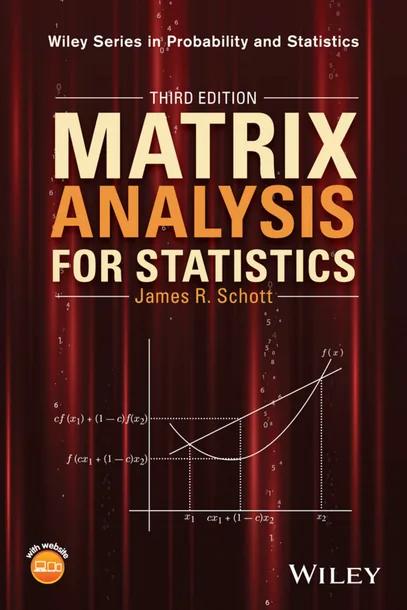
Matrix Analysis for Statistics
by James R. Schott
3rd Edition
Publisher: Wiley-Blackwell
Book Details
| Print ISBN | 9781119092483 |
| eText ISBN | 9781119092469 |
| Publisher | Wiley-Blackwell |
| Publishing Year | 2016 |
| Edition | 3rd Edition |
| Language | English |
| Pages | 552 |
Matrix Analysis for Statistics, 3rd Edition, offers a self-contained introduction to matrix methods used in statistical applications. Writing in a theorem and proof format, the author connects mathematical theory to applied statistical contexts.
The volume covers core principles such as elementary matrix algebra, vector spaces, generalized inverses, and quadratic forms. It also demonstrates how these matrix tools apply to least squares regression, mean vectors, and covariance matrices.
Intended for upper-undergraduate and graduate-level courses in matrix methods, multivariate analysis, and linear models, this textbook also functions as a reference for applied statistics researchers. Self-contained chapters and practice exercises support flexible study across various course curricula.
Table of Contents
Chapter 1: A Review of Elementary Matrix Algebra
- • 1.1 Introduction
- • 1.2 Definitions and Notation
- • 1.3 Matrix Addition and Multiplication
- • 1.4 The Transpose
- • 1.5 The Trace
- • 1.6 The Determinant
- • 1.7 The Inverse
- • 1.8 Partitioned Matrices
- • 1.9 The Rank of a Matrix
- • 1.10 Orthogonal Matrices
- • 1.11 Quadratic Forms
- • 1.12 Complex Matrices
- • 1.13 Random Vectors and Some Related Statistical Concepts
- • Problems
Chapter 2: Vector Spaces
- • 2.1 Introduction
- • 2.2 Definitions
- • 2.3 Linear Independence and Dependence
- • 2.4 Matrix Rank and Linear Independence
- • 2.5 Bases and Dimension
- • 2.6 Orthonormal Bases and Projections
- • 2.7 Projection Matrices
- • 2.8 Linear Transformations and Systems of Linear Equations
- • 2.9 The Intersection and Sum of Vector Spaces
- • 2.10 Oblique Projections
- • 2.11 Convex Sets
- • Problems
Chapter 3: Eigenvalues and Eigenvectors
- • 3.1 Introduction
- • 3.2 Eigenvalues, Eigenvectors, and Eigenspaces
- • 3.3 Some Basic Properties of Eigenvalues and Eigenvectors
- • 3.4 Symmetric Matrices
- • 3.5 Continuity of Eigenvalues and Eigenprojections
- • 3.6 Extremal Properties of Eigenvalues
- • 3.7 Additional Results Concerning Eigenvalues Of Symmetric Matrices
- • 3.8 Nonnegative Definite Matrices
- • 3.9 Antieigenvalues and Antieigenvectors
- • Problems
Chapter 4: Matrix Factorizations and Matrix Norms
- • 4.1 Introduction
- • 4.2 The Singular Value Decomposition
- • 4.3 The Spectral Decomposition of a Symmetric Matrix
- • 4.4 The Diagonalization of a Square Matrix
- • 4.5 The Jordan Decomposition
- • 4.6 The Schur Decomposition
- • 4.7 The Simultaneous Diagonalization of Two Symmetric Matrices
- • 4.8 Matrix Norms
- • Problems
Chapter 5: Generalized Inverses
- • 5.1 Introduction
- • 5.2 The Moore–Penrose Generalized Inverse
- • 5.3 Some Basic Properties of the Moore–Penrose Inverse
- • 5.4 The Moore–Penrose Inverse of a Matrix Product
- • 5.5 The Moore–Penrose Inverse of Partitioned Matrices
- • 5.6 The Moore–Penrose Inverse of a Sum
- • 5.7 The Continuity of the Moore–Penrose Inverse
- • 5.8 Some Other Generalized Inverses
- • 5.9 Computing Generalized Inverses
- • Problems
Chapter 6: Systems of Linear Equations
- • 6.1 Introduction
- • 6.2 Consistency of a System of Equations
- • 6.3 Solutions to a Consistent System of Equations
- • 6.4 Homogeneous Systems of Equations
- • 6.5 Least Squares Solutions to a System of Linear Equations
- • 6.6 Least Squares Estimation For Less Than Full Rank Models
- • 6.7 Systems of Linear Equations and The Singular Value Decomposition
- • 6.8 Sparse Linear Systems of Equations
- • Problems
Chapter 7: Partitioned Matrices
- • 7.1 Introduction
- • 7.2 The Inverse
- • 7.3 The Determinant
- • 7.4 Rank
- • 7.5 Generalized Inverses
- • 7.6 Eigenvalues
- • Problems
Chapter 8: Special Matrices and Matrix Operations
- • 8.1 Introduction
- • 8.2 The Kronecker Product
- • 8.3 The Direct Sum
- • 8.4 The Vec Operator
- • 8.5 The Hadamard Product
- • 8.6 The Commutation Matrix
- • 8.7 Some Other Matrices Associated With the Vec Operator
- • 8.8 Nonnegative Matrices
- • 8.9 Circulant and Toeplitz Matrices
- • 8.10 Hadamard and Vandermonde Matrices
- • Problems
Chapter 9: Matrix Derivatives and Related Topics
- • 9.1 Introduction
- • 9.2 Multivariable Differential Calculus
- • 9.3 Vector and Matrix Functions
- • 9.4 Some Useful Matrix Derivatives
- • 9.5 Derivatives of Functions of Patterned Matrices
- • 9.6 The Perturbation Method
- • 9.7 Maxima and Minima
- • 9.8 Convex and Concave Functions
- • 9.9 The Method of Lagrange Multipliers
- • Problems
Chapter 10: Inequalities
- • 10.1 Introduction
- • 10.2 Majorization
- • 10.3 Cauchy-Schwarz Inequalities
- • 10.4 H¨older’s Inequality
- • 10.5 Minkowski’s Inequality
- • 10.6 The Arithmetic-Geometric Mean Inequality
- • Problems
Chapter 11: Some Special Topics Related to Quadratic Forms
- • 11.1 Introduction
- • 11.2 Some Results on Idempotent Matrices
- • 11.3 Cochran’s Theorem
- • 11.4 Distribution of Quadratic Forms in Normal Variates
- • 11.5 Independence of Quadratic Forms
- • 11.6 Expected Values of Quadratic Forms
- • 11.7 The Wishart Distribution
- • Problems
Customer Reviews
0.0
0 reviews
No reviews yet. Be the first to review this book!
Write a Review
Reviewed by GradeFocus Editorial Team