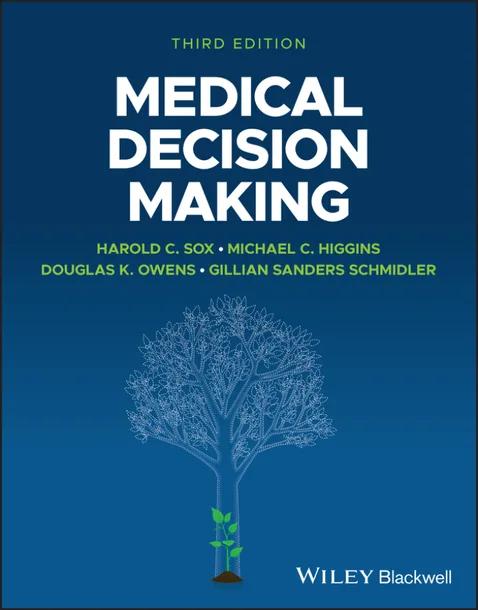
Medical Decision Making
by Harold C. Sox, Michael C. Higgins, Douglas K. Owens
3rd Edition
Publisher: Wiley-Blackwell
Book Details
| Print ISBN | 9781119627807 |
| eText ISBN | 9781119627722 |
| Publisher | Wiley-Blackwell |
| Publishing Year | 2024 |
| Edition | 3rd Edition |
| Language | English |
| Pages | 368 |
The textbook Medical Decision Making, 3rd Edition presents a patient-centered framework for clinical decision-making under uncertainty. Authored by Harold C. Sox, Michael C. Higgins, Douglas K. Owens, and Gillian Sanders Schmidler, this volume establishes structured analytical methods to guide clinical evaluation.
The material follows a progressive sequence starting with differential diagnosis and probability estimation to quantify clinical uncertainty. The text details how to measure diagnostic test accuracy and apply Bayes' theorem to interpret incoming clinical information. Subsequent discussion addresses the selection and interpretation of diagnostic tests, illustrating how practitioners update diagnostic probabilities when presented with new clinical evidence.
The authors revised and updated every chapter for the Third Edition. This volume provides systematic decision science principles to support structured clinical evaluations and evidence analysis.
Table of Contents
Chapter 1: Introduction
- • 1.1 How may I be thorough yet efficient when considering the possible causes of my patient’s problems?
- • 1.2 How do I characterize the information I have gathered during the medical interview and physical examination?
- • 1.3 How do I interpret new diagnostic information?
- • 1.4 How do I select the appropriate diagnostic test?
- • 1.5 How do I choose among several risky treatment alternatives?
Chapter 2: Differential diagnosis
- • 2.1 An introduction
- • 2.2 How clinicians make a diagnosis
- • 2.3 The principles of hypothesis-driven differential diagnosis
- • 2.3.1 The first step in differential diagnosis: listening and generating hypotheses
- • 2.3.2 The second step in differential diagnosis: gathering data to test hypotheses
- • 2.3.3 Hypothesis testing
- • 2.3.4 Selecting a course of action
- • 2.4 An extended example
- • 2.4.1 Clinical aphorisms
- • Bibliography
Chapter 3: Probability: quantifying uncertainty
- • 3.1 Uncertainty and probability in medicine
- • 3.1.1 The uncertain nature of clinical information
- • 3.1.2 Definition and key concepts
- • 3.1.3 The meaning of probability: the present state vs. a future event
- • 3.1.4 Odds: an alternative way to express a probability
- • 3.2 How to determine a probability
- • 3.2.1 Probability: a quantification of judgment about the likelihood of an event
- • 3.2.2 Indirect probability assessment
- • 3.2.3 Direct probability assessment
- • 3.3 Sources of error in using personal experience to estimate the probability
- • 3.3.1 Heuristics defined
- • 3.3.2 Heuristic I: representativeness
- • 3.3.3 Heuristic II: availability
- • 3.3.4 Heuristic III: anchoring and adjustment
- • 3.3.5 Correctly using heuristics for estimating probability
- • 3.4 The role of empirical evidence in quantifying uncertainty
- • 3.4.1 Determining probability from the prevalence of disease in patients with a symptom, physical finding, or test result
- • 3.4.2 Determining the probability of a disease from its prevalence in patients with a clinical syndrome
- • 3.4.3 Establishing a probability using a clinical prediction model
- • 3.5 Limitations of published studies of disease prevalence
- • 3.5.1 Caution in using published reports to determine probability
- • 3.6 Taking the special characteristics of the patient into account when determining probabilities
- • Bibliography
Chapter 4: Interpreting new information: Bayes’ theorem
- • 4.1 Introduction
- • 4.2 Conditional probability defined
- • 4.3 Bayes’ theorem
- • 4.3.1 Derivation of Bayes’ theorem
- • 4.3.2 Clinically useful forms of Bayes’ theorem
- • 4.4 The odds ratio form of Bayes’ theorem
- • 4.4.1 The derivation of the odds ratio form of Bayes’ theorem
- • 4.4.2 The likelihood ratio: a measure of test discrimination
- • 4.4.3 Using the odds ratio form of Bayes’ theorem
- • 4.5 Lessons to be learned from using Bayes’ theorem
- • 4.5.1 Further thoughts
- • 4.5.2 The clinical significance of test specificity
- • 4.5.3 The clinical significance of test sensitivity
- • 4.6 The assumptions of Bayes’ theorem
- • 4.7 Using Bayes’ theorem to interpret a sequence of tests
- • 4.8 Using Bayes’ theorem when many diseases are under consideration
- • Bibliography
Chapter 5: Measuring the accuracy of clinical findings
- • 5.1 A language for describing test results
- • 5.1.1 Defining a test result
- • 5.2 The measurement of diagnostic test performance
- • 5.2.1 How to measure test performance
- • 5.2.2 Measures of concordance between index test and disease state
- • 5.2.3 Measures of discordance between index test and disease state
- • 5.2.4 Predictive value
- • 5.3 How to measure diagnostic test performance: a hypothetical example
- • 5.3.1 Description of the study
- • 5.3.2 Description of results
- • 5.3.3 An important limitation of the spleen scan study
- • 5.4 Pitfalls of predictive value
- • 5.5 How to perform a high quality study of diagnostic test performance
- • 5.5.1 The features of a high-quality prospective study of a diagnostic test
- • 5.5.2 Study characteristics that help ensure that the results apply to usual practice
- • 5.5.3 Study characteristics that insure unbiased, reproducible interpretation of the index test and the gold standard test
- • 5.6 Spectrum bias in the measurement of test performance
- • 5.6.1 The first phase of test evaluation: testing the“sickest of the sick” and the “wellest of the well”
- • 5.6.2 The second phase of test evaluation: reluctance to order the gold standard test because of over-confidence in a negative index test result
- • 5.6.3 Effects of spectrum bias
- • 5.6.4 Adjusting for biased estimates of sensitivity and specificity
- • 5.6.5 Heuristics for adjusting published reports for disease severity bias
- • 5.7 When to be concerned about inaccurate measures of test performance
- • 5.8 Test results as a continuous variable: the ROC curve
- • 5.8.1 The distribution of test results in diseased and well individuals
- • 5.8.2 The receiver operating characteristic curve
- • 5.8.3 Using the ROC curve to compare tests
- • 5.8.4 Setting the cut point for a test
- • 5.9 Combining data from studies of test performance: the systematic review and meta-analysis
- • A.5.1 Appendix: derivation of the method for using an ROC curve to choose the definition of an abnormal test result
- • Bibliography
Chapter 6: Decision trees– representing the structure of a decision problem
- • 6.1 Introduction
- • 6.2 Key concepts and terminology
- • 6.2.1 Final outcomes
- • 6.2.2 Branch probabilities and outcome probabilities
- • 6.2.3 Expected value calculations and life expectancy
- • 6.3 Constructing the decision tree for a hypothetical decision problem
- • 6.4 Constructing the decision tree for a medical decision problem
- • 6.4.1 Management of coronary artery disease overview
- • 6.4.2 Simple decision in the management of coronary artery disease
- • 6.4.3 Determining the branch probabilities
- • 6.4.4 Alternate chance node ordering
- • 6.4.5 Computing the life expectancy for the decision alternatives
- • Epilogue
- • Bibliography
Chapter 7: Decision tree analysis
- • 7.1 Introduction
- • 7.2 Folding-back operation
- • 7.2.1 Folding-back operation applied to hypothetical problem
- • 7.2.2 Chance node ordering revisited
- • 7.2.3 Two-stage decision in the management of coronary artery disease
- • 7.2.4 Decision tree for two-stage coronary artery disease management decision
- • 7.2.5 Folding-back operation applied to two-stage coronary artery disease decision problem
- • 7.2.6 Conclusion of the folding-back operation
- • 7.2.7 Comment on number of significant figures used in calculations
- • 7.3 Sensitivity analysis
- • 7.3.1 One-way sensitivity analysis for simple decision problems
- • 7.3.2 Two-way sensitivity analysis for simple decision problems
- • 7.3.3 Sensitivity analysis for problems with two decisions
- • 7.3.4 Sensitivity analysis and clinical policies
- • Epilogue
- • Bibliography
Chapter 8: Outcome utility– representing risk attitudes
- • 8.1 Introduction
- • 8.2 What are risk attitudes?
- • 8.2.1 Risk-tolerant preferences
- • 8.3 Demonstration of risk attitudes in a medical context
- • 8.3.1 Depicting choice of lung cancer treatment as a decision tree
- • 8.3.2 Branch probabilities for the lung cancer treatment decision
- • 8.3.3 von Neumann-Morgenstern utility and the outcome values
- • 8.3.4 Using standard gamble assessment questions to determine outcome utilities
- • 8.3.5 Determining the outcome utilities for the lung cancer decision problem
- • 8.3.6 Computing Patient A’s expected utility for each of the treatments
- • 8.3.7 Risk attitudes matter
- • 8.4 General observations about outcome utilities
- • 8.4.1 Certainty equivalent– providing a tangible meaning for expected utility analysis
- • 8.4.2 Risk attitudes revisited
- • 8.5 Determining outcome utilities– underlying concepts
- • 8.5.1 Lifetime-tradeoff assessment
- • 8.5.2 Survival-tradeoff assessment
- • Epilogue
- • Bibliography
Chapter 9: Outcome utilities– clinical applications
- • 9.1 Introduction
- • 9.2 A parametric model for outcome utilities
- • 9.2.1 What is a parametric model?
- • 9.2.2 The exponential utility model
- • 9.2.3 Scaling exponential utility models
- • 9.2.4 Assumption underlying the exponential utility model
- • 9.2.5 Determining the exponential utility model parameter– first approach
- • 9.2.6 Determining the exponential utility model parameter– alternate assessment approach
- • 9.2.7 Exponential utility model parameter and risk attitudes
- • 9.3 Incorporating risk attitudes into clinical policies
- • 9.3.1 Risk-adjusted clinical policies– underlying concept
- • 9.3.2 Clinical context for illustrating risk-adjusted clinical policy design
- • 9.3.3 Determining the risk parameter threshold
- • 9.3.4 A simpler assessment question
- • 9.3.5 Generalized age- and gender-specific clinical policy
- • 9.3.6 Risk-adjusted clinical policies– what does it all mean?
- • 9.4 Helping patients communicate their preferences
- • Epilogue
- • A.9.1 Exponential utility model parameter nomogram
- • Bibliography
Chapter 10: Outcome utilities– adjusting for the quality of life
- • 10.1 Introduction
- • 10.2 Example– why the quality of life matters
- • 10.3 Quality-lifetime tradeoff models
- • 10.3.1 Parameterizing the quality-lifetime tradeoff model
- • 10.3.2 Quality-lifetime parametric utility model with constant risk attitudes
- • 10.3.3 Quality-lifetime tradeoff models and risk aversion– a fly in the ointment
- • 10.3.4 Quality-lifetime tradeoff modelling and healthcare policy analysis
- • 10.4 Quality-survival tradeoff models
- • 10.4.1 Assessing quality preferences with the quality-survival tradeoff model
- • 10.4.2 Parameterized quality-survival tradeoff model
- • 10.4.3 Parameterized quality-survival tradeoff model and exponential survival
- • 10.5 What does it all mean?– an extended example
- • 10.5.1 Direct approach to outcome utility assessment
- • 10.5.2 Outcome utility assessment based on outcome decomposition
- • Epilogue
- • Bibliography
Chapter 11: Survival models: representing uncertainty about the length of life
- • 11.1 Introduction
- • 11.2 Survival model basics
- • 11.2.1 Survival probabilities
- • 11.2.2 Lifetime probabilities
- • 11.2.3 Lifetime probabilities and the representation of time
- • 11.2.4 Hazard rates
- • 11.2.5 Estimating a survival model from observations
- • 11.2.6 Kaplan–Meier survival model
- • 11.3 Medical example– survival after breast cancer recurrence
- • 11.4 Exponential survival model
- • 11.4.1 Lifetime probabilities with the exponential survival model
- • 11.4.2 Fitting an exponential survival model to observations– first attempt
- • 11.5 Actuarial survival models
- • 11.5.1 Age- and gender-specific actuarial survival models
- • 11.5.2 Further adjustments of the actuarial survival model
- • 11.6 Two-part survival models
- • 11.6.1 Representing observed survival with an exponential survival model– second attempt
- • 11.6.2 Age adjusting a survival model
- • 11.6.3 Computing outcome utilities with the parametric two-part survival model
- • 11.6.4 Limitations
- • Epilogue
- • Bibliography
Chapter 12: Markov models
- • 12.1 Introduction
- • 12.2 Markov model basics
- • 12.2.1 Health states and transition probabilities
- • 12.2.2 Markov model diagrams and notation
- • 12.2.3 Markov independence
- • 12.2.4 Stationarity assumption
- • 12.2.5 Acyclic graph assumption
- • 12.3 Determining transition probabilities
- • 12.3.1 Markov model used to illustrate how transition probabilities are determined
- • 12.3.2 Determining mortality rates
- • 12.3.3 Determining probability for transitions between stages of recurrence
- • 12.3.4 Determining transition probabilities for treatment response
- • 12.4 Markov model analysis– an overview
- • 12.4.1 Direct approach to Markov model analysis
- • 12.4.2 Using Monte Carlo simulation to analyze Markov models
- • Epilogue
- • Bibliography
Chapter 13: Selection and interpretation of diagnostic tests
- • 13.1 Introduction
- • 13.2 Four principles of decision making
- • 13.2.1 Two examples of decision making under uncertainty
- • 13.2.2 The four principles as a framework
- • 13.3 The threshold probability for treatment
- • 13.3.1 The rationale for a treatment threshold probability
- • 13.3.2 Deriving an expression for the treatment threshold probability
- • 13.3.3 Heuristics for setting a treatment threshold probability
- • 13.3.4 Determining the treatment threshold probability for pulmonary embolism– a formal approach
- • 13.4 Threshold probabilities for testing
- • 13.4.1 The criteria for doing a test
- • 13.4.2 A method for deciding when to perform a diagnostic test
- • 13.4.3 Equations for calculating testing thresholds
- • 13.5 Clinical application of the threshold model of decision making
- • 13.5.1 Test selection for suspected pulmonary embolism: an example
- • 13.5.2 Incorporating a clinical prediction model into a probabilistic framework for test selection for suspected pulmonary embolism
- • 13.6 Accounting for the non-diagnostic effects of undergoing a test
- • 13.7 Sensitivity analysis
- • 13.8 Decision curve analysis
- • 13.8.1 Making the plot of net benefit vs. p*
- • 13.8.2 Use of DCA in practice
- • Bibliography
Chapter 14: Medical decision analysis in practice: advanced methods
- • 14.1 An overview of advanced modeling techniques
- • 14.1.1 When are advanced modeling approaches needed?
- • 14.1.2 Types of modeling approaches
- • 14.1.3 Choosing among modeling approaches
- • 14.2 Use of medical decision‐making concepts to analyze a policy problem: the cost‐effectiveness of screening for HIV
- • 14.2.1 The policy question
- • 14.2.2 Steps of the analysis
- • 14.2.3 Define the problem, objectives, and perspective
- • 14.2.4 Identify alternatives and choose the modeling framework
- • 14.2.5 Structure the problem, define chance events, represent the time sequence
- • 14.2.6 Determine the probability of chance events
- • 14.2.7 Value the outcomes
- • 14.2.8 Estimate costs and discount outcomes
- • 14.2.9 Calculate the expected utility, costs, and cost‐effectiveness
- • 14.2.10 Evaluate uncertainty
- • 14.2.11 Address ethical issues, discuss results
- • 14.3 Use of medical decision‐making concepts to analyze a clinical diagnostic problem: strategies to diagnose tumors in the lung
- • 14.3.1 Define the problem, objectives, and perspective
- • 14.3.2 Identify alternatives and choose the modeling framework
- • 14.3.3 Structure the problem, define chance events, and represent the time sequence
- • 14.3.4 Determine the probability of the chance events
- • 14.3.5 Value the outcomes
- • 14.3.6 Estimate costs and discount outcomes
- • 14.3.7 Calculate expected utility, costs, and cost‐effectiveness
- • 14.3.8 Evaluate uncertainty
- • 14.3.9 Address ethical issues, discuss results
- • 14.4 Calibration and validation of decision models
- • 14.5 Use of complex models for individual‐patient decision making
- • 14.5.1 The Alchemist decision support system
- • 14.5.2 Challenges for individual‐patient decision making
- • Bibliography
Chapter 15: Cost-effectiveness analysis
- • 15.1 The clinician’s conflicting roles: patient advocate, member of society, and entrepreneur
- • 15.1.1 Principles of allocating scarce resources
- • 15.2 Cost-effectiveness analysis: a method for comparing management strategies
- • 15.2.1 Using cost-effectiveness analysis to set institutional policy: an exten
Customer Reviews
0.0
0 reviews
No reviews yet. Be the first to review this book!
Write a Review
Reviewed by GradeFocus Editorial Team
▶Research Sources (14)
- [PDF] Medical Decision Making by Harold C. Sox, 3rd edition
- Medical Decision Making - AXON
- Medical Decision Making, 3e (Feb 27, 2024)_(111962780X)
- Medical Decision Making
- Medical Decision Making, 3rd Edition - CHDS repository
- Medical Decision Making
- Medical Decision Making
- 馬偕紀念醫院圖書館書刊目錄查詢網
- Medical Decision Making [3 ed.] 111962780X ...
- Medical Decision Making, 3rd Edition by Harold C. Sox
- Decision Making and the Patient - JAMAevidence
- Medical Decision Making : Harold C. Sox
- About Medical Decision Making
- Medical Decision Making, 3rd Edition - 9781119627807