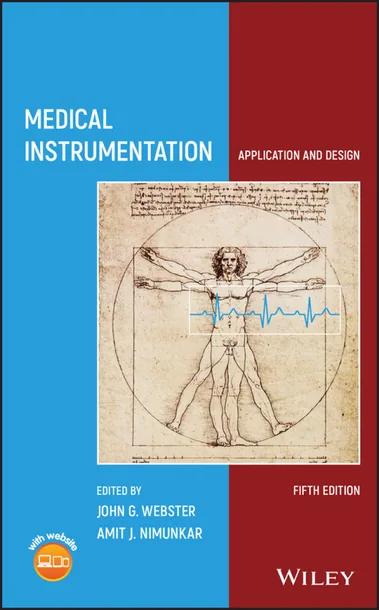
Medical Instrumentation
Application and Design
by John G. Webster, Amit J. Nimunkar
5th Edition
Publisher: Wiley-Blackwell
Book Details
| Print ISBN | 9781119457336 |
| eText ISBN | 9781119457312 |
| Publisher | Wiley-Blackwell |
| Publishing Year | 2020 |
| Edition | 5th Edition |
| Language | English |
| Pages | 928 |
Medical Instrumentation: Application and Design, 5th Edition, explores the principles, applications, and design of equipment commonly used in hospitals. The textbook emphasizes core engineering principles to help researchers and scientists with limited electronics experience develop instruments that may not be available commercially.
Coverage spans essential sensor mechanisms, biopotential origins and electrodes, analog signal conditioning, and microcontroller-based digital processing. The text relates these hardware fundamentals to physiological monitoring of the cardiovascular and respiratory systems, as well as chemical biosensors, clinical laboratory apparatus, and imaging systems.
To aid learning and practical problem-solving, the text includes worked-out examples and end-of-chapter problems supported by a companion webpage and a complete solutions manual.
Table of Contents
Chapter 1: Basic Concepts of Medical Instrumentation
- • 1.1 Terminology of Medicine and Medical Devices
- • 1.2 Generalized Medical Instrumentation System
- • 1.3 Alternative Operational Modes
- • 1.4 Medical Measurement Constraints
- • 1.5 Classifications of Biomedical Instruments
- • 1.6 Interfering and Modifying Inputs
- • 1.7 Compensation Techniques
- • 1.8 Biostatistics
- • 1.9 Generalized Static Characteristics
- • 1.10 Generalized Dynamic Characteristics
- • 1.11 Amplifiers and Signal Processing
- • 1.12 Inverting Amplifiers
- • 1.13 Noninverting Amplifiers
- • 1.14 Differential Amplifiers
- • 1.15 Comparators
- • 1.16 Rectifiers
- • 1.17 Logarithmic Amplifiers
- • 1.18 Integrators
- • 1.19 Differentiators
- • 1.20 Active Filters
- • 1.21 Frequency Response
- • 1.22 Offset Voltage
- • 1.23 Bias Current
- • 1.24 Input and Output Resistance
- • 1.25 Design Criteria
- • 1.26 Commercial Medical Instrumentation Development Process
- • 1.27 Regulation of Medical Devices
- • Problems
- • References
Chapter 2: Basic Sensors and Principles
- • 2.1 Displacement Measurements
- • 2.2 Resistive Sensors
- • 2.3 Bridge Circuits
- • 2.4 Inductive Sensors
- • 2.5 Phase-Sensitive Demodulators
- • 2.6 Capacitive Sensors
- • 2.7 Piezoelectric Sensors
- • 2.8 Accelerometer
- • 2.9 Temperature Measurements
- • 2.10 Thermocouples
- • 2.11 Thermistors
- • 2.12 Radiation Thermometry
- • 2.13 Fiber-Optic Temperature Sensors
- • 2.14 Optical Measurements
- • 2.15 Radiation Sources
- • 2.16 Geometrical and Fiber Optics
- • 2.17 Optical Filters
- • 2.18 Radiation Sensors
- • 2.19 Optical Combinations
- • Problems
- • References
Chapter 3: Microcontrollers in Medical Instrumentation
- • 3.1 Basics of Microcontroller
- • 3.2 Embedded Medical System
- • 3.3 ECG-Based Embedded Medical System Example
- • 3.4 Selection of a Microcontroller
- • 3.5 IoT-Based Medical Devices
- • Problems
- • References
Chapter 4: The Origin of Biopotentials
- • 4.1 Electrical Activity of Excitable Cells
- • 4.2 Volume Conductor Fields
- • 4.3 Functional Organization of the Peripheral Nervous System
- • 4.4 The Electroneurogram
- • 4.5 The Electromyogram
- • 4.6 The Electrocardiogram
- • 4.7 The Electroretinogram
- • 4.8 The Electroencephalogram
- • 4.9 The Magnetoencephalogram
- • Problems
- • References
Chapter 5: Biopotential Electrodes
- • 5.1 The Electrode–Electrolyte Interface
- • 5.2 Polarization
- • 5.3 Polarizable and Nonpolarizable Electrodes
- • 5.4 Electrode Behavior and Circuit Models
- • 5.5 The Electrode–Skin Interface and Motion Artifact
- • 5.6 Body-Surface Recording Electrodes
- • 5.7 Internal Electrodes
- • 5.8 Electrode Arrays
- • 5.9 Microelectrodes
- • 5.10 Electrodes for Electric Stimulation of Tissue
- • 5.11 Practical Hints in Using Electrodes
- • Problems
- • References
Chapter 6: Biopotential Amplifiers
- • 6.1 Basic Requirements
- • 6.2 The Electrocardiograph
- • 6.3 Problems Frequently Encountered
- • 6.4 Transient Protection
- • 6.5 Common-Mode and Other Interference-Reduction Circuits
- • 6.6 Amplifiers for Other Biopotential Signals
- • 6.7 Example of a Biopotential Preamplifier
- • 6.8 Other Biopotential Signal Processors
- • 6.9 Cardiac Monitors
- • 6.10 Biotelemetry
- • Problems
- • References
Chapter 7: Blood Pressure and Sound
- • 7.1 Direct Measurements
- • 7.2 Harmonic Analysis of Blood Pressure Waveforms
- • 7.3 Dynamic Properties of Pressure-Measurement Systems
- • 7.4 Measurement of System Response
- • 7.5 Effects of System Parameters on Response
- • 7.6 Bandwidth Requirements for Measuring Blood Pressure
- • 7.7 Typical Pressure-Waveform Distortion
- • 7.8 Systems for Measuring Venous Pressure
- • 7.9 Heart Sounds
- • 7.10 Phonocardiography
- • 7.11 Cardiac Catheterization
- • 7.12 Effects of Potential and Kinetic Energy on Pressure Measurements
- • 7.13 Indirect Measurements of Blood Pressure
- • 7.14 Tonometry
- • Problems
- • References
Chapter 8: Measurement of Flow and Volume of Blood
- • 8.1 Indicator-Dilution Method that Uses Continuous Infusion
- • 8.2 Indicator-Dilution Method that Uses Rapid Injection
- • 8.3 Electromagnetic Flowmeters
- • 8.4 Ultrasonic Flowmeters
- • 8.5 Thermal-Convection Velocity Sensors
- • 8.6 Chamber Plethysmography
- • 8.7 Electrical-Impedance Plethysmography
- • 8.8 Photoplethysmography
- • Problems
- • References
Chapter 9: Measurements of the Respiratory System
- • 9.1 Modeling the Respiratory System
- • 9.2 Measurement of Pressure
- • 9.3 Measurement of Gas Flow
- • 9.4 Lung Volume
- • 9.5 Respiratory Plethysmography
- • 9.6 Some Tests of Respiratory Mechanics
- • 9.7 Measurement of Gas Concentration
- • 9.8 Some Tests of Gas Transport
- • Problems
- • References
Chapter 10: Chemical Biosensors
- • 10.1 Blood-Gas and Acid–Base Physiology
- • 10.2 Electrochemical Sensors
- • 10.3 Chemical Fibrosensors
- • 10.4 Ion-Sensitive Field-Effect Transistor (ISFET)
- • 10.5 Immunologically Sensitive Field-Effect Transistor (IMFET)
- • 10.6 Noninvasive Blood-Gas Monitoring
- • 10.7 Blood-Glucose Sensors
- • 10.8 Electronic Noses
- • 10.9 Lab-on-a-chip
- • 10.10 Summary
- • Problems
- • References
Chapter 11: Clinical Laboratory Instrumentation
- • 11.1 Spectrophotometry
- • 11.2 Automated Chemical Analyzers
- • 11.3 Chromatology
- • 11.4 Electrophoresis
- • 11.5 Hematology
- • Problems
- • References
Chapter 12: Medical Imaging Systems
- • 12.1 Information Content of an Image
- • 12.2 Modulation Transfer Function
- • 12.3 Noise-Equivalent Bandwidth
- • 12.4 Image Processing
- • 12.5 Radiography
- • 12.6 Computed Radiography
- • 12.7 Computed Tomography
- • 12.8 Magnetic Resonance Imaging
- • 12.9 Nuclear Medicine
- • 12.10 Single-Photon Emission Computed Tomography
- • 12.11 Positron Emission Tomography
- • 12.12 Ultrasonography
- • 12.13 Contrast Agents
- • Problems
- • References
Chapter 13: Therapeutic and Prosthetic Devices
- • 13.1 Cardiac Pacemakers and Other Electric Stimulators
- • 13.2 Defibrillators and Cardioverters
- • 13.3 Mechanical Cardiovascular Orthotic and Prosthetic Devices
- • 13.4 Hemodialysis
- • 13.5 Lithotripsy
- • 13.6 Ventilators
- • 13.7 Infant Incubators
- • 13.8 Drug Delivery Devices
- • 13.9 Surgical Instruments
- • 13.10 Therapeutic Applications of the Laser
- • Problems
- • References
Chapter 14: Electrical Safety
- • 14.1 Physiological Effects of Electricity
- • 14.2 Important Susceptibility Parameters
- • 14.3 Distribution of Electric Power
- • 14.4 Macroshock Hazards
- • 14.5 Microshock Hazards
- • 14.6 Electrical-Safety Codes and Standards
- • 14.7 Basic Approaches to Protection Against Shock
- • 14.8 Protection: Power Distribution
- • 14.9 Protection: Equipment Design
- • 14.10 Electrical-Safety Analyzers
- • 14.11 Testing the Electric System
- • 14.12 Tests of Electric Appliances
- • 14.13 Conclusion
- • Problems
- • References
Chapter Appendix: Appendix
- • A.1 Physical Constants
- • A.2 International System of Units (SI) Prefixes
- • A.3 International System of Units
- • A.4 Abbreviations
- • A.5 Chemical Elements
Customer Reviews
0.0
0 reviews
No reviews yet. Be the first to review this book!
Write a Review
Reviewed by GradeFocus Editorial Team
Related Books
Biomechanics of the Human Spine
Fabio Galbusera
Emerging Diagnostic Glucose Sensing Approaches
Abhishek Kandwal

Engineering Nanoparticles for Biomedical Applications
Sulalit Bandyopadhyay
Soft Electronics for Diagnosis, Therapy, and Integrated Systems
Xinge Yu
Green Carbon Dots for Theranostic Applications
Hamed Barabadi
Human-Machine interfaces in Medical Robotics
Yanpei Huang