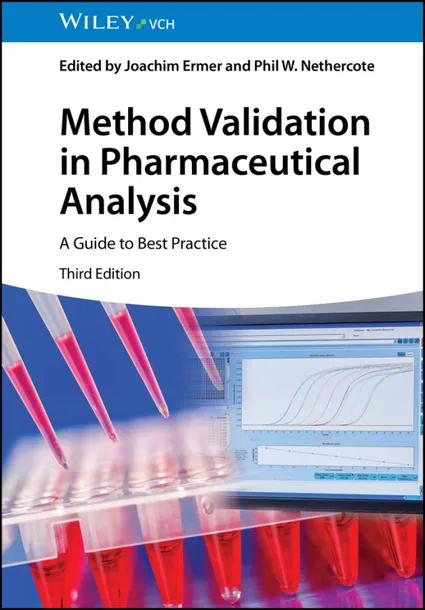
Method Validation in Pharmaceutical Analysis
A Guide to Best Practice
by Joachim Ermer, Phil W. Nethercote
3rd Edition
Publisher: Wiley-VCH
Book Details
| Print ISBN | 9783527348909 |
| eText ISBN | 9783527831715 |
| Publisher | Wiley-VCH |
| Publishing Year | 2025 |
| Edition | 3rd Edition |
| Language | English |
| Pages | 544 |
The reference volume Method Validation in Pharmaceutical Analysis, 3rd Edition, provides structured guidance on analytical procedure lifecycle management within pharmaceutical research and manufacturing settings. The text presents principles for designing, validating, and monitoring analytical methods across drug development programs.
The main chapters incorporate revised international guidance, specifically addressing ICH Guidelines Q2(R2) and Q14. Coverage includes analytical target profiles, decision rules, and fitness for intended use. The text also outlines strategies for method selection, optimization techniques, multivariate analytical procedures, and risk-based analytical control strategies.
A defining feature of this edition is its detailed framework for data governance, data integrity, and ALCOA criteria during routine testing. The volume is structured for analytical chemists, quality control and quality assurance staff, pharmaceutical industry professionals, and public regulatory authorities.
Table of Contents
Chapter 1: Analytical Validation Within the Pharmaceutical Lifecycle
- • 1.1 Development of Process and Analytical Validation Concepts
- • 1.2 Alignments Between Process and Analytics: Three-Stage Approach
- • 1.3 Predefined Objectives: ATP
- • 1.4 Analytical Lifecycle
- • References
Chapter 2: Data Governance, Data Integrity, and Data Quality
- • 2.1 Terminology Used in This Chapter
- • 2.2 Data Governance and Data Integrity Model
- • 2.3 Interaction Between Levels 1 and 2
- • 2.4 Overview of Data Integrity
- • 2.5 ALCOA Criteria for Data Integrity
- • 2.6 Understanding Level 3: Right Analysis for the Right Reportable Result
- • 2.7 Second-Person Review
- • 2.8 Summary
- • References
Chapter 3: Analytical Instrument Qualification and System Validation Lifecycle
- • 3.1 Data Integrity and Data Quality in a GMP Environment
- • 3.2 AIQSV Approach as an Essential Part of the Analytical Procedure Lifecycle
- • 3.3 USP General Chapter <1058>
- • 3.4 Enhancement of <1058> and Harmonization of a Risk-Based Approach to Instruments and Systems with GAMP
- • 3.5 Risk-Based Approaches to Analytical Instrument and System Qualification [3]
- • References
Chapter 4: Continued HPLC Performance Qualification
- • 4.1 Introduction
- • 4.2 Development of the Revised OQ/PQ Parameters List
- • 4.3 Transfer of Modular Parameters into the Holistic Approach
- • 4.4 OQ/PQ Data in Comparison with SST Data
- • 4.5 Performance Monitoring: Trending Plots/Control Charts
- • 4.6 General Procedure for cPQ
- • 4.7 Example
- • 4.8 Concluding Remarks
- • Acknowledgment
- • References
Chapter 5: Analytical Target Profile
- • 5.1 Introduction
- • 5.2 Components of an ATP
- • 5.3 The Probability Statements
- • 5.4 Metrics for Assessment
- • 5.5 Summary
- • Acknowledgments
- • References
Chapter 6: Decision Rules and Fitness for Intended Purpose
- • 6.1 Introduction
- • 6.2 Defining the Fitness for Intended Purpose
- • 6.3 Decision Rules
- • 6.4 Overview of Process to Develop Requirements for Procedure Performance
- • 6.5 Decision Rules and Compliance
- • 6.6 Calculating Target Measurement Uncertainty
- • 6.7 Types of Decision Rules
- • 6.8 Target Measurement Uncertainty in the ATP
- • 6.9 Bias and Uncertainty in a Procedure
- • 6.10 ATP and Key Performance Indicators
- • 6.11 Measurement Uncertainty
- • 6.12 Example
- • 6.13 Conclusion
- • References
Chapter 7: Performance Characteristics of Analytical Procedures
- • 7.1 Precision
- • 7.2 Accuracy
- • 7.3 Specificity/Selectivity
- • 7.4 Response (Calibration Model)
- • 7.5 Detection and Quantitation Limits
- • Acknowledgments
- • References
Chapter 8: ICHQ14 Analytical Procedure Development
- • 8.1 Introduction
- • 8.2 The ATP
- • 8.3 Connection Between Product and Analytical Procedure Understanding
- • 8.4 Prior and Platform Knowledge
- • 8.5 Robustness and Method Operable Design Region (MODR)
- • 8.6 Link and Impact with Analytical Procedure Validation
- • 8.7 Analytical Procedure Control Strategy and Ongoing Procedure Performance Verification
- • 8.8 Lifecycle Strategy Including Enhanced Approaches in Submission
- • 8.9 Summary
- • References
Chapter 9: Method Selection, Development, and Optimization
- • 9.1 Introduction
- • 9.2 Method Selection
- • 9.3 Method Development
- • 9.4 Method Optimization
- • Acknowledgments
- • References
Chapter 10: Multivariate Analytical Procedures
- • 10.1 Introduction
- • 10.2 Sampling and Data Quality
- • 10.3 Development of Multivariate Models
- • 10.4 Model Optimization and Validation
- • 10.5 Model Maintenance and Lifecycle Management
- • 10.6 Summary
- • Acknowledgments
- • References
Chapter 11: Case Study: Robustness Investigations
- • 11.1 Introduction
- • 11.2 General Considerations in the Context of Robustness Testing
- • 11.3 Examples of Computer-Assisted Robustness Studies
- • Acknowledgment
- • References
Chapter 12: Risk Assessment and Analytical Procedure Control Strategy
- • 12.1 Background
- • 12.2 Risk Management Process
- • 12.3 ICH Q9
- • 12.4 Using Risk Management to Develop a Control Strategy
- • 12.5 Analytical Procedure Control Strategy
- • References
Chapter 13: ICH Q2(R2): Validation of Analytical Procedures
- • 13.1 How to Read This Chapter
- • 13.2 Introduction
- • 13.3 General Considerations for Analytical Procedure Validation
- • 13.4 Validation Tests, Methodology, and Evaluation
- • 13.5 Annex 2: Illustrative Examples for Analytical Techniques
- • 13.6 Conclusion
- • References
Chapter 14: Case Study: Validation of a High-performance Liquid Chromatography (HPLC) Method for Identity, Assay, and Degradation of Products
- • 14.1 Introduction
- • 14.2 Experimental
- • 14.3 Validation Summary
- • 14.4 Validation Methodology
- • 14.5 Conclusion
- • References
Chapter 15: Case Study: Design and Qualification of a Delivered Dose Uniformity Procedure for a Pressurized Metered Dose Inhaler with a Focus on Sample Preparation
- • 15.1 Introduction
- • 15.2 Designing a DDU Procedure that will Meet an ATP
- • 15.3 Performance Characteristics of the DDU Procedure
- • 15.4 Qualification of the DDU Procedure
- • 15.5 Summary of the Analytical Procedure Control Strategy for a DDU Procedure
- • Acknowledgments
- • References
Chapter 16: Case Study: Validation of a Bioassay Method
- • 16.1 Introduction
- • 16.2 Material Considerations
- • 16.3 Study Design
- • 16.4 Specificity/Selectivity
- • 16.5 Accuracy
- • 16.6 Precision
- • 16.7 Range
- • 16.8 Robustness
- • 16.9 Conclusion
- • Acknowledgments
- • References
Chapter 17: Implementation of Compendial/Pharmacopeia Test Procedures
- • 17.1 Background of Pharmacopeia Procedures
- • 17.2 How Pharmacopeia Methods Are Generated and Published
- • 17.3 Challenges with Compendial Procedures and the Need to Verify
- • 17.4 Using Pharmacopeia Procedures in a Laboratory for the First Time
- • 17.5 Verification of Pharmacopeia Procedures
- • 17.6 Integration of the Verification Process and the Lifecycle Approach
- • 17.7 Implementation of a Pharmacopeia Procedure Using the Lifecycle Approach
- • 17.8 Performance Qualification
- • 17.9 Conclusion
- • References
Chapter 18: Transfer of Analytical Procedures
- • 18.1 Transfer Process and Strategy
- • 18.2 Comparative Testing
- • References
Chapter 19: Lifecycle Approach to Transfer of Analytical Procedures
- • 19.1 Facilitation of Transfer by Risk Assessment
- • 19.2 Facilitation of Transfer by the APCS
- • 19.3 “Lean” Transfer Strategy
- • 19.4 Conclusion
- • References
Chapter 20: Continuous Improvements, Adjustments, and Changes
- • 20.1 Drivers for Change
- • 20.2 Control of Change in the Pharmaceutical Industry
- • 20.3 Implementing a Change
- • References
Chapter 21: Monitoring of Analytical Performance
- • 21.1 Sources of Performance Data and Information
- • 21.2 Systematic Monitoring Program
- • 21.3 Analytical Performance Evaluation Tools
- • 21.4 Assessment of Analytical Performance
- • 21.5 Conclusion
- • References
Customer Reviews
0.0
0 reviews
No reviews yet. Be the first to review this book!
Write a Review
Reviewed by GradeFocus Editorial Team
▶Research Sources (16)
- Method Validation in Pharmaceutical Analysis, eBook by Joachim ...
- 9783527348909: Method Validation in Pharmaceutical Analysis: A ...
- Start reading Method Validation in Pharmaceutical Analysis for free
- Method Validation in Pharmaceutical Analysis: A Guide to Best Practice
- Print Friendly Search Results
- Method Validation in Pharmaceutical Analysis: A Guide to Best Practice
- Sourcebooks, LLC.
- Thompson Learn.
- Please verify you are human - Captcha
- Method Validation in Pharmaceutical Analysis: A Guide to Best Practice ...
- Meet the Expert: Method Validation in Pharmaceutical Analysis - BioQC
- Method Validation in Pharmaceutical Analysis - Wiley-VCH
- Method Validation in Pharmaceutical Analysis - Booktopia
- A practical approach to method validation in pharmaceutical analysis
- A Step-by-Step Guide to Analytical Method Development and Validation
- Method Validation in Pharmaceutical Analysis: A Guide to Best Practice ...
Related Books
Advances in Tablet Manufacturing Technologies
Honey Goel
Protein-Based Nanoparticles in Drug Delivery
Prashant Kesharwani
Lipids in Pulmonary Drug Delivery
Md Faiyazuddin
Bioactive-Based Nanotherapeutics
Rakesh K. Sindhu

Natural Biopolymers for Drug Delivery
Amit Kumar Nayak

Drug Delivery Systems for Wound Healing
Pedro Fonte