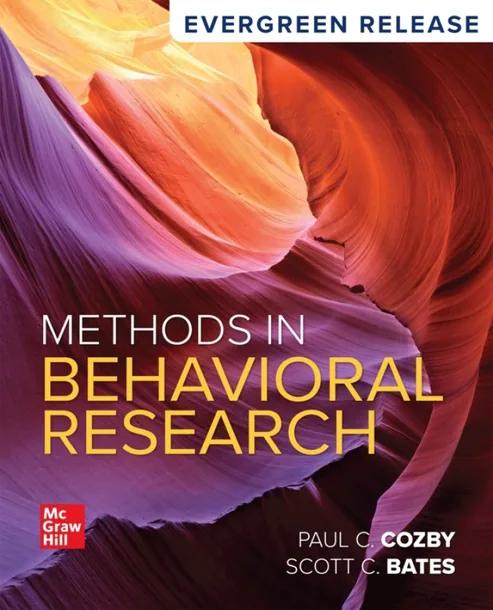
Methods in Behavioral Research
by Paul C. Cozby, Scott Bates
15th Edition
Publisher: McGraw-Hill Higher Education
Book Details
| Print ISBN | 9781260718904 |
| eText ISBN | 9781260883077 |
| Publisher | McGraw-Hill Higher Education |
| Publishing Year | 2024 |
| Edition | 15th Edition |
| Language | English |
| Pages | 512 |
In an era dominated by rapid information exchange and digital media, the ability to critically evaluate empirical evidence is more vital than ever. Methods in Behavioral Research 15th Edition serves as an essential guide for students navigating the complexities of psychological science and social inquiry. By demystifying the scientific method, this text empowers learners to transition from passive consumers of information to active, analytical thinkers. It provides a structured framework that helps students understand how research is conceptualized, executed, and applied to real-world issues, making it an indispensable resource for modern academic curricula. This foundational knowledge is crucial for anyone entering the fields of psychology, sociology, or education.
The scope of this work spans the entire lifecycle of behavioral investigation, beginning with the initial spark of inquiry and progressing through complex experimental designs. Paul C. Cozby and Scott Bates employ a highly accessible narrative style that balances rigorous scientific standards with practical, real-world examples. Readers are introduced to foundational concepts such as validity, measurement reliability, and observational techniques before diving into experimental and non-experimental methodologies. The authors emphasize the critical role of ethical standards, ensuring that students appreciate the moral responsibilities that accompany scientific discovery and human participant interaction. This comprehensive approach ensures that complex statistical and methodological concepts are easily digested.
Designed primarily for undergraduate courses in research methods, this text features a wealth of pedagogical tools, including active learning exercises and updated guidelines aligned with the latest APA standards. Instructors worldwide adopt Methods in Behavioral Research 15th Edition because of its clear organization, which mirrors the actual flow of a research project. For students seeking flexible digital access, utilizing the Methods in Behavioral Research 15th Edition PDF format enhances their study efficiency with interactive search capabilities and portable reading options. This edition continues to refine its focus on critical thinking, helping students master the analytical skills necessary for academic and professional success in an increasingly data-driven world.
Table of Contents
Chapter 1: Scientific Understanding of Behavior
- • Consuming Research
- • Ways of Knowing
- • Goals of Behavioral Science
- • Basic and Applied Research
Chapter 2: Where to Start
- • Research Questions, Hypotheses, and Predictions
- • Sources of Ideas
- • Types of Journal Articles
- • Exploring Past Research
Chapter 3: Ethics in Behavioral Research
- • Milgram's Obedience Experiment
- • Historical Context of Current Ethical Standards
- • APA Ethics Code
- • Assessment of Risks and Benefits
- • Informed Consent
- • The Importance of Debriefing
- • Institutional Review Boards
- • Research with Nonhuman Animal Subjects
- • Being an Ethical Researcher: The Issue of Misrepresentation
Chapter 4: Fundamental Research Issues
- • Validity: An Introduction
- • Variables
- • Operational Definitions of Variables
- • Relationships Between Variables
- • Nonexperimental Versus Experimental Methods
- • Experimental Methods: Additional Considerations
- • Evaluating Research: Summary of the Four Validities
Chapter 5: Measurement Concepts
- • Reliability of Measures
- • Construct Validity of Measures
- • Reactivity of Measures
- • Variables and Measurement Scales
Chapter 6: Observational Methods
- • Quantitative and Qualitative Approaches
- • Naturalistic Observation
- • Systematic Observation
- • Case Studies
- • Archival Research
Chapter 7: Asking People About Themselves: Survey Research
- • Why Conduct Surveys?
- • Constructing Questions to Ask
- • Responses to Questions
- • Finalizing the Survey Instrument
- • Administering Surveys
- • Survey Designs to Study Changes Over Time
- • Sampling From a Population
- • Sampling Techniques
- • Evaluating Samples
- • Reasons for Using Convenience Samples
Chapter 8: Experimental Design
- • Confounding and Internal Validity
- • Basic Experiments
- • Assigning Participants to Experimental Conditions
Chapter 9: Conducting Experiments
- • Selecting Research Participants
- • Manipulating the Independent Variable
- • Measuring the Dependent Variable
- • Additional Controls
- • Final Planning Considerations
- • Analyzing and Interpreting Results
- • Communicating Research to Others
Chapter 10: Complex Experimental Designs
- • Increasing the Number of Levels of an Independent Variable
- • Increasing the Number of Independent Variables: Factorial Designs
- • Outcomes of a 2 x 2 Factorial Design
- • Assignment Procedures and Factorial Designs
- • Factorial Designs with Three or More Independent Variables
Chapter 11: Single-Case, Quasi-Experimental, and Developmental Research
- • Single-Case Experimental Designs
- • Quasi-Experimental Designs
- • Developmental Research Designs
Chapter 12: Understanding Research Results: Description and Correlation
- • Scales of Measurement: A Review
- • Describing Results
- • Frequency Distributions
- • Descriptive Statistics
- • Graphing Relationships
- • Correlation Coefficients: Describing the Strength of Relationships
- • Effect Size
- • Regression Equations
- • Multiple Correlation/Regression
- • The Third-Variable Problem
- • Structural Equation Modeling
Chapter 13: Understanding Research Results: Statistical Inference
- • Samples and Populations
- • Inferential Statistics
- • Null and Research Hypotheses
- • Probability and Sampling Distributions
- • Group Differences: The t and F Tests
- • Type I and Type II Errors
- • Choosing a Significance Level
- • Interpreting Nonsignificant Results
- • Choosing a Sample Size: Power Analysis
- • The Importance of Replications
- • Significance of a Pearson r Correlation Coefficient
- • Statistical Analysis Software
- • Selecting the Appropriate Statistical Test
Chapter 14: Generalization
- • Generalizing to Other Populations
- • Generalizing Across Methods
- • Supporting Good External Validity
- • Using Research to Improve Lives
Customer Reviews
0.0
0 reviews
No reviews yet. Be the first to review this book!
Write a Review
Reviewed by GradeFocus
▶Research Sources (13)
- eBook - Methods in Behavioral Research 15e-9781260883077
- Methods in Behavioral Research 15th Edition Direct Textbook
- Methods In Behavioral Research by: Paul C. Cozby - RedShelf
- Methods in Behavioral Research [Rental Edition] - eCampus.com
- [REQUEST] Methods in Behavioral Research 15th Edition by Paul C ...
- Methods in Behavioral Research - ISBN 9781260883053
- Methods in Behavioral Research - Paul C. Cozby, Scott Bates
- Methods in Behavioral Research: Arizona State University
- [PDF] Methods in Behavioral Research - studentebookhub.com
- Methods in Behavioral Research Top Books - Print, and eBook
- [PDF] Methods In Behavioral Research
- Table of contents for Methods in behavioral research / Paul C. Cozby.
- Methods in Behavioral Research by Paul C. Cozby: 9781260205589