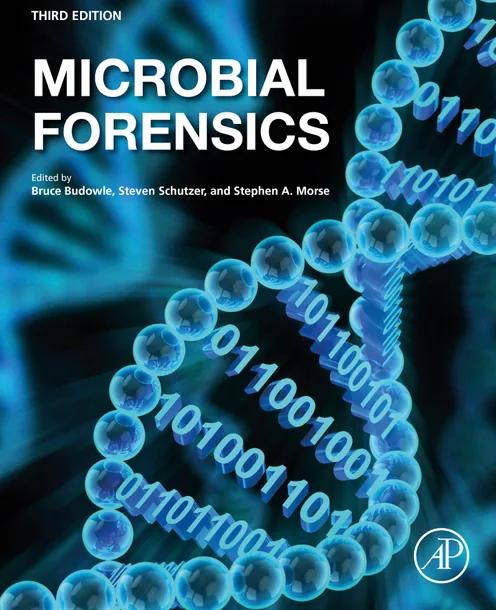
Microbial Forensics
by Bruce Budowle, Steven Schutzer, Stephen Morse
3rd Edition
Publisher: Academic Press
Book Details
| Print ISBN | 9780128153796 |
| eText ISBN | 9780128153802 |
| Publisher | Academic Press |
| Publishing Year | 2019 |
| Edition | 3rd Edition |
| Language | English |
| Pages | 526 |
Microbial Forensics, 3rd Edition, provides comprehensive reference coverage of the scientific investigations, analytical methods, and regulatory frameworks used to address biocrimes and bioterrorism. The volume explains how biological evidence is collected, characterized, and evaluated for investigative and legal proceedings.
Core areas of coverage include pathogen analysis across bacterial, viral, and fungal agents, as well as analytical testing for biological toxins such as ricin. The text also reviews microbiome-based applications, including human identification using skin genetic signatures and postmortem interval estimation.
Written primarily for forensic scientists, researchers, and laboratory practitioners, this reference also supports attorneys, law enforcement, intelligence personnel, and officials involved with Biological Weapons Treaties.
Table of Contents
Chapter 1: The Kameido anthrax incident: a microbial forensic case study
Chapter 2: The FBI’s Amerithrax Task Force and the advent of microbial forensics
Chapter 3: Microbial forensic investigation of the anthrax letter attacks: how the investigation would differ using today’s technologies
Chapter 4: Foodborne outbreaks
Chapter 5: Forensic plant pathology
Chapter 6: Microbial source tracking: characterization of human fecal pollution in environmental waters with HF183 quantitative real-time PCR
Chapter 7: Influenza forensics
Chapter 8: Forensic public health: epidemiological and microbiological investigations for biosecurity
Chapter 9: Forensic analysis in bacterial pathogens
Chapter 10: Genomic epidemiology and forensics of fungal pathogens
Chapter 11: Forensic human identification using skin microbiome genetic signatures
Chapter 12: Using microbiome tools for estimating the postmortem interval
Chapter 13: Select methods for microbial forensic nucleic acid analysis of trace and uncultivable specimens
Chapter 14: The use of host factors in microbial forensics
Chapter 15: Toxin analysis using mass spectrometry
Chapter 16: Ricin forensics: comparisons to microbial forensics
Chapter 17: Proteomics for bioforensics
Chapter 18: Rapid bacterial typing in the postgenomic era: developments in computational methods
Chapter 19: Genomics
Chapter 20: Design of genomic signatures for pathogen identification and characterization
Chapter 21: Collection and preservation of microbial forensic samples
Chapter 22: Assessment of the threat
Chapter 23: Scientific testimonial standards for microbial forensic evidence
Chapter 24: Inferential validation and evidence interpretation
Chapter 25: Microbial forensic investigations in the context of bacterial population genetics
Chapter 26: Use of microbial forensics data in scientific, legal, and policy contexts
Chapter 27: Lessons for expert witnesses
Chapter 28: Select agent regulations
Chapter 29: Biorepositories and their foundation
Chapter 30: The National Bioforensic Analysis Center
Chapter 31: An international microbial forensics research strategy and its collaborative pursuit is needed
Chapter 32: Education and training in microbial forensics
Chapter 33: Microbial forensics: what next?
Customer Reviews
0.0
0 reviews
No reviews yet. Be the first to review this book!
Write a Review
Reviewed by GradeFocus Editorial Team
▶Research Sources (1)
Related Books

Forensic Serology
Shanan S. Tobe
Human Skeletal Remains
Teresa A. White
Investigative and Predictive DNA Testing
Hirak Ranjan Dash

Mathematical Methods for Accident Reconstruction
Harold Franck
Forensic Science and Quality Management
Roberto C. Parra
Criminalistics: Forensic Science, Crime, and Terrorism
James E. Girard