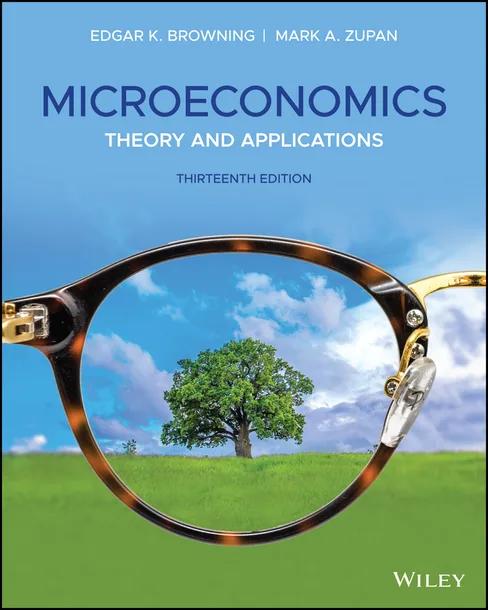
Microeconomics: Theory and Applications
by Edgar K. Browning, Mark A. Zupan
13th Edition
Publisher: Wiley
Book Details
| Print ISBN | 9781119368922 |
| eText ISBN | 9781119368953 |
| Publisher | Wiley |
| Publishing Year | 2020 |
| Edition | 13th Edition |
| Language | English |
| Pages | 592 |
Microeconomics: Theory and Applications, 13th Edition, by Edgar K. Browning and Mark A. Zupan, teaches analytical tools used to explain and predict market phenomena. Designed for economics and business students, the textbook establishes a solid foundation in microeconomic principles through theoretical models and real-world examples.
The volume covers core topics including supply and demand, consumer preferences, production costs, competitive and noncompetitive market structures, input markets, and externalities. It places special emphasis on factor markets, examining the pricing and employment of inputs alongside wages, rent, interest, and profit.
To encourage active learning, the text integrates theoretical principles with four chapters dedicated entirely to extended applications, complemented by over 100 shorter real-world applications that reinforce graphical and logical analysis.
Table of Contents
Chapter 1: An Introduction to Microeconomics
- • 1.1 The Scope of Microeconomic Theory
- • 1.2 The Nature and Role of Theory
- • 1.3 Positive versus Normative Analysis
- • 1.4 Market Analysis and Real versus Nominal Prices
- • 1.5 Basic Assumptions about Market Participants
- • 1.6 Opportunity Cost
- • 1.7 Production Possibility Frontier
Chapter 2: Supply and Demand
- • 2.1 Demand and Supply Curves
- • 2.2 Determination of Equilibrium Price and Quantity
- • 2.3 Adjustment to Changes in Demand or Supply
- • 2.4 Government Intervention in Markets: Price Controls
- • 2.5 Elasticities
Chapter 3: The Theory of Consumer Choice
- • 3.1 Consumer Preferences
- • 3.2 The Budget Constraint
- • 3.3 The Consumer’s Choice
- • 3.4 Changes in Income and Consumption Choices
- • 3.5 Are People Selfish?
- • 3.6 The Utility Approach to Consumer Choice
Chapter 4: Individual and Market Demand
- • 4.1 Price Changes and Consumption Choices
- • 4.2 Income and Substitution Effects of a Price Change
- • 4.3 Income and Substitution Effects: Inferior Goods
- • 4.4 From Individual to Market Demand
- • 4.5 Consumer Surplus
- • 4.6 Price Elasticity and the Price–Consumption Curve
- • 4.7 Network Effects
- • 4.8 The Basics of Demand Curve Estimation
Chapter 5: Using Consumer Choice Theory
- • 5.1 Excise Subsidies, Health Care, and Consumer Welfare
- • 5.2 Subsidizing Health Insurance: ObamaCare
- • 5.3 Public Schools and the Voucher Proposal
- • 5.4 Paying for Garbage
- • 5.5 The Consumer’s Choice to Save or Borrow
- • 5.6 Investor Choice
Chapter 6: Exchange, Efficiency, and Prices
- • 6.1 Two-Person Exchange
- • 6.2 Efficiency in the Distribution of Goods
- • 6.3 Competitive Equilibrium and Efficient Distribution
- • 6.4 Price and Nonprice Rationing and Efficiency
Chapter 7: Production
- • 7.1 Relating Output to Inputs
- • 7.2 Production When Only One Input is Variable: The Short Run
- • 7.3 Production When All Inputs are Variable: The Long Run
- • 7.4 Returns to Scale
- • 7.5 Functional Forms and Empirical Estimation of Production Functions
Chapter 8: The Cost of Production
- • 8.1 The Nature of Cost
- • 8.2 Short-Run Cost of Production
- • 8.3 Short-Run Cost Curves
- • 8.4 Long-Run Cost of Production
- • 8.5 Input Price Changes and Cost Curves
- • 8.6 Long-Run Cost Curves
- • 8.7 Learning by Doing
- • 8.8 Importance of Cost Curves to Market Structure
- • 8.9 Using Cost Curves: Controlling Pollution
- • 8.10 Economies of Scope
- • 8.11 Estimating Cost Functions
Chapter 9: Profit Maximization in Perfectly Competitive Markets
- • 9.1 The Assumptions of Perfect Competition
- • 9.2 Profit Maximization
- • 9.3 The Demand Curve for a Competitive Firm
- • 9.4 Short-Run Profit Maximization
- • 9.5 The Perfectly Competitive Firm’s Short-Run Supply Curve
- • 9.6 The Short-Run Industry Supply Curve
- • 9.7 Long-Run Competitive Equilibrium
- • 9.8 The Long-Run Industry Supply Curve
- • 9.9 When Does the Competitive Model Apply?
Chapter 10: Using the Competitive Model
- • 10.1 The Evaluation of Gains and Losses
- • 10.2 Excise Taxation
- • 10.3 Airline Regulation and Deregulation
- • 10.4 City Taxicab Markets
- • 10.5 Consumer and Producer Surplus, and the Net Gains from Trade
- • 10.6 Government Intervention in Markets: Quantity Controls
Chapter 11: Monopoly
- • 11.1 The Monopolist’s Demand and Marginal Revenue Curves
- • 11.2 Profit-Maximizing Output of a Monopoly
- • 11.3 Further Implications of Monopoly Analysis
- • 11.4 The Measurement and Sources of Monopoly Power
- • 11.5 The Efficiency Effects of Monopoly
- • 11.6 Public Policy toward Monopoly
Chapter 12: Product Pricing with Monopoly Power
- • 12.1 Price Discrimination
- • 12.2 Three Necessary Conditions for Price Discrimination
- • 12.3 Price and Output Determination with Price Discrimination
- • 12.4 Intertemporal Price Discrimination and Peak-Load Pricing
- • 12.5 Two-Part Tariffs
Chapter 13: Monopolistic Competition and Oligopoly
- • 13.1 Price and Output under Monopolistic Competition
- • 13.2 Oligopoly and the Cournot Model
- • 13.3 Other Oligopoly Models
- • 13.4 Cartels and Collusion
Chapter 14: Game Theory and the Economics of Information
- • 14.1 Game Theory
- • 14.2 The Prisoner’s Dilemma Game
- • 14.3 Repeated Games
- • 14.4 Asymmetric Information
- • 14.5 Adverse Selection and Moral Hazard
- • 14.6 Limited Price Information
- • 14.7 Advertising
Chapter 15: Using Noncompetitive Market Models
- • 15.1 The Size of the Deadweight Loss of Monopoly
- • 15.2 Do Monopolies Suppress Inventions?
- • 15.3 Natural Monopoly
- • 15.4 More on Game Theory: Iterated Dominance and Commitment
Chapter 16: Employment and Pricing of Inputs
- • 16.1 The Input Demand Curve of a Competitive Firm
- • 16.2 Industry and Market Demand Curves for an Input
- • 16.3 The Supply of Inputs
- • 16.4 Industry Determination of Price and Employment of Inputs
- • 16.5 Input Price Determination in a Multi-Industry Market
- • 16.6 Input Demand and Employment by an Output Market Monopoly
- • 16.7 Monopsony in Input Markets
Chapter 17: Wages, Rent, Interest, and Profit
- • 17.1 The Income–Leisure Choice of the Worker
- • 17.2 The Supply of Hours of Work
- • 17.3 The General Level of Wage Rates
- • 17.4 Why Wages Differ
- • 17.5 Economic Rent
- • 17.6 Monopoly Power in Input Markets: The Case of Unions
- • 17.7 Borrowing, Lending, and the Interest Rate
- • 17.8 Investment and the Marginal Productivity of Capital
- • 17.9 Saving, Investment, and the Interest Rate
- • 17.10 Why Interest Rates Differ
Chapter 18: Using Input Market Analysis
- • 18.1 The Minimum Wage
- • 18.2 Who Really Pays for Social Security?
- • 18.3 The Hidden Cost of Social Security
- • 18.4 The NCAA Cartel
- • 18.5 Discrimination in Employment
- • 18.6 The Benefits and Costs of Immigration
Chapter 19: General Equilibrium Analysis and Economic Efficiency
- • 19.1 Partial and General Equilibrium Analysis Compared
- • 19.2 Economic Efficiency
- • 19.3 Conditions for Economic Efficiency
- • 19.4 Efficiency in Production
- • 19.5 The Production Possibility Frontier and Efficiency in Output
- • 19.6 Competitive Markets and Economic Efficiency
- • 19.7 The Causes of Economic Inefficiency
Chapter 20: Public Goods and Externalities
- • 20.1 What are Public Goods?
- • 20.2 Efficiency in the Provision of a Public Good
- • 20.3 Externalities
- • 20.4 Externalities and Property Rights
- • 20.5 Controlling Pollution, Revisited
- • The Market for Los Angeles Smog
Customer Reviews
0.0
0 reviews
No reviews yet. Be the first to review this book!
Write a Review
Reviewed by GradeFocus Editorial Team