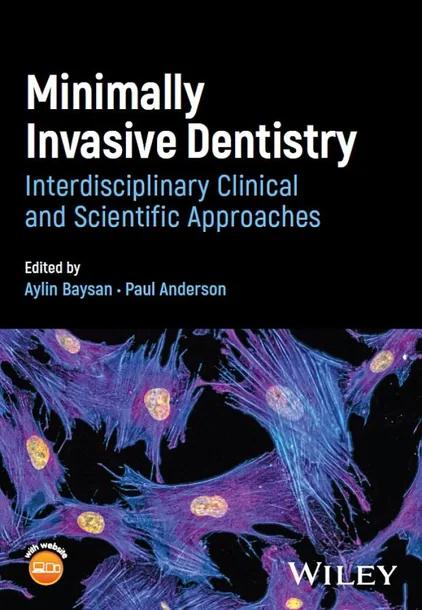
Minimally Invasive Dentistry
Interdisciplinary Clinical and Scientific Approaches
by Aylin Baysan, Paul Anderson
1st Edition
Publisher: Wiley-Blackwell
Book Details
| Print ISBN | 9781119215066 |
| eText ISBN | 9781119215011 |
| Publisher | Wiley-Blackwell |
| Publishing Year | 2025 |
| Edition | 1st Edition |
| Language | English |
| Pages | 208 |
Minimally Invasive Dentistry, 1st Edition, presents a practical introduction to holistic patient care across multiple dental specialties. The reference establishes how minimal intervention principles assist clinicians in preserving healthy biological tissue during treatment. Authors Aylin Baysan and Paul Anderson connect foundational scientific principles directly with patient-focused clinical delivery.
The text synthesizes key aspects of oral healthcare, covering dental disease risk assessments, early disease detection, and caries management. It highlights the protective role of saliva as a natural product alongside preventative strategies and patient health education. Chapters also introduce futuristic dental materials and techniques aimed at advancing biological preservation.
A companion website containing structured clinical case studies and interactive MCQs supports ongoing practice and knowledge verification. Designed for undergraduate dental students, postgraduate dental students, and active members of the clinical dental team, this volume offers a reliable reference for modern conservative dentistry.
Table of Contents
Chapter 1: Introduction to Minimally Invasive Dentistry: History of Minimally Invasive Dentistry and Key Concepts
- • Key Topics
- • Learning Objectives
- • Introduction
- • The Epidemiology of Dental Caries Worldwide
- • The Epidemiology of Periodontitis Worldwide
- • The Epidemiology of Tooth Wear
- • The Epidemiology of Tooth Loss
- • The Concept of Minimally Invasive Dentistry (MID)
- • Principles of Minimally Invasive Dentistry (MID) with Advantages and Disadvantages
- • The History of Minimally Invasive Dentistry (MID)
Chapter 2: Where Are We with the Evidence for Minimally Invasive Dentistry?
- • Key Topics
- • Learning Objectives
- • Introduction
- • Clinical Experiences and Patient Values
- • Evidence
- • Clinical Experience
- • Patients Values
- • The Evidence-based Approach
- • Asking Answerable Questions
- • Searching for the Best Evidence
- • Evidence-based Computerised Decision Support Systems
- • Evidence-based Guidelines
- • Systematic Reviews
- • Individual Studies
- • Critical Appraisal
- • Applying the Evidence
- • Evaluating the Outcome
- • High Quality Evidence in Relation to MID
- • Cochrane Reviews on the Effects of Minimal Intervention Approaches in Caries Management
- • The Main Findings/Conclusions from Each Review Were
- • Cochrane Reviews on the Effects of Other MID Approaches (Consequences of Dental Caries)
Chapter 3: Molecular Dentistry: Role of Salivary Proteins in Dental Hard Tissue Protection
- • Key Topics
- • Learning Objectives
- • Introduction
- • Protein Control of Enamel Formation
- • The Inorganic Chemistry of Dental Hard Tissue Mineral Loss
- • The Role of the Organic Proteins of Saliva in Enamel Mineral Preservation
- • Biomineralisation and Bio-demineralisation/remineralisation
- • The Potential Roles of Protein Engineered Salivas in Minimally Invasive Dentistry
- • Overall Conclusion
Chapter 4: Dental Caries Risk Assessment and Early Caries Detection
- • Key Topics
- • Learning Objectives
- • Introduction
- • What Is Caries Risk Assessment and Its Benefits?
- • The Components and Uses of Caries Risk Assessment Tools
- • The Caries Risk Likelihood Matrix
- • Identification of Factors Predictive of Risk
- • Caries Detection, Activity Assessment, Staging, and Diagnosis in Caries Risk Assessment
- • Visual Caries Detection
- • Detecting Early Lesions on Buccal, Lingual and Root Surfaces
- • Detecting Early Caries in Pits and Fissures on Tooth Surface
- • Detecting Lesions on Tooth Proximal Surfaces
- • Detecting Early Caries around Restorations
- • Assessing Caries Lesion Activity
- • Staging of the Caries Process
- • Radiographic Detection of Early Caries
- • Diagnosis of Dental Caries
- • Clinical Application of Caries Risk Assessment
Chapter 5: Management of Dental Caries: Minimally Invasive Dentistry vs. Conventional Strategies
- • Key Topics
- • Learning Objectives
- • Introduction
- • Clinical Challenges to Manage Dental Caries
- • Caries Risk Assessment and the Process
- • Disease Indicators
- • Biological and Environmental Risk Factors
- • Protective Factors
- • Determining the Caries Risk as Low, Moderate, High, or Extreme
- • Levels of Chemical Therapy Needed According to the Caries Risk Assessment
- • Low Caries Risk Chemical Therapy
- • Moderate Caries Risk Chemical Therapy
- • High Caries Risk Chemical Therapy
- • Extreme Caries Risk Chemical Therapy
- • Anticaries Agents and Delivery Systems
- • Bioactive Materials and the Future
- • When to Consider Conventional Treatment in High Risk Patients?
Chapter 6: Intraoral Vaccine and Their Potential Clinical Use
- • Key Topics
- • Learning Objectives
- • Introduction
- • A Brief History of Vaccination
- • Principals of Vaccination
- • Types of Vaccine Preparations
- • Immunisation
- • The Structure and Function of the Oral Cavity
- • Immune Responses in the Oral Cavity
- • Inflammation and the Immune Response: Defending the Barricades
- • Inductive and Effector Sites in the Oral Cavity
- • Mucosal Immunisation and Oral Tolerance
- • Oral Diseases and Vaccination
- • Dental Caries
- • Periodontal Disease
- • Behçet’s Disease (BD)
- • Sublingual and Buccal Vaccine Delivery
- • 'Biologics'-passive Immunotherapy with Monoclonal Antibodies
- • Cancer
Chapter 7: Can Minimally Invasive Strategies Be Applicable in Restorative Dentistry?
- • Key Topics
- • Learning Objectives
- • Introduction
- • Evolution of Minimally Invasive (MI) Strategies in Restorative Dentistry
- • mi Operative Management Strategies in Anterior and Posterior Dentition
- • mi Management of Early Carious Lesions
- • Fissure Sealants
- • Preventive Resin Restoration (PRR)
- • Resin Infiltration Technique
- • mi Restorations in Non-Carious Cervical Lesions
- • mi Management for Deep Carious Lesions
- • Remineralisation of Demineralised Dentine
- • Cavity Design and Principles for MID
- • Appropriate Excavation Methods
- • mi Restorations in Posterior Teeth
- • mi Restorations in The “Aesthetic Zone”
- • "No-Prep" Adhesive Restorations: Another Way to Deal with Problems Related to Aesthetics
- • Management of Tooth Discoloration with MI Approach
- • Tooth Whitening/Bleaching
- • Management of Tooth Wear with MI Approaches
- • Tooth Loss and MI Restorative Approaches
- • An Alternative Replacement Approach to Tooth Loss: Resin Bonded Bridges
- • Repair of Defective Restorations
Chapter 8: Dental Materials and Their Clinical Implications in Minimally Invasive Dentistry
- • Key Topics
- • Learning Objectives
- • Introduction
- • Glass Ionomer Cements and the Atraumatic Restorative Treatment (ART)
- • Bioactive Dental Composites
- • Cention N
- • Activa Bioactive
- • Bioactive Glass as Remineralizing Agent
- • Original Studies by Hench and Spilman on Incorporating Fluoride
- • New Fluoride- Containing Bioactive Glasses
- • Sol=Gel Fluoride- Containing Bioactive Glasses
- • Chloride- Containing Bioactive Glasses
- • Incorporating Bioactive Glasses into Resin Matrices
Chapter 9: Where Are We with a Minimally Invasive Approach in Periodontology?
- • Key Topics
- • Learning Objectives
- • Introduction
- • Changing Concepts: Dynamic Paradigm Shifts in Dentistry and in Periodontology
- • Non-surgical and Surgical Procedures in Periodontology
- • Non-surgical Procedures
- • Surgical Procedures in Minimally Invasive Periodontal Surgery (mips/mist)
- • Advantages of Minimally Invasive Periodontal Surgery
- • Disadvantages of Minimally Invasive Periodontal Surgery
- • Example of Applying the Principles of Minimal Invasive Periodontal Surgery in a Periodontal Practice
- • Relevant Medical and Dental History
- • Clinical Examination
- • Main Complaint
- • Surgical Procedure
- • Post-operative Instructions
- • Patient Outcomes
- • Post Script
- • Concluding Remarks
Chapter 10: Pulp and Endodonic Regeneration
- • Key Topics
- • Learning Objectives
- • Introduction
- • The Dentin-Pulp Complex
- • Dental Pulp Stem Cells and Regeneration of the Dentine-Pulp Complex
- • Vital Pulp Therapy
- • Regenerative Endodontics
Chapter 11: Minimally Invasive Dentistry in Paediatric Dentistry
- • Key Topics
- • Learning Objectives
- • Introduction
- • Differences between Primary and Permanent Teeth and How This Will Influence the MI Approach
- • Eruption and Exfoliation
- • Thinner Enamel and Dentine
- • Pulp Chamber and Canals
- • Dental Materials for Primary Teeth
- • Differences between Treating Children and Adults and How This Will Influence the MI Approach
- • Managing Behaviour
- • Health Promotion for Children
- • mi Therapies for Children
- • Silver Diamine Fluoride
- • Sealing in Caries
- • Atraumatic Restorative Technique
Chapter 12: Minimally Invasive Dentistry in Orthodontics
- • Key Topics
- • Learning Objectives
- • Introduction
- • New Technologies in Orthodontics (Diagnosis and Treatment Options)
- • How New Technologies in Orthodontics Help Achieving Minimally Invasive Orthodontics
- • Anchorage
- • Dentofacial Orthopedics
- • Accelerated Tooth Movement
- • Summary
- • References
Customer Reviews
0.0
0 reviews
No reviews yet. Be the first to review this book!
Write a Review
Reviewed by GradeFocus Editorial Team
▶Research Sources (12)
- Minimally Invasive Dentistry, eBook by Aylin Baysan
- Minimally Invasive Dentistry
- Minimally Invasive Dentistry
- Minimally Invasive Dentistry (ebook) | 9781119215011 | Boeken | bol
- Minimally Invasive Dentistry - Aylin Baysan (9781119215011)
- New Arrivals Archives
- Minimally invasive dentistry :: Universitäts
- Minimally Invasive Dentistry - Paperback [9781119215066]
- Minimally invasive dentistry approach in dental public health
- What is minimally invasive dentistry?
- Policy on Minimally Invasive Dentistry
- Minimally Invasive Esthetic Dentistry: "No Drill Techniques"