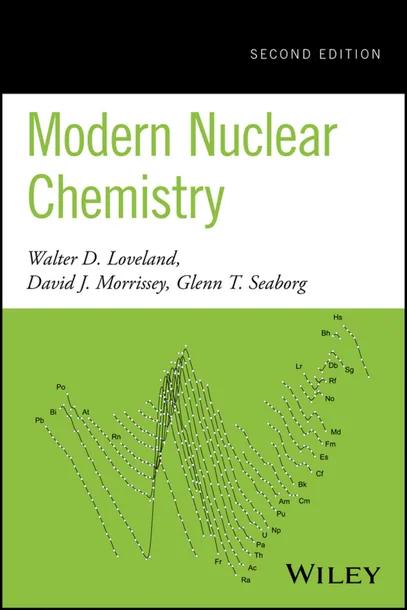
Modern Nuclear Chemistry
by Walter D. Loveland, David J. Morrissey, Glenn T. Seaborg
2nd Edition
Publisher: Wiley-Blackwell
Book Details
| Print ISBN | 9780470906736 |
| eText ISBN | 9781119328483 |
| Publisher | Wiley-Blackwell |
| Publishing Year | 2017 |
| Edition | 2nd Edition |
| Language | English |
| Pages | 800 |
Modern Nuclear Chemistry, 2nd Edition, is a textbook that presents fundamental scientific principles, current research trends, and practical applications of nuclear chemistry across the sciences and engineering. The volume addresses theoretical and practical dimensions of both nuclear chemistry and radiochemistry.
Foundational topics include nuclear properties, radioactive decay kinetics, nuclear structure, and nuclear reactions. The presentation explains essential physical principles in a succinct manner without requiring previous coursework in quantum mechanics.
This second edition introduces mathematical tools and simulations to demonstrate physical phenomena, alongside chapters examining nuclear medicine, nuclear forensics, and particle physics. Additional in-chapter sample problems with accompanying solutions are integrated throughout the text to assist students.
Table of Contents
Chapter 1: Introductory Concepts
- • 1.1 Introduction
- • 1.2 The Excitement and Relevance of Nuclear Chemistry
- • 1.3 The Atom
- • 1.4 Atomic Processes
- • 1.4.1 Ionization
- • 1.4.2 X-Ray Emission
- • 1.5 The Nucleus: Nomenclature
- • 1.6 Properties of the Nucleus
- • 1.7 Survey of Nuclear Decay Types
- • 1.8 Modern Physical Concepts Needed in Nuclear Chemistry
- • 1.8.1 Elementary Mechanics
- • 1.8.2 Relativistic Mechanics
- • 1.8.3 de Broglie Wavelength: Wave–Particle Duality
- • 1.8.4 Heisenberg Uncertainty Principle
- • 1.8.5 Units and Conversion Factors
- • Problems
- • Bibliography
Chapter 2: Nuclear Properties
- • 2.1 Nuclear Masses
- • 2.2 Terminology
- • 2.3 Binding Energy Per Nucleon
- • 2.4 Separation Energy Systematics
- • 2.5 Abundance Systematics
- • 2.6 Semiempirical Mass Equation
- • 2.7 Nuclear Sizes and Shapes
- • 2.8 Quantum Mechanical Properties
- • 2.8.1 Nuclear Angular Momentum
- • 2.9 Electric and Magnetic Moments
- • 2.9.1 Magnetic Dipole Moment
- • 2.9.2 Electric Quadrupole Moment
- • Problems
- • Bibliography
Chapter 3: Radioactive Decay Kinetics
- • 3.1 Basic Decay Equations
- • 3.2 Mixture of Two Independently Decaying Radionuclides
- • 3.3 Radioactive Decay Equilibrium
- • 3.4 Branching Decay
- • 3.5 Radiation Dosage
- • 3.6 Natural Radioactivity
- • 3.6.1 General Information
- • 3.6.2 Primordial Nuclei and the Uranium Decay Series
- • 3.6.3 Cosmogenic Nuclei
- • 3.6.4 Anthropogenic Nuclei
- • 3.6.5 Health Effects of Natural Radiation
- • 3.7 Radionuclide Dating
- • Problems
- • Bibliography
Chapter 4: Nuclear Medicine
- • 4.1 Introduction
- • 4.2 Radiopharmaceuticals
- • 4.3 Imaging
- • 4.4 99Tcm
- • 4.5 PET
- • 4.6 Other Imaging Techniques
- • 4.7 Some Random Observations about the Physics of Imaging
- • 4.8 Therapy
- • Problems
- • Bibliography
Chapter 5: Particle Physics and the Nuclear Force
- • 5.1 Particle Physics
- • 5.2 The Nuclear Force
- • 5.3 Characteristics of the Strong Force
- • 5.4 Charge Independence of Nuclear Forces
- • Problems
- • Bibliography
Chapter 6: Nuclear Structure
- • 6.1 Introduction
- • 6.2 Nuclear Potentials
- • 6.3 Schematic Shell Model
- • 6.4 Independent Particle Model
- • 6.5 Collective Model
- • 6.6 Nilsson Model
- • 6.7 Fermi Gas Model
- • Problems
- • Bibliography
Chapter 7: 𝛂-Decay
- • 7.1 Introduction
- • 7.2 Energetics of α Decay
- • 7.3 Theory of α Decay
- • 7.4 Hindrance Factors
- • 7.5 Heavy Particle Radioactivity
- • 7.6 Proton Radioactivity
- • Problems
- • Bibliography
Chapter 8: 𝛃-Decay
- • 8.1 Introduction
- • 8.2 Neutrino Hypothesis
- • 8.3 Derivation of the Spectral Shape
- • 8.4 Kurie Plots
- • 8.5 β Decay Rate Constant
- • 8.6 Electron Capture Decay
- • 8.7 Parity Nonconservation
- • 8.8 Neutrinos Again
- • 8.9 β-Delayed Radioactivities
- • 8.10 Double β Decay
- • Problems
- • Bibliography
Chapter 9: 𝛄-Ray Decay
- • 9.1 Introduction
- • 9.2 Energetics of γ-Ray Decay
- • 9.3 Classification of Decay Types
- • 9.4 Electromagnetic Transition Rates
- • 9.5 Internal Conversion
- • 9.6 Angular Correlations
- • 9.7 Mössbauer Effect
- • Problems
- • Bibliography
Chapter 10: Nuclear Reactions
- • 10.1 Introduction
- • 10.2 Energetics of Nuclear Reactions
- • 10.3 Reaction Types and Mechanisms
- • 10.4 Nuclear Reaction Cross Sections
- • 10.5 Reaction Observables
- • 10.6 Rutherford Scattering
- • 10.7 Elastic (Diffractive) Scattering
- • 10.8 Aside on the Optical Model
- • 10.9 Direct Reactions
- • 10.10 Compound Nuclear Reactions
- • 10.11 Photonuclear Reactions
- • 10.12 Heavy-Ion Reactions
- • 10.12.1 Coulomb Excitation
- • 10.12.2 Elastic Scattering
- • 10.12.3 Fusion Reactions
- • 10.12.4 Incomplete Fusion
- • 10.12.5 Deep-Inelastic Scattering
- • 10.13 High-Energy Nuclear Reactions
- • 10.13.1 Spallation/Fragmentation Reactions
- • 10.13.2 Reactions Induced by Radioactive Projectiles
- • 10.13.3 Multifragmentation
- • 10.13.4 Quark–Gluon Plasma
- • Problems
- • Bibliography
Chapter 11: Fission
- • 11.1 Introduction
- • 11.2 Probability of Fission
- • 11.2.1 Liquid Drop Model
- • 11.2.2 Shell Corrections
- • 11.2.3 Spontaneous Fission
- • 11.2.4 Spontaneously Fissioning Isomers
- • 11.2.5 The Transition Nucleus
- • 11.3 Dynamical Properties of Fission Fragments
- • 11.4 Fission Product Distributions
- • 11.4.1 Total Kinetic Energy (TKE) Release
- • 11.4.2 Fission Product Mass Distribution
- • 11.4.3 Fission Product Charge Distributions
- • 11.5 Excitation Energy of Fission Fragments
- • Problems
- • Bibliography
Chapter 12: Nuclear Astrophysics
- • 12.1 Introduction
- • 12.2 Elemental and Isotopic Abundances
- • 12.3 Primordial Nucleosynthesis
- • 12.3.1 Stellar Evolution
- • 12.4 Thermonuclear Reaction Rates
- • 12.5 Stellar Nucleosynthesis
- • 12.5.1 Introduction
- • 12.5.2 Hydrogen Burning
- • 12.5.3 Helium Burning
- • 12.5.4 Synthesis of Nuclei with A < 60
- • 12.5.5 Synthesis of Nuclei with A > 60
- • 12.6 Solar Neutrino Problem
- • 12.6.1 Introduction
- • 12.6.2 Expected Solar Neutrino Sources, Energies, and Fluxes
- • 12.6.3 Detection of Solar Neutrinos
- • 12.6.4 The Solar Neutrino Problem
- • 12.6.5 Solution to the Problem: Neutrino Oscillations
- • 12.7 Synthesis of Li, Be, and B
- • Problems
- • Bibliography
Chapter 13: Reactors and Accelerators
- • 13.1 Introduction
- • 13.2 Nuclear Reactors
- • 13.2.1 Neutron-Induced Reaction
- • 13.2.2 Neutron-Induced Fission
- • 13.2.3 Neutron Inventory
- • 13.2.4 Light Water Reactors
- • 13.2.5 The Oklo Phenomenon
- • 13.3 Neutron Sources
- • 13.4 Neutron Generators
- • 13.5 Accelerators
- • 13.5.1 Ion Sources
- • 13.5.2 Electrostatic Machines
- • 13.5.3 Linear Accelerators
- • 13.5.4 Cyclotrons, Synchrotrons, and Rings
- • 13.6 Charged-Particle Beam Transport and Analysis
- • 13.7 Radioactive Ion Beams
- • 13.8 Nuclear Weapons
- • Problems
- • Bibliography
Chapter 14: The Transuranium Elements
- • 14.1 Introduction
- • 14.2 Limits of Stability
- • 14.3 Element Synthesis
- • 14.4 History of Transuranium Element Discovery
- • 14.5 Superheavy Elements
- • 14.6 Chemistry of the Transuranium Elements
- • 14.7 Environmental Chemistry of the Transuranium Elements
- • Problems
- • Bibliography
Chapter 15: Nuclear Reactor Chemistry
- • 15.1 Introduction
- • 15.2 Fission Product Chemistry
- • 15.3 Radiochemistry of Uranium
- • 15.3.1 Uranium Isotopes
- • 15.3.2 Metallic Uranium
- • 15.3.3 Uranium Compounds
- • 15.3.4 Uranium Solution Chemistry
- • 15.4 The Nuclear Fuel Cycle: The Front End
- • 15.4.1 Mining and Milling
- • 15.4.2 Refining and Chemical Conversion
- • 15.4.3 Isotopic Enhancement
- • 15.4.4 Fuel Fabrication
- • 15.5 The Nuclear Fuel Cycle: The Back End
- • 15.5.1 Properties of Spent Fuel
- • 15.5.2 Fuel Reprocessing
- • 15.6 Radioactive Waste Disposal
- • 15.6.1 Classifications of Radioactive Waste
- • 15.6.2 Waste Amounts and Associated Hazards
- • 15.6.3 Storage and Disposal of Nuclear Waste
- • 15.6.4 Spent Nuclear Fuel
- • 15.6.5 HLW
- • 15.6.6 Transuranic Waste
- • 15.6.7 Low-Level Waste
- • 15.6.8 Mill Tailings
- • 15.6.9 Partitioning of Waste
- • 15.6.10 Transmutation of Waste
- • 15.7 Chemistry of Operating Reactors
- • 15.7.1 Radiation Chemistry of Coolants
- • 15.7.2 Corrosion
- • 15.7.3 Coolant Activities
- • Problems
- • Bibliography
Chapter 16: Interaction of Radiation with Matter
- • 16.1 Introduction
- • 16.2 Heavy Charged Particles
- • 16.2.1 Stopping Power
- • 16.2.2 Range
- • 16.3 Electrons
- • 16.4 Electromagnetic Radiation
- • 16.4.1 Photoelectric Effect
- • 16.4.2 Compton Scattering
- • 16.4.3 Pair Production
- • 16.5 Neutrons
- • 16.6 Radiation Exposure and Dosimetry
- • Problems
- • Bibliography
Chapter 17: Radiation Detectors
- • 17.1 Introduction
- • 17.1.1 Gas Ionization
- • 17.1.2 Ionization in a Solid (Semiconductor Detectors)
- • 17.1.3 Solid Scintillators
- • 17.1.4 Liquid Scintillators
- • 17.1.5 Nuclear Emulsions
- • 17.2 Detectors Based on Collecting Ionization
- • 17.2.1 Gas Ionization Detectors
- • 17.2.2 Semiconductor Detectors (Solid State Ionization Chambers)
- • 17.3 Scintillation Detectors
- • 17.4 Nuclear Track Detectors
- • 17.5 Neutron Detectors
- • 17.6 Nuclear Electronics and Data Collection
- • 17.7 Nuclear Statistics
- • 17.7.1 Distributions of Data and Uncertainty
- • 17.7.2 Rejection of Abnormal Data
- • 17.7.3 Setting Upper LimitsWhen No Counts Are Observed
- • Problems
- • Bibliography
Chapter 18: Nuclear Analytical Methods
- • 18.1 Introduction
- • 18.2 Activation Analysis
- • 18.2.1 Basic Description of the Method
- • 18.2.2 Advantages and Disadvantages of Activation Analysis
- • 18.2.3 Practical Considerations in Activation Analysis
- • 18.2.4 Applications of Activation Analysis
- • 18.3 PIXE
- • 18.4 Rutherford Backscattering
- • 18.5 Accelerator Mass Spectrometry (AMS)
- • 18.6 Other Mass Spectrometric Techniques
- • Problems
- • Bibliography
Chapter 19: Radiochemical Techniques
- • 19.1 Introduction
- • 19.2 Unique Aspects of Radiochemistry
- • 19.3 Availability of Radioactive Material
- • 19.4 Targetry
- • 19.5 Measuring Beam Intensity and Fluxes
- • 19.6 Recoils, Evaporation Residues, and Heavy Residues
- • 19.7 Radiochemical Separation Techniques
- • 19.7.1 Precipitation
- • 19.7.2 Solvent Extraction
- • 19.7.3 Ion Exchange
- • 19.7.4 Extraction Chromatography
- • 19.7.5 Rapid Radiochemical Separations
- • 19.8 Low-Level Measurement Techniques
- • 19.8.1 Blanks
- • 19.8.2 Low-Level Counting: General Principles
- • 19.8.3 Low-Level Counting: Details
- • 19.8.4 Limits of Detection
- • Problems
- • Bibliography
Chapter 20: Nuclear Forensics
- • 20.1 Introduction
- • 20.1.1 Basic Principles of Forensic Analysis
- • 20.2 Chronometry
- • 20.3 Nuclear Weapons and Their Debris
- • 20.3.1 RDD or Dirty Bombs
- • 20.3.2 Nuclear Explosions
- • 20.4 Deducing Sources and Routes of Transmission
- • Problems
- • Bibliography
Chapter Appendix A: Fundamental Constants and Conversion Factors
Chapter Appendix B: NuclearWallet Cards
Chapter Appendix C: Periodic Table of the Elements
Chapter Appendix D: Alphabetical List of the Elements
Chapter Appendix E: Elements of Quantum Mechanics
Customer Reviews
0.0
0 reviews
No reviews yet. Be the first to review this book!
Write a Review
Reviewed by GradeFocus Editorial Team