Book Details
| Print ISBN | 9781119495550 |
| eText ISBN | 9781119495468 |
| Publisher | Wiley |
| Publishing Year | 2019 |
| Edition | 4th Edition |
| Language | English |
| Pages | 592 |
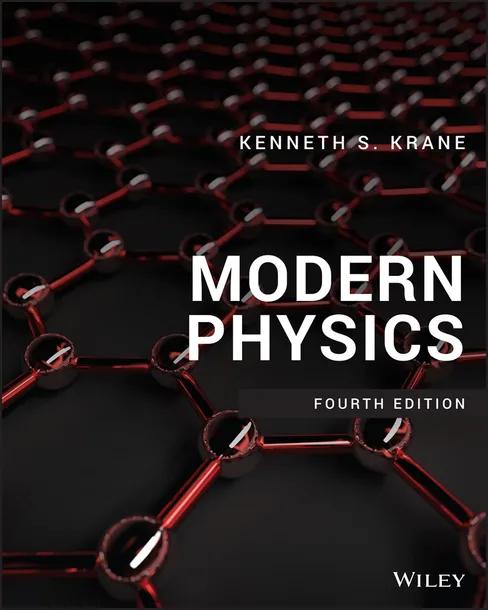
Modern Physics, 4th Edition, is an undergraduate textbook that introduces the fundamental concepts and experimental methods of modern physics. Published by Wiley, the volume explores major theoretical developments by presenting key principles from a historical perspective before analyzing them through contemporary experimental evidence.
Coverage focuses on central subjects including relativity, quantum phenomena, and statistical physics, while also investigating nuclear processes and the origin of the universe. Discussions emphasize the interrelationship between physical principles and the experiments that substantiate them.
Designed for second-year undergraduates studying science and engineering, the text features clearly defined learning objectives delivered at an accessible pace. Worked examples and exercises reinforce conceptual understanding and support practical problem-solving.
Table of Contents
Chapter 1: Some Deficiencies of Classical Physics
- • 1.1 Review of Classical Physics
- • 1.2 Deficiencies in Classical Concepts of Space and Time
- • 1.3 Deficiencies in the Classical Theory of Particle Statistics
- • 1.4 Theory, Experiment, Law
- • Questions
- • Problems
Chapter 2: The Special Theory of Relativity
- • 2.1 Classical Relativity
- • 2.2 The Michelson–Morley Experiment
- • 2.3 Einstein’s Postulates
- • 2.4 Consequences of Einstein’s Postulates
- • 2.5 The Lorentz Transformation
- • 2.6 The Twin Paradox
- • 2.7 Relativistic Dynamics
- • 2.8 Conservation Laws in Relativistic Decays and Collisions
- • 2.9 Experimental Tests of Special Relativity
- • Questions
- • Problems
Chapter 3: The Particle-Like Properties of Electromagnetic Radiation
- • 3.1 Review of Electromagnetic Waves
- • 3.2 The Photoelectric Effect
- • 3.3 Thermal Radiation
- • 3.4 The Compton Effect
- • 3.5 Other Photon Processes
- • 3.6 Particles or Waves
- • Questions
- • Problems
Chapter 4: The Wavelike Properties of Particles
- • 4.1 De Broglie’s Hypothesis
- • 4.2 Experimental Evidence for De Broglie Waves
- • 4.3 Uncertainty Relationships for Classical Waves
- • 4.4 Heisenberg Uncertainty Relationships
- • 4.5 Wave Packets
- • 4.6 The Motion of a Wave Packet
- • 4.7 Probability and Randomness
- • Questions
- • Problems
Chapter 5: The Schrödinger Equation
- • 5.1 Behavior of a Wave at a Boundary
- • 5.2 Confining a Particle
- • 5.3 The Schrödinger Equation
- • 5.4 Applications of the Schrödinger Equation
- • 5.5 The Simple Harmonic Oscillator
- • 5.6 Steps and Barriers
- • Questions
- • Problems
Chapter 6: The Rutherford-Bohr Model of the Atom
- • 6.1 Basic Properties of Atoms
- • 6.2 Scattering Experiments and the Thomson Model
- • 6.3 The Rutherford Nuclear Atom
- • 6.4 Line Spectra
- • 6.5 The Bohr Model
- • 6.6 The Franck-Hertz Experiment
- • 6.7 The Correspondence Principle
- • 6.8 Deficiencies of the Bohr Model
- • Questions
- • Problems
Chapter 7: The Hydrogen Atom in Wave Mechanics
- • 7.1 A One-Dimensional Atom
- • 7.2 Angular Momentum in the Hydrogen Atom
- • 7.3 The Hydrogen Atom Wave Functions
- • 7.4 Radial Probability Densities
- • 7.5 Angular Probability Densities
- • 7.6 Intrinsic Spin
- • 7.7 Energy Levels and Spectroscopic Notation
- • 7.8 The Zeeman Effect
- • 7.9 Fine Structure
- • Questions
- • Problems
Chapter 8: Many-Electron Atoms
- • 8.1 The Pauli Exclusion Principle
- • 8.2 Electronic States in Many-Electron Atoms
- • 8.3 Outer Electrons: Screening and Optical Transitions
- • 8.4 Properties of the Elements
- • 8.5 Inner Electrons: Absorption Edges and X Rays
- • 8.6 Addition of Angular Momenta
- • 8.7 Lasers
- • Questions
- • Problems
Chapter 9: Molecular Structure
- • 9.1 The Hydrogen Molecule
- • 9.2 Covalent Bonding in Molecules
- • 9.3 Ionic Bonding
- • 9.4 Molecular Vibrations
- • 9.5 Molecular Rotations
- • 9.6 Molecular Spectra
- • Questions
- • Problems
Chapter 10: Statistical Physics
- • 10.1 Statistical Analysis
- • 10.2 Classical and Quantum Statistics
- • 10.3 The Density of States
- • 10.4 The Maxwell–Boltzmann Distribution
- • 10.5 Quantum Statistics
- • 10.6 Applications of Bose–Einstein Statistics
- • 10.7 Applications of Fermi–Dirac Statistics
- • Questions
- • Problems
Chapter 11: Solid-State Physics
- • 11.1 Crystal Structures
- • 11.2 The Heat Capacity of Solids
- • 11.3 Electrons in Metals
- • 11.4 Band Theory of Solids
- • 11.5 Superconductivity
- • 11.6 Intrinsic and Impurity Semiconductors
- • 11.7 Semiconductor Devices
- • 11.8 Magnetic Materials
- • Questions
- • Problems
Chapter 12: Nuclear Structure and Radioactivity
- • 12.1 Nuclear Constituents
- • 12.2 Nuclear Sizes and Shapes
- • 12.3 Nuclear Masses and Binding Energies
- • 12.4 The Nuclear Force
- • 12.5 Quantum States in Nuclei
- • 12.6 Radioactive Decay
- • 12.7 Alpha Decay
- • 12.8 Beta Decay
- • 12.9 Gamma Decay and Nuclear Excited States
- • 12.10 Natural Radioactivity
- • Questions
- • Problems
Chapter 13: Nuclear Reactions and Applications
- • 13.1 Types of Nuclear Reactions
- • 13.2 Radioisotope Production in Nuclear Reactions
- • 13.3 Low-Energy Reaction Kinematics
- • 13.4 Fission
- • 13.5 Fusion
- • 13.6 Nucleosynthesis
- • 13.7 Applications of Nuclear Physics
- • Questions
- • Problems
Chapter 14: Elementary Particles
- • 14.1 The Four Basic Forces
- • 14.2 Classifying Particles
- • 14.3 Conservation Laws
- • 14.4 Particle Interactions and Decays
- • 14.5 Energy and Momentum in Particle Decays
- • 14.6 Energy and Momentum in Particle Reactions
- • 14.7 The Quark Structure of Mesons and Baryons
- • 14.8 The Standard Model
- • Questions
- • Problems
Chapter 15: Cosmology: The Origin and Fate of the Universe
- • 15.1 The Expansion of the Universe
- • 15.2 The Cosmic Microwave Background Radiation
- • 15.3 Dark Matter
- • 15.4 The General Theory of Relativity
- • 15.5 Tests of General Relativity
- • 15.6 Stellar Evolution and Black Holes
- • 15.7 Cosmology and General Relativity
- • 15.8 The Big Bang Cosmology
- • 15.9 The Formation of Nuclei and Atoms
- • 15.10 Experimental Cosmology
- • Questions
- • Problems
Chapter Appendix A: Constants and Conversion Factors
Chapter Appendix B: Complex Numbers
Chapter Appendix C: Periodic Table of the Elements
Chapter Appendix D: Table of Atomic Masses
Chapter Appendix E: Some Milestones in the History of Modern Physics
Customer Reviews
0.0
0 reviews
No reviews yet. Be the first to review this book!
Write a Review
Reviewed by GradeFocus Editorial Team