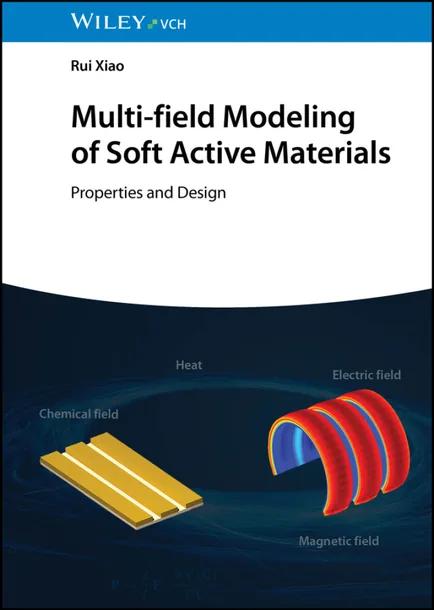
Multi-field Modeling of Soft Active Materials
Properties and Design
by Rui Xiao
1st Edition
Publisher: Wiley-VCH
Book Details
| Print ISBN | 9783527354689 |
| eText ISBN | 9783527850389 |
| Publisher | Wiley-VCH |
| Publishing Year | 2026 |
| Edition | 1st Edition |
| Language | English |
| Pages | 176 |
Multi-field Modeling of Soft Active Materials, 1st Edition, presents structured approaches for describing coupled physical behaviors in responsive media. Designed for graduate students and researchers in solid mechanics, the text establishes theoretical foundations for predicting how soft materials react under external fields.
The content covers several distinct material systems, specifically shape-memory polymers, liquid crystal elastomers, dielectric elastomers, magnetic elastomers, and hydrogels. Across these material classes, the discussion focuses on stimulus-response behaviors and theoretical descriptions of multi-field activation.
As a primary practical feature, the text supplies complete implementation procedures for finite element analysis. This material assists graduate students and polymer physics researchers who require clear computational methods alongside continuum formulations.
Table of Contents
Chapter 1: Basics of Continuum Mechanics
- • 1.1 Vectors and Tensors
- • 1.1.1 Vector
- • 1.1.2 Index Notation
- • 1.1.3 Tensor
- • 1.1.4 Gradient, Divergence, and Curl
- • 1.2 Kinematics
- • 1.2.1 Deformation Gradient
- • 1.2.2 Strain Tensor
- • 1.3 Stress
- • 1.4 Balance Principles
- • 1.4.1 Material Derivative and Spatial Derivative
- • 1.4.2 Reynolds Transport Theorem
- • 1.4.3 Conservation of Mass
- • 1.4.4 Balance of Momentum
- • 1.4.5 Balance of Angular Momentum
- • 1.4.6 Balance of Mechanical Energy
- • 1.4.7 Balance of Energy
- • 1.4.8 Entropy Inequality
- • References
Chapter 2: Hyperelastic, Viscoelastic, and Damage Models
- • 2.1 Introduction
- • 2.2 Hyperelastic Models
- • 2.2.1 Constitutive Equations of Hyperelastic Materials
- • 2.2.2 Hyperelastic Models
- • 2.2.3 Results
- • 2.3 Viscoelastic Models
- • 2.3.1 One-dimensional Small Strain Viscoelastic Models
- • 2.3.2 Finite Deformation Viscoelastic Models
- • 2.3.3 Results
- • 2.3.4 Finite Element Simulation
- • 2.4 Damage Models
- • 2.4.1 Continuum Damage Model
- • 2.4.2 Network Alteration Theory
- • 2.4.3 Progressively Damage Model
- • 2.4.4 Extended Network Alteration Theory
- • 2.4.5 Extended Progressively Damage Model
- • 2.4.6 Results
- • 2.5 Conclusion
- • References
Chapter 3: A Thermomechanical Coupled Model for Amorphous Shape-memory Polymers
- • 3.1 Introduction
- • 3.2 Thermodynamics
- • 3.2.1 Kinematics
- • 3.2.2 Thermodynamic Framework
- • 3.2.3 Constitutive Relationships
- • 3.2.4 A Reduced Version of the Constitutive Model
- • 3.3 Parameter Determination
- • 3.4 Results
- • 3.4.1 Performance of the Viscoelastic Model
- • 3.4.2 Performance of the Effective Temperature Model
- • 3.5 Discussion
- • 3.6 Conclusion
- • References
Chapter 4: An Electromechanical Coupled Model for Dielectric Elastomers
- • 4.1 Introduction
- • 4.2 Theory
- • 4.2.1 Thermodynamic Framework
- • 4.2.2 An Electro-hyperelastic Model
- • 4.2.3 An Electro-hyper-viscoelastic Model
- • 4.2.4 Electromechanical Instability of Dielectric Elastomers
- • 4.3 Finite Element Implementation
- • 4.3.1 Constitutive Relation
- • 4.3.2 Weak Forms
- • 4.4 Conclusion
- • References
Chapter 5: A Magnetomechanical Coupled Model for Magnetoactive Soft Materials
- • 5.1 Introduction
- • 5.2 A Magnetomechanical Coupled Model for h-MREs
- • 5.2.1 Kinematics
- • 5.2.2 F-based Model
- • 5.2.3 R-based Model
- • 5.2.4 Comparing R-based and F-based Models
- • 5.3 Magnetic Activated Shape-memory Polymers
- • 5.3.1 Constitutive Theory
- • 5.3.2 Parameter Determination
- • 5.3.3 Simulation Results
- • 5.4 Conclusion
- • Appendix
- • References
Chapter 6: Multi-field Modeling of Liquid Crystal Elastomers
- • 6.1 Introduction
- • 6.2 General Theory for Liquid Crystal Elastomers
- • 6.2.1 Liquid Crystal
- • 6.2.2 Nematic Polymers
- • 6.2.3 Neoclassical Model
- • 6.3 Thermomechanical Coupled Model for Monodomain Liquid Crystal Elastomers
- • 6.4 A Viscoelastic Micropolar Theory for Monodomain Liquid Crystal Elastomers
- • 6.4.1 Kinematics
- • 6.4.2 Balance of Linear and Angular Momentum
- • 6.4.3 Balance of Energy and the Second Law of Thermodynamics
- • 6.4.4 Constitutive Equations
- • 6.4.5 Simplification for the Non-gradient Case
- • 6.4.6 Free Energy Density
- • 6.5 Theory for Polydomain Liquid Crystal Elastomers
- • 6.6 Conclusion
- • References
Chapter 7: A Chemomechanical Model for Hydrogels
- • 7.1 Introduction
- • 7.2 Thermodynamics
- • 7.3 Constitutive Relations
- • 7.3.1 Neutral Gels
- • 7.3.2 Fiber-reinforced Gels
- • 7.3.3 Diffusion in Glassy Elastomers
- • 7.3.4 Numerical Method
- • 7.4 Results
- • 7.4.1 Neutral Gels and Fiber-reinforced Gels
- • 7.4.2 Diffusion in Glassy Polymers
- • 7.5 Conclusion
- • References
Customer Reviews
0.0
0 reviews
No reviews yet. Be the first to review this book!
Write a Review
Reviewed by GradeFocus Editorial Team
▶Research Sources (8)
- Multi-field Modeling of Soft Active Materials, Properties and Design
- Multi-field Modeling of Soft Active Materials - Rui Xiao
- Start reading Multi-field Modeling of Soft Active Materials for free
- Multi-field modeling of soft active materials : properties and design ...
- Sourcebooks, LLC.
- Untitled
- Multi-field Modeling of Soft Active Materials - Rui Xiao - Perlego
- Multi-field Modeling of Soft Active Materials - Rui Xiao - Booktopia
Related Books

Elastomer-Based Composites and Nanocomposites
Hamid Essabir

Piezoelectric Materials
Christopher R. Bowen

Functionalized Biopolymers
Swati Sharma

Inorganic Biomaterials for Drug Delivery
Amit Kumar Nayak

Hydrogels for Wound Healing
Sabu Thomas

Nanobiomaterials and Nanomedicines for Metabolic Disorders
Subhash C. Mandal