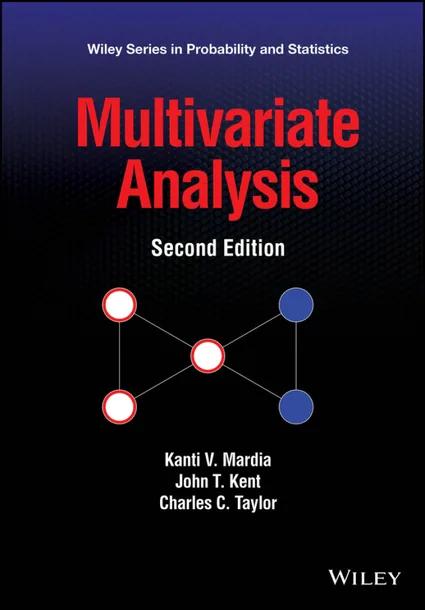
Multivariate Analysis
by Kanti V. Mardia, John T. Kent, Charles C. Taylor
2nd Edition
Publisher: Wiley
Book Details
| Print ISBN | 9781118738023 |
| eText ISBN | 9781118892510 |
| Publisher | Wiley |
| Publishing Year | 2024 |
| Edition | 2nd Edition |
| Language | English |
| Pages | 592 |
Multivariate Analysis, 2nd Edition is a statistical textbook designed to present theoretical concepts and quantitative methodology for analyzing multi-variable datasets. The volume provides a mathematical framework for structural statistical inference and complex data evaluation.
The theoretical exposition opens with basic properties of random vectors, copulas, and normal distribution theory. It expands into statistical inference, covering parameter estimation routines, hypothesis testing, multivariate regression models, and multivariate analysis of variance. The content further explores classical methods for pattern recognition and structural data representation, detailed through principal component analysis, factor analysis, and canonical correlation analysis.
To reinforce procedural skill and conceptual understanding, the authors include detailed worked examples and structured exercises at the end of each chapter. This structure provides theoretical reference material and problem-solving practice for applied scientists and active research workers across scientific disciplines.
Table of Contents
Chapter 1: Introduction
- • 1.1 Objects and Variables
- • 1.2 Some Multivariate Problems and Techniques
- • 1.3 The Data Matrix
- • 1.4 Summary Statistics
- • 1.5 Linear Combinations
- • 1.6 Geometrical Ideas
- • 1.7 Graphical Representation
- • 1.8 Measures of Multivariate Skewness and Kurtosis
- • Exercises and Complements
Chapter 2: Basic Properties of Random Vectors
- • Introduction
- • 2.1 Cumulative Distribution Functions and Probability Density Functions
- • 2.2 Population Moments
- • 2.3 Characteristic Functions
- • 2.4 Transformations
- • 2.5 The Multivariate Normal Distribution
- • 2.6 Random Samples
- • 2.7 Limit Theorems
- • Exercises and Complements
Chapter 3: Nonnormal Distributions
- • 3.1 Introduction
- • 3.2 Some Multivariate Generalizations of Univariate Distributions
- • 3.3 Families of Distributions
- • 3.4 Insights into Skewness and Kurtosis
- • 3.5 Copulas
- • Exercises and Complements
Chapter 4: Normal Distribution Theory
- • 4.1 Introduction and Characterization
- • 4.2 Linear Forms
- • 4.3 Transformations of Normal Data Matrices
- • 4.4 The Wishart Distribution
- • 4.5 The Hotelling T2 Distribution
- • 4.6 Mahalanobis Distance
- • 4.7 Statistics Based on the Wishart Distribution
- • 4.8 Other Distributions Related to the Multivariate Normal
- • Exercises and Complements
Chapter 5: Estimation
- • Introduction
- • 5.1 Likelihood and Sufficiency
- • 5.2 Maximum-likelihood Estimation
- • 5.3 Robust Estimation of Location and Dispersion for Multivariate Distributions
- • 5.4 Bayesian Inference
- • Exercises and Complements
Chapter 6: Hypothesis Testing
- • 6.1 Introduction
- • 6.2 The Techniques Introduced
- • 6.3 The Techniques Further Illustrated
- • 6.4 Simultaneous Confidence Intervals
- • 6.5 The Behrens–Fisher Problem
- • 6.6 Multivariate Hypothesis Testing: Some General Points
- • 6.7 Nonnormal Data
- • 6.8 Mardia’s Nonparametric Test for the Bivariate Two-sample Problem
- • Exercises and Complements
Chapter 7: Multivariate Regression Analysis
- • 7.1 Introduction
- • 7.2 Maximum-likelihood Estimation
- • 7.3 The General Linear Hypothesis
- • 7.4 Design Matrices of Degenerate Rank
- • 7.5 Multiple Correlation
- • 7.6 Least-squares Estimation
- • 7.7 Discarding of Variables
- • Exercises and Complements
Chapter 8: Graphical Models
- • 8.1 Introduction
- • 8.2 Graphs and Conditional Independence
- • 8.3 Gaussian Graphical Models
- • 8.4 Log-linear Graphical Models
- • 8.5 Directed and Mixed Graphs
- • Exercises and Complements
Chapter 9: Principal Component Analysis
- • 9.1 Introduction
- • 9.2 Definition and Properties of Principal Components
- • 9.3 Sampling Properties of Principal Components
- • 9.4 Testing Hypotheses About Principal Components
- • 9.5 Correspondence Analysis
- • 9.6 Allometry – Measurement of Size and Shape
- • 9.7 Discarding of Variables
- • 9.8 Principal Component Regression
- • 9.9 Projection Pursuit and Independent Component Analysis
- • 9.10 PCA in High Dimensions
- • Exercises and Complements
Chapter 10: Factor Analysis
- • 10.1 Introduction
- • 10.2 The Factor Model
- • 10.3 Principal Factor Analysis
- • 10.4 Maximum-likelihood Factor Analysis
- • 10.5 Goodness-of-fit Test
- • 10.6 Rotation of Factors
- • 10.7 Factor Scores
- • 10.8 Relationships Between Factor Analysis and Principal Component Analysis
- • 10.9 Analysis of Covariance Structures
- • Exercises and Complements
Chapter 11: Canonical Correlation Analysis
- • 11.1 Introduction
- • 11.2 Mathematical Development
- • 11.3 Qualitative Data and Dummy Variables
- • 11.4 Qualitative and Quantitative Data
- • Exercises and Complements
Chapter 12: Discriminant Analysis and Statistical Learning
- • 12.1 Introduction
- • 12.2 Bayes’ Discriminant Rule
- • 12.3 The Error Rate
- • 12.4 Discrimination Using the Normal Distribution
- • 12.5 Discarding of Variables
- • 12.6 Fisher’s Linear Discriminant Function
- • 12.7 Nonparametric Distance-based Methods
- • 12.8 Classification Trees
- • 12.9 Logistic Discrimination
- • 12.10 Neural Networks
- • Exercises and Complements
Chapter 13: Multivariate Analysis of Variance
- • 13.1 Introduction
- • 13.2 Formulation of Multivariate One-way Classification
- • 13.3 The Likelihood Ratio Principle
- • 13.4 Testing Fixed Contrasts
- • 13.5 Canonical Variables and A Test of Dimensionality
- • 13.6 The Union Intersection Approach
- • 13.7 Two-way Classification
- • Exercises and Complements
Chapter 14: Cluster Analysis and Unsupervised Learning
- • 14.1 Introduction
- • 14.2 Probabilistic Membership Models
- • 14.3 Parametric Mixture Models
- • 14.4 Partitioning Methods
- • 14.5 Hierarchical Methods
- • 14.6 Distances and Similarities
- • 14.7 Grouped Data
- • 14.8 Mode Seeking
- • 14.9 Measures of Agreement
- • Exercises and Complements
Chapter 15: Multidimensional Scaling
- • 15.1 Introduction
- • 15.2 Classical Solution
- • 15.3 Duality Between Principal Coordinate Analysis and Principal Component Analysis
- • 15.4 Optimal Properties of the Classical Solution and Goodness of Fit
- • 15.5 Seriation
- • 15.6 Nonmetric Methods
- • 15.7 Goodness of Fit Measure: Procrustes Rotation
- • 15.8 Multisample Problem and Canonical Variates
- • Exercises and Complements
Chapter 16: High-dimensional Data
- • 16.1 Introduction
- • 16.2 Shrinkage Methods in Regression
- • 16.3 Principal Component Regression
- • 16.4 Partial Least Squares Regression
- • 16.5 Functional Data
- • Exercises and Complements
Chapter A: Matrix Algebra
- • A.1 Introduction
- • A.2 Matrix Operations
- • A.3 Further Particular Matrices and Types of Matrices
- • A.4 Vector Spaces, Rank, and Linear Equations
- • A.5 Linear Transformations
- • A.6 Eigenvalues and Eigenvectors
- • A.7 Quadratic Forms and Definiteness
- • A.8 Generalized Inverse
- • A.9 Matrix Differentiation and Maximization Problems
- • A.10 Geometrical Ideas
Chapter B: Univariate Statistics
- • B.1 Introduction
- • B.2 Normal Distribution
- • B.3 Chi-squared Distribution
- • B.4 F and Beta Variables
- • B.5 t Distribution
- • B.6 Poisson Distribution
Chapter C: R commands and Data
- • C.1 Basic R Commands Related to Matrices
- • C.2 R Libraries and Commands Used in Exercises and Figures
- • C.3 Data Availability
Chapter D: Tables
Customer Reviews
0.0
0 reviews
No reviews yet. Be the first to review this book!
Write a Review
Reviewed by GradeFocus Editorial Team
▶Research Sources (15)
- eBook Details | Alabama Aviation College Bookstore
- Multivariate Analysis, eBook by Kanti V. Mardia
- Suchergebnis Auf Amazon.de Für: 9781118892510: Kindle-Shop
- Multivariate Analysis - Kanti V. Mardia, John T. Kent, Charles C. ...
- Multivariate Analysis - Kanti V. Mardia, John T. Kent, Charles C. ...
- Multivariate Analysis - C. Taylor, Charles - T. Kent, John
- Resources
- Please verify you are human - Captcha
- Multivariate Analysis
- Multivariate Analysis, 2nd Edition
- Multivariate Analysis - Oxford Academic
- Multivariate Analysis - Hardcover [9781118738023]
- Multivariate Analysis, 2nd Edition by John T. Kent
- Book recommendations for multivariate analysis
- Multivariate data analysis - Drexel Research Discovery
Related Books
The Basic Practice of Statistics
David S. Moore
Mathematical Statistics with Applications
Dennis Wackerly
Probability and Statistical Inference
Robert V. Hogg
Essentials of Statistics for the Behavioral Sciences
Frederick J Gravetter

The Practice of Statistics for the AP® Course
Daren Starnes
The Practice of Statistics for the AP® Course
Daren Starnes