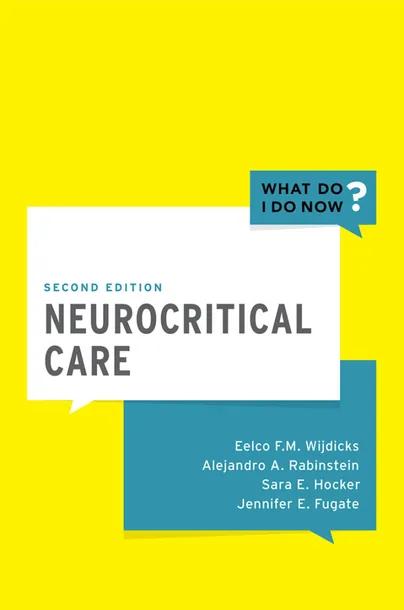
Neurocritical Care
by Eelco FM Wijdicks, Alejandro A. Rabinstein, Sara E. Hocker
2nd Edition
Publisher: Oxford University Press
Book Details
| Print ISBN | 9780190602659 |
| eText ISBN | 9780190602673 |
| Publisher | Oxford University Press |
| Publishing Year | 2016 |
| Edition | 2nd Edition |
| Language | English |
| Pages | 336 |
Neurocritical Care, 2nd Edition, is a clinical casebook published by Oxford University Press as part of the "What Do I Do Now?" series. It presents practical guidance on acute interventions for emergent neurological conditions.
The volume addresses central, peripheral, and autonomic nervous system dysfunction encountered in intensive care units. It explores core daily responsibilities, including managing deteriorating patients, treating complications, and assisting families with difficult end-of-life decisions.
Featuring more than 40 clinical cases that begin with brief patient presentations, the text functions as both an instructional case collection and an emergency self-assessment tool for clinicians.
Table of Contents
Chapter 1: Rapid Progression in Lobar Cerebral Hemorrhage
Chapter 2: Cerebral Hemorrhage and High INR
Chapter 3: Traumatic Brain Injury Arriving in the Emergency Department
Chapter 4: Meningitis Not Improving After IV Antibiotics
Chapter 5: Acute Encephalitis and Abnormal MRI
Chapter 6: A Psychotic Break and Seizures
Chapter 7: Acutely Progressive Dyspnea and Limb Weakness
Chapter 8: Swollen Lips After IV Thrombolysis
Chapter 9: When to Retrieve a Clot in Acute Stroke
Chapter 10: Swollen Ischemic Brain and When to Call the Neurosurgeon
Chapter 11: Cerebral Venous Thrombosis Not Responding to Anticoagulation
Chapter 12: The First Week After Aneurysmal Subarachnoid Hemorrhage
Chapter 13: The Neurointerventionalist and Aneurysmal Subarachnoid Hemorrhage
Chapter 14: A Worrisome MRI Of The Spine and Prior Cancer
Chapter 15: Acute Paraplegia After Aortic Surgery
Chapter 16: When Status Epilepticus Becomes Treatment Refractory
Chapter 17: Medical Options in Brain Metastasis
Chapter 18: Hemorrhage Into a Pituitary Tumor
Chapter 19: Brain Edema and Hypertensive Urgency
Chapter 20: Rare Toxicity After Chemotherapy
Chapter 21: Failure To Awaken After Surgery
Chapter 22: Awake and Then Not Awake After Uncomplicated Brain Surgery
Chapter 23: When a Spot EEG is Not Enough
Chapter 24: When an Intracranial Pressure Monitor is Helpful
Chapter 25: Wild and Agitated After Acute Abdomen
Chapter 26: Rigidity After Experimenting with Drugs
Chapter 27: Sweating, Fever and Hypertension after Traumatic Brain Injury
Chapter 28: Acute Fever and Profound Shock After Ruptured Cerebral Aneurysm
Chapter 29: Coma and Chest X-Ray White-Out After a Fracture
Chapter 30: When Blood Pressure Needs Control After Stroke
Chapter 31: A Common Cardiac Arrhythmia After Stroke
Chapter 32: Hypertension And Bradycardia in Severe Guillain Barré Syndrome
Chapter 33: Myasthenia Gravis Improved but Not Off the Ventilator
Chapter 34: Decreasing Serum Sodium in Aneurysmal Subarachnoid Hemorrhage
Chapter 35: Increasing Serum Sodium After Surgery for Tumor in The Pituitary Region
Chapter 36: Care of a Persistently Comatose Teenager
Chapter 37: Withdrawal of Care in an Elderly Person with Catastrophic Brain Injury
Chapter 38: Not Yet Brain Dead
Chapter 39: When to Mention Organ Donation
Chapter 40: What Neurologists Know About Outcome in Traumatic Brain Injury
Chapter 41: What Neurologists Know About Outcome in Post Resuscitation Coma
Customer Reviews
0.0
0 reviews
No reviews yet. Be the first to review this book!
Write a Review
Reviewed by GradeFocus Editorial Team
▶Research Sources (1)
Related Books
Irwin and Rippe's Intensive Care Medicine
Craig M. Lilly
Absolute Neurocritical Care Review
Zachary David Levy

Critical Care Medicine
Joseph E. Parrillo
The NeuroICU Book, Second Edition
Kiwon Lee
Mount Sinai Expert Guides
Stephan A. Mayer

Mechanical Ventilation in the Critically Ill Obese Patient
Antonio M. Esquinas