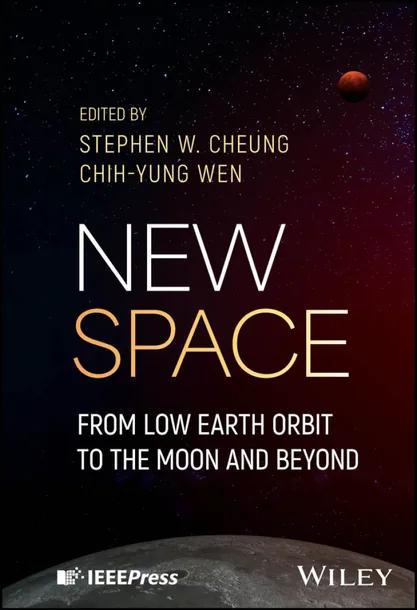
New Space
From Low Earth Orbit to the Moon and Beyond
by Stephen W. Cheung, Chih-yung Wen
1st Edition
Publisher: Wiley-IEEE Press
Book Details
| Print ISBN | 9781394292929 |
| eText ISBN | 9781394292943 |
| Publisher | Wiley-IEEE Press |
| Publishing Year | 2026 |
| Edition | 1st Edition |
| Language | English |
| Pages | 464 |
The 1st Edition of New Space delivers a comprehensive academic introduction to contemporary space technologies and orbital operations. Written and edited by Stephen W. Cheung and Chih-yung Wen, this textbook explains the technical foundation of modern space enterprise for science and engineering students, industry professionals, and interested general readers.
Initial chapters detail launch vehicle dynamics and Earth-orbiting systems. The text establishes physical principles using the Tsiolkovsky rocket equation, delta-V parameters, specific impulse, and thrust-to-weight ratios. The authors analyze megaconstellations like SpaceX Starlink, OneWeb, Amazon Kuiper, and China GW, along with Earth observation applications involving passive imaging, multispectral and hyperspectral imaging, synthetic aperture radar, and precision agriculture.
Beyond low Earth orbit, the volume addresses lunar exploration through NASA's Artemis Program and the Chinese Lunar Exploration Program. By bridging launch mechanics with lunar objectives, the book supports advanced coursework across aerospace engineering and space science curricula.
Table of Contents
Chapter 1: Introduction
- • 1.1 Introduction
- • 1.2 New Space
- • 1.3 Cislunar Space
- • 1.4 Economics and Business Considerations
- • 1.5 Conclusion
Chapter 2: Rockets
- • 2.1 Introduction
- • 2.2 Tsiolkovsky Rocket Equation
- • 2.3 Chemical Propulsion and Main Components
- • 2.4 Other Thrusters
- • 2.5 Conclusion
Chapter 3: Orbits
- • 3.1 Introduction
- • 3.2 Orbit Dynamics
- • 3.3 Launching to Orbit and Orbital Transfer
- • 3.4 Lagrange Points as Orbits
- • 3.5 ΔV Map
- • 3.6 Conclusion
Chapter 4: Satellites and Space Stations
- • 4.1 Introduction
- • 4.2 Types of LEO Satellites
- • 4.3 Miniaturized Satellites in LEO
- • 4.4 Space Stations
- • 4.5 Looking Ahead for the LEO Industry
Chapter 5: Reusable Rockets
- • 5.1 Introduction
- • 5.2 Falcon 9 Reusable Rocket
- • 5.3 Blue Origin Systems
- • 5.4 SpaceX Starship Launch System
- • 5.5 Reusable Rockets in China
- • 5.6 Conclusion
Chapter 6: Communications Satellite Constellations
- • 6.1 Introduction
- • 6.2 Overview of the Satellite Constellations
- • 6.3 Starlink Satellite Constellations
- • 6.4 OneWeb System
- • 6.5 Kuiper System
- • 6.6 China GW System
- • 6.7 Business and Economics Angle
- • 6.8 Looking Ahead
Chapter 7: Earth Observations
- • 7.1 Introduction
- • 7.2 Passive Imaging
- • 7.3 Multispectral and Hyperspectral Imaging
- • 7.4 Precision Agriculture
- • 7.5 Other Applications of Passive Earth Observations
- • 7.6 Synthetic Aperture Radar (SAR)
- • 7.7 Looking Ahead
- • 7.8 Conclusion
Chapter 8: Space Solar Power
- • 8.1 Introduction
- • 8.2 Solar Power
- • 8.3 Multi-Rotary Joints System
- • 8.4 Space Solar Power Using Optical Reflectors
- • 8.5 Laser as Wireless Power Transfer
- • 8.6 Buildup of Space Solar Power
- • 8.7 Technological Challenges
- • 8.8 Looking Ahead
Chapter 9: Space Tourism
- • 9.1 Introduction
- • 9.2 Success Factors
- • 9.3 Suborbital and Orbital Flights
- • 9.4 Space Hotels
- • 9.5 Returning to Earth
- • 9.6 Conclusion
Chapter 10: Mining Asteroids
- • 10.1 Introduction
- • 10.2 Cosmic Background
- • 10.3 The Asteroid Belt
- • 10.4 Statistics of Near-Earth Asteroids
- • 10.5 Missions to Near-Earth Asteroids
- • 10.6 Infrastructures for Mining Asteroids
- • 10.7 Conclusion
Chapter 11: Going to the Moon
- • 11.1 Introduction
- • 11.2 About the Moon
- • 11.3 Artemis Program
- • 11.4 Artemis Missions
- • 11.5 China Lunar Program
- • 11.5.1 Chang'e 5 Mission
- • 11.6 Conclusion
Chapter 12: Settling on the Moon
- • 12.1 Introduction
- • 12.2 Lunar South Pole and Water
- • 12.3 Electric Power Source
- • 12.4 Transportation and Mobility
- • 12.5 Living Shelters
- • 12.6 Foods
- • 12.7 Helium- 3
- • 12.8 Lunar Minerals
- • 12.9 Lunar Communications Infrastructure
- • 12.10 Physical Hazards
- • 12.11 Conclusion
Chapter 13: Mars
- • 13.1 Introduction
- • 13.2 About Mars
- • 13.3 Settling on Mars
- • 13.4 Three Recent Missions
- • 13.5 Future Human Missions to Mars
- • 13.6 Transportation and Communications on Mars
- • 13.7 Best Regions to Land
- • 13.8 Conclusion
Chapter 14: Space Debris
- • 14.1 Introduction
- • 14.2 Origin of the Space Debris
- • 14.3 Space Debris Management
- • 14.4 Debris Remediation
- • 14.5 Recycling
- • 14.6 Removing Debris with Lasers
- • 14.7 Space Situational Awareness
- • 14.8 Cost–Benefit Analysis of Debris Removal
- • 14.9 Conclusion
Chapter 15: Looking Ahead
- • 15.1 LEO and Beyond
- • 15.2 Below LEO for Further Commercialization
Customer Reviews
0.0
0 reviews
No reviews yet. Be the first to review this book!
Write a Review
Reviewed by GradeFocus Editorial Team
▶Research Sources (13)
- New Space - ritograk.fo
- Captcha - Erie2 BOCES | Erie BOCES
- New Space | National Aerospace Library
- New Space - Stephen W. Cheung (9781394292943) » Bokklubben
- Start reading New Space for free
- New Space From Low Earth Orbit to the Moon and Beyond
- New space : from low Earth orbit to the moon and beyond - Hong ...
- New Space: From Low Earth Orbit to the Moon and Beyond - Google ...
- New Space From Low Earth Orbit to the Moon and Beyond
- Stephen W. Cheung New Space
- Space Book Haul!! Books set in space, on a spaceship, about ...
- New Space by Stephen W. Cheung | From Low Earth Orbit ...
- New Space - by Stephen W Cheung & Chih-Yung Wen ...
Related Books
Commercial Aviation Safety
Anthony Lawrenson
Introduction to Flight
John Anderson
Fundamentals of Spacecraft Optical Navigation
John A. Christian
Advanced Aerospace Materials
Haim Abramovich
Standard Methods for Aerospace Stress Analysis
Amir Javidinejad
Aerodynamics for Engineering Students
Steven H. Collicott