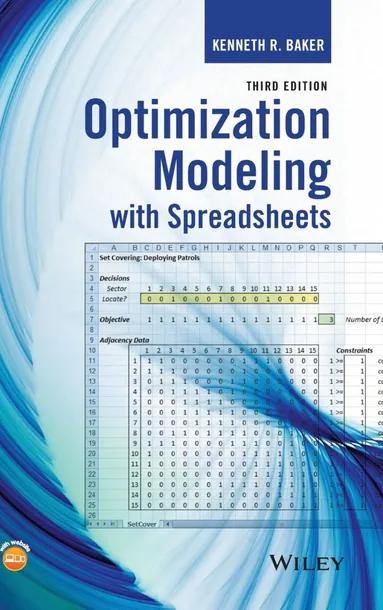
Optimization Modeling with Spreadsheets
by Kenneth R. Baker
3rd Edition
Publisher: Wiley-Blackwell
Book Details
| Print ISBN | 9781118937693 |
| eText ISBN | 9781118937716 |
| Publisher | Wiley-Blackwell |
| Publishing Year | 2015 |
| Edition | 3rd Edition |
| Language | English |
| Pages | 400 |
Optimization Modeling with Spreadsheets, 3rd Edition is a textbook that introduces optimization analysis through practical spreadsheet formulations. It demonstrates how to resolve applied optimization problems using Microsoft Office Excel Solver without requiring specialized add-on software.
The volume concentrates on model-building principles and problem classification rather than algorithmic derivations. It addresses linear, nonlinear, integer, and heuristic programming models to help learners identify shared structures across different analytical challenges.
Intended for upper-undergraduate and graduate courses in management science and operations research, the book also serves as a reference for business practitioners. The 2015 edition includes homework problems specifically designed to support novice model builders.
Table of Contents
Chapter 1: Introduction to Spreadsheet Models for Optimization
- • 1.1 Elements of a Model
- • 1.2 Spreadsheet Models
- • 1.3 A Hierarchy for Analysis
- • 1.4 Optimization Software
- • 1.5 Using Solver
Chapter 2: Linear Programming: Allocation, Covering, and Blending Models
- • 2.1 Linear Models
- • 2.2 Allocation Models
- • 2.3 Covering Models
- • 2.4 Blending Models
- • 2.5 Modeling Errors in Linear Programming
Chapter 3: Linear Programming: Network Models
- • 3.1 The Transportation Model
- • 3.2 The Assignment Model
- • 3.3 The Transshipment Model
- • 3.4 Features of Special Network Models
- • 3.5 Building Network Models with Balance Equations
- • 3.6 General Network Models with Yields
- • 3.7 General Network Models with Transformed Flows
Chapter 4: Sensitivity Analysis in Linear Programs
- • 4.1 Parameter Analysis in the Transportation Example
- • 4.2 Parameter Analysis in the Allocation Example
- • 4.3 The Sensitivity Report and the Transportation Example
- • 4.4 The Sensitivity Report and the Allocation Example
- • 4.5 Degeneracy and Alternative Optima
- • 4.6 Patterns in Linear Programming Solutions
Chapter 5: Linear Programming: Data Envelopment Analysis
- • 5.1 A Graphical Perspective on DEA
- • 5.2 An Algebraic Perspective on DEA
- • 5.3 A Spreadsheet Model for DEA
- • 5.4 Indexing
- • 5.5 Reference Sets and HCUs
- • 5.6 Assumptions and Limitations of DEA
Chapter 6: Integer Programming: Binary -Choice Models
- • 6.1 Using Solver with Integer Requirements
- • 6.2 The Capital Budgeting Problem
- • 6.3 Set Covering
- • 6.4 Set Packing
- • 6.5 Set Partitioning
- • 6.6 Playoff Scheduling
- • 6.7 The Algorithm for Solving Integer Programs
Chapter 7: Integer Programming: Logical Constraints
- • 7.1 Simple Logical Constraints: Exclusivity
- • 7.2 Linking Constraints: The Fixed Cost Problem
- • 7.3 Linking Constraints: The Threshold Level Problem
- • 7.4 Linking Constraints: The Facility Location Model
- • 7.5 Disjunctive Constraints: The Machine -Sequencing Problem
- • 7.6 Tour Constraints: The Traveling Salesperson Problem
Chapter 8: Nonlinear Programming
- • 8.1 One -Variable Models
- • 8.2 Local Optima and the Search for an Optimum
- • 8.3 Two -Variable Models
- • 8.4 Nonlinear Models with Constraints
- • 8.5 Linearizations
Chapter 9: Heuristic Solutions with the Evolutionary Solver
- • 9.1 Features of the Evolutionary Solver
- • 9.2 An Illustrative Example: Nonlinear Regression
- • 9.3 The Machine -Sequencing Problem Revisited
- • 9.4 The Traveling Salesperson Problem Revisited
- • 9.5 Budget Allocation
- • 9.6 Two -Dimensional Location
- • 9.7 Line Balancing
- • 9.8 Group Assignment
Chapter Appendices 1: Supplemental Files and Software
- • A1.1 Supplemental Microsoft Office Excel Files
- • A1.2 Analytic Solver Platform for Education Software
- • A1.3 Opensolver Software
Chapter Appendices 2: Graphical Methods for Linear Programming
- • A2.1 An Example
- • A2.2 Generalities
Chapter Appendices 3: The Simplex Method
- • A3.1 An Example
- • A3.2 Variations of the Algorithm
Customer Reviews
0.0
0 reviews
No reviews yet. Be the first to review this book!
Write a Review
Reviewed by GradeFocus Editorial Team