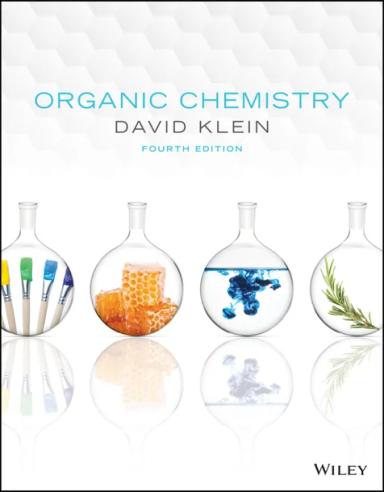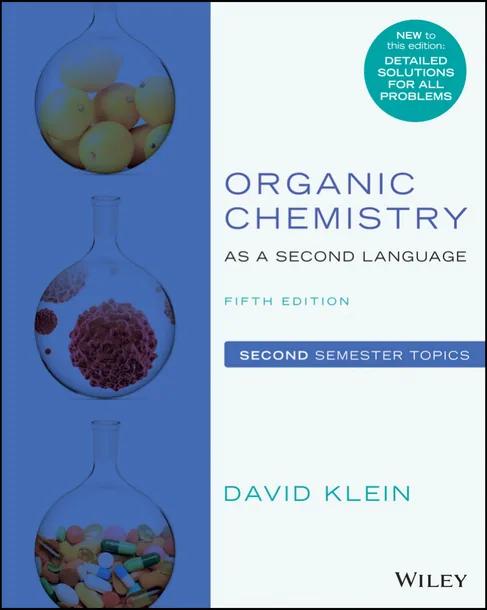
Organic Chemistry as a Second Language
Second Semester Topics
by David R. Klein
5th Edition
Publisher: Wiley
Book Details
| Print ISBN | 9781119493914 |
| eText ISBN | 9781119493822 |
| Publisher | Wiley |
| Publishing Year | 2020 |
| Edition | 5th Edition |
| Language | English |
| Pages | 400 |
Organic Chemistry as a Second Language: Second Semester Topics, 5th Edition, is a textbook supplement designed to support students through the second half of an organic chemistry course. Building on foundational principles from earlier coursework, the text explores molecular mechanisms, chemical reactions, and analytical techniques.
Core subject areas include aromatic compounds, the reactivity of carbonyl groups, and spectroscopic analysis methods. The presentation emphasizes evaluating chemical principles in context, encouraging students to establish effective study habits for understanding reaction behavior and synthetic transformations.
The guide uses an informal voice and instructive analogies to explain challenging concepts with clarity. Hands-on exercises paired with detailed, fully-worked solutions provide step-by-step explanations intended to support practice and strengthen problem-solving skills.
Table of Contents
Chapter 1: Aromaticity
- • 1.1 Introduction to Aromatic Compounds
- • 1.2 Nomenclature of Aromatic Compounds
- • 1.3 Criteria for Aromaticity
- • 1.4 Lone Pairs
Chapter 2: IR Spectroscopy
- • 2.1 Vibrational Excitation
- • 2.2 IR Spectra
- • 2.3 Wavenumber
- • 2.4 Signal Intensity
- • 2.5 Signal Shape
- • 2.6 Analyzing an IR Spectrum
Chapter 3: NMR Spectroscopy
- • 3.1 Chemical Equivalence
- • 3.2 Chemical Shift (Benchmark Values)
- • 3.3 Integration
- • 3.4 Multiplicity
- • 3.5 Pattern Recognition
- • 3.6 Complex Splitting
- • 3.7 No Splitting
- • 3.8 Hydrogen Deficiency Index (Degrees of Unsaturation)
- • 3.9 Analyzing a Proton NMR Spectrum
- • 3.10 13C NMR Spectroscopy
Chapter 4: Electrophilic Aromatic Substitution
- • 4.1 Halogenation and the Role of Lewis Acids
- • 4.2 Nitration
- • 4.3 Friedel–Crafts Alkylation and Acylation
- • 4.4 Sulfonation
- • 4.5 Activation and Deactivation
- • 4.6 Directing Effects
- • 4.7 Identifying Activators and Deactivators
- • 4.8 Predicting and Exploiting Steric Effects
- • 4.9 Synthesis Strategies
Chapter 5: Nucleophilic Aromatic Substitution
- • 5.1 Criteria for Nucleophilic Aromatic Substitution
- • 5.2 SNAr Mechanism
- • 5.3 Elimination–Addition
- • 5.4 Mechanism Strategies
Chapter 6: Ketones and Aldehydes
- • 6.1 Preparation of Ketones and Aldehydes
- • 6.2 Stability and Reactivity of C===O Bonds
- • 6.3 H-Nucleophiles
- • 6.4 O-Nucleophiles
- • 6.5 S-Nucleophiles
- • 6.6 N-Nucleophiles
- • 6.7 C-Nucleophiles
- • 6.8 Exceptions to the Rule
- • 6.9 How to Approach Synthesis Problems
Chapter 7: Carboxylic Acid Derivatives
- • 7.1 Reactivity of Carboxylic Acid Derivatives
- • 7.2 General Rules
- • 7.3 Acid Halides
- • 7.4 Acid Anhydrides
- • 7.5 Esters
- • 7.6 Amides and Nitriles
- • 7.7 Synthesis Problems
Chapter 8: Enols and Enolates
- • 8.1 Alpha Protons
- • 8.2 Keto-Enol Tautomerism
- • 8.3 Reactions Involving Enols
- • 8.4 Making Enolates
- • 8.5 Haloform Reaction
- • 8.6 Alkylation of Enolates
- • 8.7 Aldol Reactions
- • 8.8 Claisen Condensation
- • 8.9 Decarboxylation
- • 8.10 Michael Reactions
Chapter 9: Amines
- • 9.1 Nucleophilicity and Basicity of Amines
- • 9.2 Preparation of Amines Through SN2 Reactions
- • 9.3 Preparation of Amines Through Reductive Amination
- • 9.4 Acylation of Amines
- • 9.5 Reactions of Amines with Nitrous Acid
- • 9.6 Aromatic Diazonium Salts
Chapter 10: Diels–Alder Reactions
- • 10.1 Introduction and Mechanism
- • 10.2 The Dienophile
- • 10.3 The Diene
- • 10.4 Other Pericyclic Reactions
Customer Reviews
0.0
0 reviews
No reviews yet. Be the first to review this book!
Write a Review
Reviewed by GradeFocus Editorial Team