Book Details
| Print ISBN | 9780443158674 |
| eText ISBN | 9780443158681 |
| Publisher | Academic Press |
| Publishing Year | 2024 |
| Edition | 5th Edition |
| Language | English |
| Pages | 1144 |
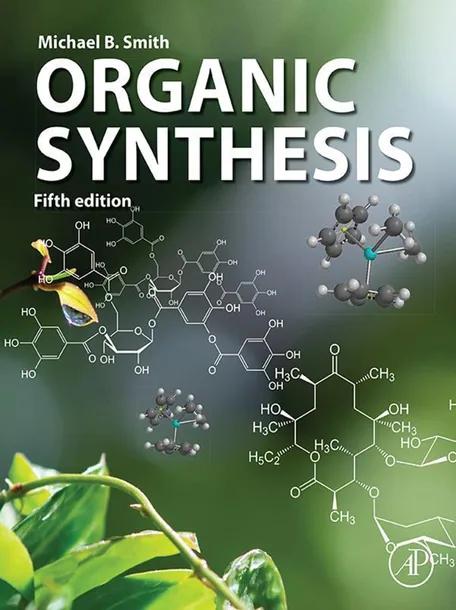
Organic Synthesis, 5th Edition, by Michael Smith provides comprehensive instruction in planning complex multi-step transformations for graduate students in organic chemistry, upper-level undergraduate chemistry majors, and research chemists in the pharmaceutical industry. The textbook opens by building analytical frameworks around retrosynthetic analysis, stereochemistry, and conformational principles to guide modern synthetic planning.
The text organizes transformations into logical thematic areas, progressing through acid-base chemistry, addition reactions, and functional group exchange processes, including oxidations, reductions, hydroborations, and protecting groups. Carbon-carbon bond construction is addressed in depth through cyanide reactions, alkyne anions, Grignard reagents, organolithium compounds, acyl substitutions, and stabilized enolate anions.
Recognized with the 2025 Textbook Excellence "Texty" Award from the Textbook and Academic Authors Association, this edition pairs synthetic strategy with rigorous mechanistic coverage. It offers a clear, structured resource for graduate-level academic coursework and industrial laboratory practice.
Table of Contents
Chapter 1: Retrosynthesis, Stereochemistry, And Conformations
- • 1.1. Introduction
- • 1.2. The Disconnection Protocol
- • 1.3. Bond Proximity and Implications for Chemical Reactions
- • 1.4. Stereochemistry
- • 1.5. Conformations
- • 1.6. Conclusion
Chapter 2: Acids And Bases and Addition Reactions
- • 2.1. Introduction
- • 2.2. Brønsted-Lowry Acids and Bases
- • 2.3. Lewis Acids
- • 2.4 Hard-Soft Acid-Base Theory
- • 2.5. Acid-Base Reactions in Organic Chemistry
- • 2.5. Addition Reactions
- • 2.6. Conclusion
Chapter 3: Functional Group Exchange Reactions. Aliphatic and Aromatic Substitution, and Elimination Reactions
- • 3.1. Introduction
- • 3.2. Aliphatic Substitution Reactions
- • 3.3. Heteroatom-Stabilized Carbocations
- • 3.4. Substitution by Halogen
- • 3.5. Elimination Reactions
- • 3.6. Characteristics Of Substitution and Elimination Reactions
- • 3.7. Syn-Elimination Reactions
- • 3.8. 1,3-Elimination (Decarboxylation)
- • 3.9. 1,3-Elimination (Grob Fragmentation)
- • 3.10. Aromatic Substitution
Chapter 4: Acids, Bases, And Functional Group Exchange Reactions. Acyl Addition and Acyl Substitution
- • 4.1. Introduction
- • 4.2. Nucleophilic Acyl Addition and Substitution
- • 4.3. Conjugate Addition
- • 4.4. Functional Group Manipulation by Rearrangement
- • 4.5. Macrocyclic Compounds
- • 4.6. Conclusion
Chapter 5: Functional Groups Exchange Reactions. Protecting Groups
- • 5.1. Introduction
- • 5.2. When Are Protecting Groups Needed?
- • 5.3. Protecting Groups for Alcohols, Carbonyls, And Amines
- • 5.4. Conclusion
Chapter 6: Functional Group Exchange Reactions. Oxidations
- • 6.1. Introduction
- • 6.2. Alcohols To Carbonyls (CH-OH ® C=O)
- • 6.3. Formation of Phenols and Quinones
- • 6.4. Oxidation of Alkenes to Epoxides
- • 6.5. Conversion of Alkenes to Diols (C=C ® CHOH-CHOH)
- • 6.6. Baeyer-Villiger Oxidation (RCOR' ® RCO2R')
- • 6.7. Oxidative Bond Cleavage (C=C ® C=O + O=C)
- • 6.8. Oxidation Of Alkyl or Alkenyl Fragments (CH ® C=O or C—OH)
- • 6.9. Oxidation Of Sulfur, Selenium, And Nitrogen
- • 6.10. Conclusion
Chapter 7: Functional Group Exchange Reactions. Reductions
- • 7.1. Introduction
- • 7.2. The Nature of Hydride Reducing Agents
- • 7.3. Borane and Aluminum Hydride
- • 7.4. Sodium Borohydride
- • 7.5. Alternative Metal Borohydrides (Li, Zn, Ce)
- • 7.6. Lithium Aluminum Hydride
- • 7.7. Hydride Reducing Agents with Electron-Releasing Groups
- • 7.8. Hydride Reducing Agents with Electron-Withdrawing Groups
- • 7.9. Stereoselectivity In Reductions
- • 7.10. Catalytic Hydrogenation
- • 7.11. Dissolving Metal Reductions
- • 7.12. Nonmetallic Reducing Agents
- • 7.13. Conclusion
Chapter 8: SYNTHETIC STRATEGIES
- • 8.1. Introduction
- • 8.2. Target Selection
- • 8.3. Retrosynthesis
- • 8.4. Synthetic Strategies
- • 8.5. The Strategic Bond Approach
- • 8.6. Strategic Bonds in Rings
- • 8.7. Selected Synthetic Strategies: Ra current popular target
- • 8.8. Biomimetic Approach to Retrosynthesis
- • 8.9. The Chiral Template Approach
- • 8.10. Degradation Techniques as a Tool for Retrosynthesis
- • 8.11. Computer Generated Strategies
- • 8.12. Conclusion
Chapter 9: Functional Group Exchange Reactions. Hydroboration
- • 9.1. Introduction
- • 9.2. Preparation of Alkyl Boranes
- • 9.3. Preparation of Alkenylboranes
- • 9.4. Formation of Oxygen-Containing Functional Groups
- • 9.5. Other Functional Group Exchange Reactions
- • 9.6. Conclusion
Chapter 10: Functional Group Exchange Reactions. Selectivity
- • 10.1. Introduction
- • 10.2. Stereocontrol In Acyclic Systems
- • 10.3. Stereocontrol In Cyclic Systems
- • 10.4. Neighboring Group Effects and Chelation Effects
- • 10.5. Acyclic Stereocontrol Via Cyclic Precursors
- • 10.6. Baldwin's Rules for Ring Closure
- • 10.7. Conclusion
Chapter 11: Carbon-Carbon Bond-Forming Reactions. Cyanide, Alkyne Anions, Grignard Reagents, and Organolithium Reagents
- • 11.1. Introduction
- • 11.2. Cyanide
- • 11.3. Alkyne Anions (R-CºC:-)
- • 11.4 Grignard Reagents (C—Mg)
- • 11.5. Grignard Reagents. Reduction, Organocerium Reagents, and Enolization
- • 11.6. Organolithium Reagents (C—Li)
- • 11.7. Conclusion
Chapter 12: Carbon–Carbon Bond-Forming Reactions. Stabilized Carbanions, Organocuprates, and Ylids
- • 12.1. Introduction
- • 12.2. Sulfur Stabilized Carbanions and Umpolung
- • 12.3. Organocopper Reagents (C—Cu)
- • 12.4. Phenolic Carbanions
- • 12.5. Ylids
- • 12.6. Transition Metal Olefination Reagents
- • 12.7. Silane Reagents
- • 12.8. Conclusion
Chapter 13: Carbon-Carbon Bond-Forming Reactions. Enolate Anions
- • 13.1. Introduction
- • 13.2. Formation Of Enolate Anions
- • 13.3. Reactions Of Enolate Anions with Electrophiles
- • 13.4. Enolate Condensation Reactions
- • 13.5. Stereoselective Enolate Reactions
- • 13.6. Enamines
- • 13.7. Michael Addition and Related Reactions
- • 13.8. Enolate Reactions of a Halo Carbonyl Derivatives
Chapter 14: Pericyclic Reactions. The Diels–Alder Reaction
- • 14.1. Introduction
- • 14.2. Frontier Molecular Orbital Theory
- • 14.3. HOMO, LUMO Energies and Orbital Coefficients
- • 14.4. Allowed and Forbidden Reactions
- • 14.5. The Diels-Alder Reaction
- • 14.6. Rate Enhancement in Diels-Alder Reactions
- • 14.7. Intramolecular Diels-Alder Reactions
- • 14.8. Inverse Electron Demand and The Retro Diels-Alder Reactions
- • 14.9. Heteroatom Diels-Alder Reactions
- • 14.10. Enantioselective Diels-Alder Reactions
- • 14.11. Conclusion
Chapter 15: Pericyclic Reactions: [m+n]-Cycloadditions, Sigmatropic Rearrangements, Electrocyclic and Ene Reactions
- • 15.1. Introduction
- • 15.2. [2+2]-Cycloaddition Reactions
- • 15.3. Electrocyclic Reactions
- • 15.4. [3+2]-Cycloaddition Reactions
- • 15.5. (m+n]-Cycloaddition Reactions
- • 15.5. Sigmatropic Rearrangements
- • 15.6. The Ene Reaction
- • 15.7. Conclusion
Chapter 16: Carbon-Carbon Bond-Forming Reactions. Carbocation and Oxocarbenium Ion Intermediates
- • 16.1. Introduction
- • 16.2. Carbocations
- • 16.3. Carbocations and Carbon–Carbon Bond Forming Reactions
- • 16.4. Friedel-Crafts Reactions
- • 16.5. Friedel-Crafts Reactions: Formation of Heteroatom–Containing Derivatives
- • 16.6. Conclusion
Chapter 17: Formation Of Carbon-Carbon Bonds Via Radicals and Carbenes
- • 17.1. Introduction
- • 17.2. Structure Of Radicals
- • 17.3. Formation Of Radicals by Thermolysis
- • 17.4. Photochemical Formation of Radicals
- • 17.5. Reactions Of Free Radicals
- • 17.6. Intermolecular Radical Reactions
- • 17.7. Intramolecular Radical Reactions (Radical Cyclization)
- • 17.8. Metal-Induced Radical Reactions
- • 17.9. Carbenes And Carbenoids
- • 17.10. Conclusion
Chapter 18: Metal-Mediated, Carbon-Carbon Bond-Forming Reactions
- • 18.1. Introduction
- • 18.2. Copper-Catalyzed Coupling Reactions
- • 18.3. p-Allyl Palladium Complexes
- • 18.4. Named Palladium-Catalyzed Coupling Reactions
- • 18.5. p-Allyl Nickel Complexes
- • 18.6. Metathesis Reactions
- • 18.7. Pauson-Khand Reaction
- • 18.8. Organometallic Compounds as Carbanionic Reagents
- • 18.9. Electrophilic Iron Complexes
- • 18.10. Conclusion
Chapter 19: Combinatorial And Process Chemistry
- • 19.1. Combinatorial Chemistry
- • 19.2. Process Chemistry
- • 19.3. Continuous Flow Synthesis
- • 19.4. Conclusion
Customer Reviews
0.0
0 reviews
No reviews yet. Be the first to review this book!
Write a Review
Reviewed by GradeFocus Editorial Team
▶Research Sources (16)
- 9780443158681: Organic Synthesis | BookScouter.com
- Organic Synthesis - Michael Smith - E-kirja (9780443158681 ...
- Organic Synthesis - Porrúa
- About the Book - University of California Press
- Organic Synthesis - 5th Edition - Elsevier Shop
- Organic Synthesis - Fnac
- Live Beyond - Bookshop.org
- Thompson Learn.
- Please verify you are human - Captcha
- Organic Synthesis
- Organic Synthesis : Michael Smith
- Organic Synthesis (Paperback) by Michael Smith
- Organic Synthesis [5 ed.] 9780443158674
- Reference Works for Organic Synthesis: Home - Guides
- Organic Synthesis, 5th Edition by Michael Smith
- Organic Synthesis - Edition 5 - By Michael Smith Elsevier ...