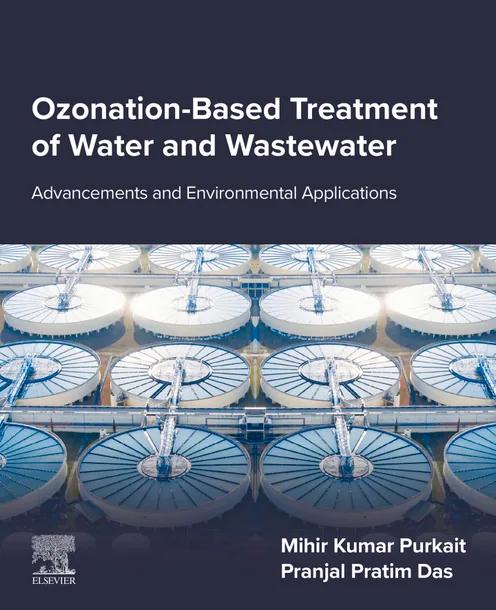
Ozonation-Based Treatment of Water and Wastewater
Advancements and Environmental Applications
by Mihir Kumar Purkait, Pranjal Pratim Das
1st Edition
Publisher: Elsevier
Book Details
| Print ISBN | 9780443275982 |
| eText ISBN | 9780443275999 |
| Publisher | Elsevier |
| Publishing Year | 2025 |
| Edition | 1st Edition |
| Language | English |
| Pages | 282 |
Ozonation-Based Treatment of Water and Wastewater, 1st Edition presents an exploration of ozone and related oxidation methods for eliminating harmful contaminants from drinking water and wastewater. Authored by Mihir Kumar Purkait and Pranjal Pratim Das and published by Elsevier, this book provides technical perspectives for modern water resource management.
The text focuses on recent advancements in ozone nano bubble technology and its role in environmental engineering. Physical concepts are combined with quantitative mathematical models and reaction kinetics to characterize how contaminants are eliminated during water treatment operations.
Real-life applications are demonstrated through global case studies covering drinking water and wastewater treatment facilities. This material offers a structured reference for evaluating ozone-based treatment technologies in academic and professional settings.
Table of Contents
Chapter 1: Water and wastewater: A global perspective
- • 1.1 Introduction
- • 1.2 Temporal and spatial variation of water resources across the globe
- • 1.3 Water resource management
- • 1.3.1 Pollution-prevention strategy
- • 1.3.2 Preservation strategy
- • 1.3.3 Purification strategy
- • 1.4 Major sources of water and wastewater pollution
- • 1.4.1 Ground water and surface water
- • 1.4.2 Sewage and domestic waste
- • 1.4.3 Industrial effluents and agricultural waste
- • 1.4 Quality characteristics of water and wastewater
- • 1.4.1 Physical characteristics
- • 1.4.1.1 Turbidity and color
- • 1.4.1.2 Taste and odor
- • 1.4.2 Chemical characteristics
- • 1.4.2.1 Alkalinity and hardness
- • 1.4.2.3 Organic and inorganic substances
- • 1.4.3 Biological characteristics
- • 1.4.3.1 Bacteria and viruses
- • 1.4.3.2 Protozoa and worms
- • 1.5 Safe drinking water and clean water legislations
- • 1.6 Challenges and possible solutions
- • 1.7 Conclusion
Chapter 2: Conventional treatment processes for water and wastewater
- • 2.1 Introduction
- • 2.2 Water-quality standards and sources
- • 2.2.1 Drinking water standards
- • 2.2.2 Industrial discharge standards
- • 2.3 Classification of conventional treatment techniques
- • 2.3.1 Physical treatment
- • 2.3.1.1 Evaporation
- • 2.3.1.2 Activated carbon/alumina
- • 2.3.1.3 Membrane separation
- • 2.3.2 Chemical treatment
- • 2.3.2.1 Chlorination
- • 2.3.2.2 Ion exchange/sorption
- • 2.3.2.3 Chemical coagulation/flocculation
- • 2.3.3 Biological treatment
- • 2.3.3.1 Biological contact oxidation
- • 2.3.3.2 Moving bed biofilm reactor
- • 2.3.3.3 Aerobic and anaerobic digestion
- • 2.4 Drawbacks associated with each of the conventional treatment techniques
- • 2.5 Paradigm shift from conventional to advanced oxidation process
- • 2.6 Challenges and future research scope
- • 2.7 Conclusion
Chapter 3: Ozonation process: Fundamentals and mechanism
- • 3.1 Introduction
- • 3.2 Historical timeline and theoretical background of ozone
- • 3.3 Reaction mechanism of ozonation process
- • 3.3.1 Direct reaction mechanism
- • 3.3.2 Indirect reaction mechanism
- • 3.4 Physical and chemical properties of ozone
- • 3.4.1 Ozone solubility in water
- • 3.4.2 Ozone decay measurement
- • 3.4.3 Stability of ozone solutions
- • 3.4.4 Reduction potentials of in-situ generated oxygen species
- • 3.5 Ozone reaction with various functional groups of micropollutants
- • 3.5.1 Olefins
- • 3.5.2 Aliphatic amines
- • 3.5.3 Aromatic compounds
- • 3.5.4 Heterocyclic compounds
- • 3.5.5 Organosulfur compounds
- • 3.6 Factors affecting the ozonation process
- • 3.6.1 Ozone doses
- • 3.6.2 Solution pH
- • 3.6.3 Initial concentration
- • 3.6.4 Reaction time and temperature
- • 3.7 Challenges and future prospects
- • 3.8 Conclusion
Chapter 4: Advancements in ozone nano bubble technology
- • 4.1 Introduction
- • 4.2 Conventional ozone disinfection and its limitations
- • 4.3 Current status on ozone nano bubbles
- • 4.3.1 Fundamentals of nano bubbles
- • 4.3.2 Generation methods of nano bubbles
- • 4.3.3 Size determination of nano bubbles
- • 4.4 Properties of ozone nano bubbles
- • 4.4.1 Long residence time
- • 4.4.2 Enhanced reactivity
- • 4.4.3 High oxidative potential
- • 4.4.4 Miniature size and high efficiency for mass transfer
- • 4.4.5 High negative zeta potential and hydrophobicity
- • 4.5 Applications of ozone nano bubbles in various fields
- • 4.5.1 Drinking water
- • 4.5.2 Irrigation water
- • 4.5.3 Ground water
- • 4.5.4 Aquaculture systems
- • 4.5.5 Hospital wastewater
- • 4.5.6 Municipal wastewater
- • 4.5.7 Industrial wastewater
- • 4.6 Challenges and future recommendations
- • 4.7 Conclusion
Chapter 5: Mass transfer and mathematical modelling of ozonation process
- • 5.1 Introduction
- • 5.2 Theory of mass transfer between one and two phases
- • 5.3 Parameters effecting mass transfer of ozone
- • 5.3.1 Simultaneous chemical reactions
- • 5.3.2 Correction factor for water composition
- • 5.3.3 Change in surface tension and bubble coalescence
- • 5.4 Determination of mass transfer coefficients
- • 5.4.1 Equilibrium Concentration
- • 5.4.2 Steady state methods
- • 5.4.3 Non-steady state methods
- • 5.5 Modelling of ozone
- • 5.5.1 Chemical model of ozonation
- • 5.5.2 Mathematical model of ozonation
- • 5.6 Modelling of water and wastewater oxidation
- • 5.6.1 Determination of hydroxyl-radical concentration
- • 5.6.1.1 Indirect measurement
- • 5.6.1.2 Complete radical chain-reaction
- • 5.6.1.3 Empirical Selectivity for Scavengers
- • 5.6.1.4 Semi-empirical method based on observed hydroxyl radical rate
- • 5.6.2 Determination of reaction order and rate constants
- • 5.7 Challenges and possible solutions
- • 5.8 Conclusion
Chapter 6: Ozonation process for water and wastewater treatment
- • 6.1 Introduction
- • 6.2 Classification of emerging contaminants in drinking water and wastewater
- • 6.3 Significance of different phases during ozonation process
- • 6.3.1 Liquid phase
- • 6.3.2 Gaseous phase
- • 6.3.3 Solid phase
- • 6.4 Reaction kinetics of ozone
- • 6.4.1 Slow and fast kinetic regime
- • 6.4.2 Batch and flow reactor kinetics
- • 6.4.3 Ozone decomposition reactions
- • 6.4.4 Effect of water phase and gas flows
- • 6.5 Ozone disinfection in drinking water and wastewater
- • 6.5.1 Drinking water
- • 6.5.1.1 From microbial disinfection to oxidation
- • 6.5.1.2 Disinfection by-products formation and mitigation
- • 6.5.1.3 Small-scale technique for household applications in drinking water
- • 6.5.2 Wastewater
- • 6.5.2.1 Pathogen inactivation for water reuse
- • 6.5.2.2 Disinfection of micropollutants for safe discharge into water bodies
- • 6.6 Challenges and future perspectives
- • 6.7 Conclusion
Chapter 7: Hybrid ozone-based oxidation of water and wastewater
- • 7.1 Introduction
- • 7.2 Potential of ozone-based oxidation for the removal of emerging contaminants
- • 7.3 Classification of hybrid ozonation processes
- • 7.3.1 Ozone assisted electrocoagulation process
- • 7.3.2 Ozone assisted hydrogen peroxide
- • 7.3.3 Ozone assisted UV radiation
- • 7.3.4 Ozone assisted sonication process
- • 7.3.5 Catalytic ozonation
- • 7.3.5.1 Homogenous catalytic ozonation
- • 7.3.5.2 Heterogeneous catalytic ozonation
- • 7.3.6 Photo-catalytic ozonation
- • 7.3.7 Nano-catalyzed ozonation
- • 7.3.8 Ozone assisted activated carbon
- • 7.3.9 Ozone assisted membrane process
- • 7.3.10 Ozone assisted electrical discharge plasma
- • 7.4 Scaling up of the hybrid ozonation processes
- • 7.5 Energy consumption of ozone-based oxidation processes
- • 7.6 Constraints and future recommendations
- • 7.7 Conclusion
Chapter 8: Disinfection and by-products formation during ozonation
- • 8.1 Introduction
- • 8.2 Disinfection strategy during ozonation
- • 8.2.1 Effect of molecular ozone (O3)
- • 8.2.2 Effect of hydroxyl radicals (OH)
- • 8.3 Formation of disinfection by-products and mitigation strategies
- • 8.3.1 By-product formation in presence of bromide
- • 8.3.1.1 Occurrence of bromide and bromate in ozonation plants
- • 8.3.1.2 Bromate formation during oxidation of bromide-containing water
- • 8.3.1.3 Bromate formation during oxidation of micropollutants
- • 8.3.1.4 Bromo-organic compounds
- • 8.3.1.5 Approaches for bromate mitigation
- • 8.3.2 By-product formation in absence of bromide
- • 8.3.3 By-product formation in iodide-containing waters
- • 8.3.4 By-product formation in sulfur-containing waters
- • 8.3.5 Chlorine derived by-products
- • 8.3.6 N-Nitrosodimethylamine (NDMA) formation
- • 8.4 Toxicity analysis and water quality parameters
- • 8.5 Challenges and possible solutions
- • 8.6 Conclusion
Chapter 9: Case studies on ozone-based oxidation of water and wastewater
- • 9.1 Introduction
- • 9.2 Advances in batch and continuous ozone-based oxidation reactors
- • 9.3 Real life applications of ozone-based treatment processes
- • 9.3.1 Ozone-based treatment of drinking water: Case studies
- • 9.3.1.1 Ozone assisted hydrogen peroxide for the treatment of drinking water and raw groundwater
- • 9.3.1.2 Treatment of trace organic contaminants (TrOCs) in drinking water by ozone assisted peroxide process
- • 9.3.1.3 Hybrid ozone-activated carbon treatment for the degradation of emerging contaminants from drinking water
- • 9.3.1.4 Ozone assisted membrane filtration process for the treatment of drinking water
- • 9.3.1.5 Hybrid ozone-UV irradiation for the removal of synthetic musks during the treatment of drinking water
- • 9.3.2 Ozone-based treatment of wastewater: Case studies
- • 9.3.2.1 Treatment of veterinary pharmaceutical wastewater by hybrid catalytic ozonation-electroflocculation process
- • 9.3.2.2 Ozone assisted peroxi-coagulation process for the treatment of coal chemical industry wastewater
- • 9.3.2.3 Hybrid electrocatalytic ozonation treatment of simulated high-salinity carbamazepine wastewater
- • 9.3.2.4 Treatment of municipal reverse osmosis concentrate by hybrid ozonation-membrane aerated biofilm reactor
- • 9.3.2.5 Hybrid ozone-electrocoagulation process for the treatment of distillery industry wastewater
- • 9.3.2.6 Treatment of petroleum industry wastewater by heterogeneous catalytic ozonation using Mn-Fe-Cu/Al2O3 catalyst
- • 9.4 Comparison of ozone-based treatment with conventional processes
- • 9.5 Challenges and future perspectives
- • 9.6 Conclusion
Chapter 10: Techno-economic assessment of ozonation systems
- • 10.1 Introduction
- • 10.2 Cost estimation of ozonation systems
- • 10.2.1 Estimation of capital costs
- • 10.2.2 Estimation of operation and maintenance costs
- • 10.3 Effect of ozonation systems on capital cost
- • 10.3.1 Ozone requirement
- • 10.3.2 System size and housing
- • 10.3.3 Degree of automation
- • 10.3.4 Power availability to the site
- • 10.4 Effect of ozonation systems on operation and maintenance cost
- • 10.4.1 Feed gas stream
- • 10.4.2 Ozone generators
- • 10.4.3 Dissolution systems
- • 10.4.4 Destruction of ozone containing offgas
- • 10.5 Other cost considerations
- • 10.5.1 Training of personals during equipment set-up
- • 10.5.2 Safety considerations
- • 10.6 Challenges and future recommendations
- • 10.7 Conclusion
Customer Reviews
0.0
0 reviews
No reviews yet. Be the first to review this book!
Write a Review
Reviewed by GradeFocus Editorial Team
▶Research Sources (19)
- Ozonation-Based Treatment of Water and Wastewater
- Ozonation-Based Treatment of Water and Wastewater
- Ozonation-based treatment of water and wastewater ...
- Ozonation-Based Treatment of Water and Wastewater ...
- Ozonation-Based Treatment of Water and Wastewater ...
- Ozonation-Based Treatment of Water and Wastewater
- Ozonation-Based Treatment Of Water And Wastewater eBook
- Booklovers Library
- Freshwater pollution print books and ebooks
- Please verify you are human - Captcha
- Ozonation-Based Treatment of Water and Wastewater - ritograk.fo
- Ozonation-Based Treatment of Water and Wastewater
- (PDF) Ozone-Based Technologies in Water and Wastewater Treatment
- Ozonation-Based Treatment of Water and Wastewater - Amazon.ie
- Ozonation: Wastewater Treatment Explained - RACO Manufacturing's
- Ozonation in Wastewater Disinfection
- [PDF] Ozonation in Advanced Wastewater Treatment
- Chemistry of Ozone in Water and Wastewater Treatment
- [PDF] Christiane-Gottschalk-Judy-Ann-Libra ...