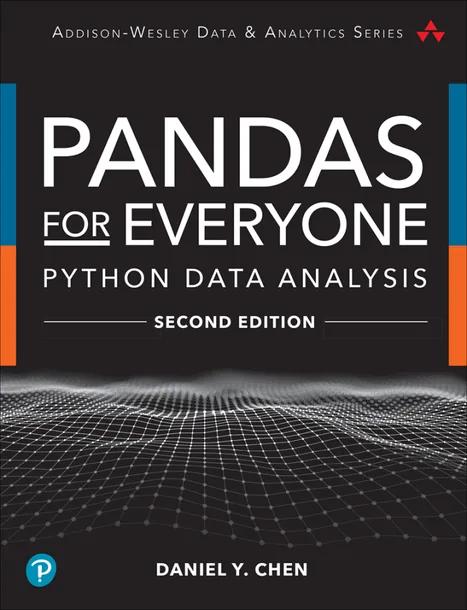
Pandas for Everyone
Python Data Analysis
by Daniel Y. Chen
2nd Edition
Publisher: Addison-Wesley Professional PTG
Book Details
| Print ISBN | 9780137891153 |
| eText ISBN | 9780137891054 |
| Publisher | Addison-Wesley Professional PTG |
| Publishing Year | 2022 |
| Edition | 2nd Edition |
| Language | English |
| Pages | 512 |
Pandas for Everyone: Python Data Analysis, 2nd Edition, is a textbook that explains how to automate and conduct data analysis tasks using Python and the open source Pandas library. The volume outlines practical workflows for managing diverse datasets and preparing data for effective decision-making.
Coverage focuses on foundational data manipulation, including assembling multiple datasets, handling missing values, and shaping tidy data structures. Practical examples demonstrate how to aggregate, transform, and filter records using groupby operations alongside date and time functionality.
The text progressively builds toward predictive modeling, regularization to prevent overfitting, and unsupervised clustering. Updated for Python 3.9, this edition also incorporates extended coverage of plotting with the Seaborn library.
Table of Contents
Chapter 1: Pandas DataFrame Basics
- • Learning Objectives
- • 1.1 Introduction
- • 1.2 Load Your First Data Set
- • 1.3 Look at Columns, Rows, and Cells
- • 1.4 Grouped and Aggregated Calculations
- • 1.5 Basic Plot
- • Conclusion
Chapter 2: Pandas Data Structures Basics
- • Learning Objectives
- • 2.1 Create Your Own Data
- • 2.2 The Series
- • 2.3 The DataFrame
- • 2.4 Making Changes to Series and DataFrames
- • 2.5 Exporting and Importing Data
- • Conclusion
Chapter 3: Plotting Basics
- • Learning Objectives
- • 3.1 Why Visualize Data?
- • 3.2 Matplotlib Basics
- • 3.3 Statistical Graphics Using matplotlib
- • 3.4 Seaborn
- • 3.5 Pandas Plotting Method
- • Conclusion
Chapter 4: Tidy Data
- • Learning Objectives
- • Note About This Chapter
- • 4.1 Columns Contain Values, Not Variables
- • 4.2 Columns Contain Multiple Variables
- • 4.3 Variables in Both Rows and Columns
- • Conclusion
Chapter 5: Apply Functions
- • Learning Objectives
- • Note About This Chapter
- • 5.1 Primer on Functions
- • 5.2 Apply (Basics)
- • 5.3 Vectorized Functions
- • 5.4 Lambda Functions (Anonymous Functions)
- • Conclusion
Chapter 6: Data Assembly
- • Learning Objectives
- • 6.1 Combine Data Sets
- • 6.2 Concatenation
- • 6.3 Observational Units Across Multiple Tables
- • 6.4 Merge Multiple Data Sets
- • Conclusion
Chapter 7: Data Normalization
- • Learning Objectives
- • 7.1 Multiple Observational Units in a Table (Normalization)
- • Conclusion
Chapter 8: Groupby Operations: Split-Apply-Combine
- • Learning Objectives
- • 8.1 Aggregate
- • 8.2 Transform
- • 8.3 Filter
- • 8.4 The pandas.core.groupby.DataFrameGroupBy object
- • 8.5 Working with a MultiIndex
- • Conclusion
Chapter 9: Missing Data
- • Learning Objectives
- • 9.1 What Is a NaN Value?
- • 9.2 Where Do Missing Values Come From?
- • 9.3 Working with Missing Data
- • 9.4 Pandas Built-In NA Missing
- • Conclusion
Chapter 10: Data Types
- • Learning Objectives
- • 10.1 Data Types
- • 10.2 Converting Types
- • 10.3 Categorical Data
- • Conclusion
Chapter 11: Strings and Text Data
- • Introduction
- • Learning Objectives
- • 11.1 Strings
- • 11.2 String Methods
- • 11.3 More String Methods
- • 11.4 String Formatting (F-Strings)
- • 11.5 Regular Expressions (RegEx)
- • 11.6 The regex Library
- • Conclusion
Chapter 12: Dates and Times
- • Learning Objectives
- • 12.1 Python's datetime Object
- • 12.2 Converting to datetime
- • 12.3 Loading Data That Include Dates
- • 12.4 Extracting Date Components
- • 12.5 Date Calculations and Timedeltas
- • 12.6 Datetime Methods
- • 12.7 Getting Stock Data
- • 12.8 Subsetting Data Based on Dates
- • 12.9 Date Ranges
- • 12.10 Shifting Values
- • 12.11 Resampling
- • 12.12 Time Zones
- • 12.13 Arrow for Better Dates and Times
- • Conclusion
Chapter 13: Linear Regression (Continuous Outcome Variable)
- • 13.1 Simple Linear Regression
- • 13.2 Multiple Regression
- • 13.3 Models with Categorical Variables
- • 13.4 One-Hot Encoding in scikit-learn with Transformer Pipelines
- • Conclusion
Chapter 14: Generalized Linear Models
- • About This Chapter
- • 14.1 Logistic Regression (Binary Outcome Variable)
- • 14.2 Poisson Regression (Count Outcome Variable)
- • 14.3 More Generalized Linear Models
- • Conclusion
Chapter 15: Survival Analysis
- • 15.1 Survival Data
- • 15.2 Kaplan Meier Curves
- • 15.3 Cox Proportional Hazard Model
- • Conclusion
Chapter 16: Model Diagnostics
- • 16.1 Residuals
- • 16.2 Comparing Multiple Models
- • 16.3 k-Fold Cross-Validation
- • Conclusion
Chapter 17: Regularization
- • 17.1 Why Regularize?
- • 17.2 LASSO Regression
- • 17.3 Ridge Regression
- • 17.4 Elastic Net
- • 17.5 Cross-Validation
- • Conclusion
Chapter 18: Clustering
- • 18.1 k-Means
- • 18.2 Hierarchical Clustering
- • Conclusion
Chapter 19: Life Outside of Pandas
- • 19.1 The (Scientific) Computing Stack
- • 19.2 Performance
- • 19.3 Dask
- • 19.4 Siuba
- • 19.5 Ibis
- • 19.6 Polars
- • 19.7 PyJanitor
- • 19.8 Pandera
- • 19.9 Machine Learning
- • 19.10 Publishing
- • 19.11 Dashboards
- • Conclusion
Chapter 20: It's Dangerous To Go Alone!
- • 20.1 Local Meetups
- • 20.2 Conferences
- • 20.3 The Carpentries
- • 20.4 Podcasts
- • 20.5 Other Resources
- • Conclusion
Chapter A: Concept Maps
Chapter B: Installation and Setup
Chapter C: Command Line
Chapter D: Project Templates
Chapter E: Using Python
Chapter F: Working Directories
Chapter G: Environments
Chapter H: Install Packages
Chapter I: Importing Libraries
Chapter J: Code Style
Chapter K: Containers: Lists, Tuples, and Dictionaries
Chapter L: Slice Values
Chapter M: Loops
Chapter N: Comprehensions
Chapter O: Functions
Chapter P: Ranges and Generators
Chapter Q: Multiple Assignment
Chapter R: Numpy ndarray
Chapter S: Classes
Chapter T: SettingWithCopyWarning
Chapter U: Method Chaining
Chapter V: Timing Code
Chapter W: String Formatting
Chapter X: Conditionals (if-elif-else)
Chapter Y: New York ACS Logistic Regression Example
Chapter Z: Replicating Results in R
Customer Reviews
0.0
0 reviews
No reviews yet. Be the first to review this book!
Write a Review
Reviewed by GradeFocus Editorial Team