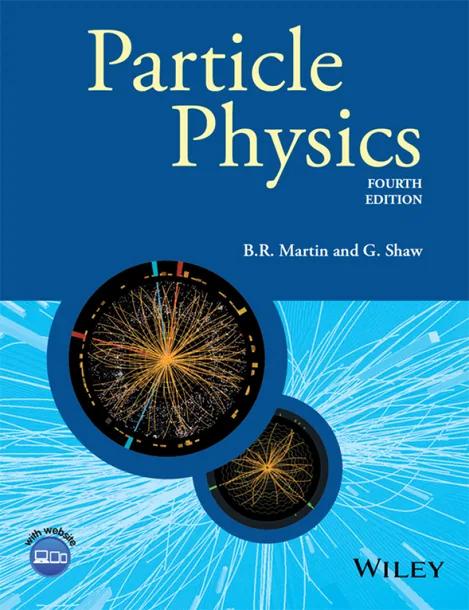
Particle Physics
by Brian R. Martin, Graham Shaw
4th Edition
Publisher: Wiley-Blackwell
Book Details
| Print ISBN | 9781118912164 |
| eText ISBN | 9781118912218 |
| Publisher | Wiley-Blackwell |
| Publishing Year | 2017 |
| Edition | 4th Edition |
| Language | English |
| Pages | 496 |
Particle Physics, 4th Edition, serves as an introductory textbook in the Manchester Physics series. The volume provides a structured foundation in theoretical models and experimental methods.
Coverage introduces leptons, hadrons, and the quark model before examining electroweak unification and quantum chromodynamics. The text also addresses space–time symmetries, discrete symmetries, the Higgs boson, and neutrino physics.
Study features include chapter problems with solutions to selected exercises available on the book's website. Optional starred sections organize advanced material to allow flexible use across different course structures.
Table of Contents
Chapter 1: Some basic concepts
- • 1.1 Introduction
- • 1.2 Antiparticles
- • 1.3 Interactions and Feynman diagrams
- • 1.4 Particle exchange
- • 1.5 Units and dimensions
- • Problems 1
Chapter 2: Leptons and the weak interaction
- • 2.1 Lepton multiplets and lepton numbers
- • 2.2 Leptonic weak interactions
- • 2.3 Neutrino masses and neutrino mixing
- • Problems 2
Chapter 3: Quarks and hadrons
- • 3.1 Quarks
- • 3.2 General properties of hadrons
- • 3.3 Pions and nucleons
- • 3.4 Strange particles, charm and bottom
- • 3.5 Short-lived hadrons
- • 3.6 Allowed and exotic quantum numbers
- • Problems 3
Chapter 4: Experimental methods
- • 4.1 Overview
- • 4.2 Accelerators and beams
- • 4.3 Particle interactions with matter
- • 4.4 Particle detectors
- • 4.5 Detector systems and accelerator experiments
- • 4.6 Non-accelerator experiments
- • Problems 4
Chapter 5: Space–time symmetries
- • 5.1 Translational invariance
- • 5.2 Rotational invariance
- • 5.3 Parity
- • 5.4 Charge conjugation
- • 5.5 Positronium
- • 5.6 Time reversal
- • Problems 5
Chapter 6: The quark model
- • 6.1 Isospin symmetry
- • 6.2 The lightest hadrons
- • 6.3 The _L_ = 0 heavy quark states
- • 6.4 Colour
- • 6.5 Charmonium and bottomonium
- • Problems 6
Chapter 7: QCD, jets and gluons
- • 7.1 Quantum chromodynamics
- • 7.2 Electron–positron annihilation
- • Problems 7
Chapter 8: Quarks and partons
- • 8.1 Elastic electron scattering: the size of the proton
- • 8.2 Inelastic electron and muon scattering
- • 8.3 Inelastic neutrino scattering
- • 8.4 Other processes
- • 8.5 Current and constituent quarks
- • Problems 8
Chapter 9: Weak interactions: quarks and leptons
- • 9.1 Charged current reactions
- • 9.2 The third generation
- • Problems 9
Chapter 10: Weak interactions: electroweak unification
- • 10.1 Neutral currents and the unified theory
- • 10.2 Gauge invariance and the Higgs boson
- • Problems 10
Chapter 11: Discrete symmetries: _C, P, CP_ and _CPT_
- • 11.1 _P_ violation, _C_ violation and _CP_ conservation
- • 11.2 _CP_ violation and particle–antiparticle mixing
- • 11.3 _CP_ violation in the standard model
- • Problems 11
Chapter 12: Beyond the standard model
- • 12.1 Grand unification
- • 12.2 Supersymmetry
- • 12.3 Strings and things
- • 12.4 Particle physics and cosmology
- • 12.5 Dirac or Majorana neutrinos?
- • Problems 12
Chapter A: Relativistic kinematics
- • A.1 The Lorentz transformation for energy and momentum
- • A.2 The invariant mass
- • A.2.1 Beam energies and thresholds
- • A.2.2 Masses of unstable particles
- • A.3 Transformation of the scattering angle
- • Problems A
Chapter B: Amplitudes and cross-sections
- • B.1 Rates and cross-sections
- • B.2 The total cross-section
- • B.3 Differential cross-sections
- • B.4 The scattering amplitude
- • B.5 The Breit–Wigner formula
- • B.5.1 Decay distributions
- • B.5.2 Resonant cross-sections
- • Problems B
Chapter C: The isospin formalism
- • C.1 Isospin operators
- • C.2 Isospin states
- • C.3 Isospin multiplets
- • C.3.1 Hadron states
- • C.4 Branching ratios
- • C.5 Spin states
- • Problems C
Chapter D: Gauge theories
- • D.1 Electromagnetic interactions
- • D.2 Gauge transformations
- • D.3 Gauge invariance and the photon mass
- • D.4 The gauge principle
- • D.5 The Higgs mechanism
- • D.5.1 Charge and current densities
- • D.5.2 Spin-0 bosons
- • D.5.3 Spontaneous symmetry breaking
- • D.6 Quantum chromodynamics
- • D.7 Electroweak interactions
- • D.7.1 Weak isospin
- • D.7.2 Gauge invariance and charged currents
- • D.7.3 The unification condition
- • D.7.4 Spin structure and parity violation
- • Problems D
Chapter E: Answers to selected questions
Customer Reviews
0.0
0 reviews
No reviews yet. Be the first to review this book!
Write a Review
Reviewed by GradeFocus Editorial Team