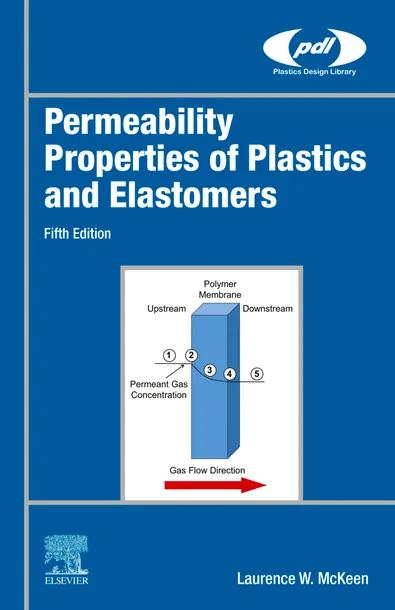
Permeability Properties of Plastics and Elastomers
by Laurence W. McKeen
5th Edition
Publisher: William Andrew
Book Details
| Print ISBN | 9780443449055 |
| eText ISBN | 9780443449062 |
| Publisher | William Andrew |
| Publishing Year | 2026 |
| Edition | 5th Edition |
| Language | English |
Laurence W. McKeen presents Permeability Properties of Plastics and Elastomers, 5th Edition, a detailed handbook dedicated to the transport of gases and vapors through solid materials. Built to assist materials engineers and design engineers, the text clarifies how gaseous and liquid penetrants migrate through polymeric barrier structures.
The instructional progression starts with foundational barrier science, explaining transport mechanisms through solution-diffusion and pore-flow models. The discussion connects base polymer compositions and functional additives directly to manufacturing considerations for barrier films, containers, and industrial membranes.
A primary feature of the volume is its quantitative evaluation of permeation performance across over 60 generic plastic families. This empirical data set assists applications engineers, chemists, and industrial professionals tasked with selecting specific material grades for commercial packaging, automotive components, and medical devices.
Table of Contents
Chapter 1: Introduction to Permeation of Plastics and Elastomers
- • 1.1. History
- • 1.2. Transport of Gases and Vapors though solid materials
- • 1.2.1. Effusion
- • 1.2.2. Solution-Diffusion and Pore-flow Models
- • 1.2.2.1. Non-Fickian Diffusion
- • 1.2.2.2. Dependence of Permeability, Diffusion and Solubility Pressure
- • 1.2.2.3. Dependence of Permeability, Diffusion and Solubility on Temperature - The Arrhenius Equation
- • 1.3. Multiple layered films
- • 1.4. Permeation of Coatings
- • 1.5. Permeation and Vapor Transmission Testing
- • 1.5.1. Units of measurement
- • 1.5.2. Gas Permeation test cells
- • 1.5.3. Vapor Permeation Cup testing
- • 1.5.4. Mass spectrometry and calibrated standard gas leaks
- • 1.5.5. Standard Tests for permeation and vapor transmission
- • 1.5.6 Permeation testing of coatings
- • 1.5.6.1. Electrochemical Impedance Spectroscopy (EIS)
- • 1.5.6.2. Salt Spray/Humidity
- • 1.5.6.3. Atlas Cell
- • 1.5.6.4. Adhesion
- • 1.5.6.4.1. Instron Peel Test
- • 1.5.6.4.2. Pull-Off Adhesion Tests
- • 1.6. Summary
Chapter 2: Introduction to Plastics and Polymers
- • 2.1. Polymerization
- • 2.1.1. Addition Polymerization
- • 2.1.2. Condensation Polymerization
- • 2.2. Copolymers
- • 2.3. Linear, Branched and Crosslinked Polymers
- • 2.4. Polarity
- • 2.5. Unsaturation
- • 2.6. Steric Hindrance
- • 2.7. Isomers
- • 2.7.1. Structural isomers
- • 2.7.2. Geometric Isomers
- • 2.7.3. Stereosiomers - Syndiotactic, Isotactic, Atactic
- • 2.8. Inter and Intra molecular attractions in polymers
- • 2.8.1. Hydrogen bonding
- • 2.8.2. Van der Waals forces
- • 2.8.3. Chain entanglement
- • 2.9. General classifications
- • 2.9.1. Molecular Weight
- • 2.9.2. Thermosets vs. Thermoplastics
- • 2.9.3. Crystalline vs. Amorphous
- • 2.9.4. Orientation
- • 2.10. Polymer Compositions
- • 2.10.1. Additives
- • 2.10.1.1. Fillers, Reinforcement, Composites
- • 2.10.1.2. Combustion Modifiers, Fire, Flame Retardants and Smoke Suppressants
- • 2.10.1.3. Release Agents
- • 2.10.1.4. Slip additives/Internal Lubricants
- • 2.10.1.5. Antiblock additives
- • 2.10.1.6. Catalysts
- • 2.10.1.7. Impact Modifiers and Tougheners
- • 2.10.1.8. UV Stabilizers
- • 2.10.1.9. Optical brighteners
- • 2.10.1.10. Plasticizers
- • 2.10.1.11. Pigments, Extenders, Dyes, Mica
- • 2.10.1.12. Coupling Agents
- • 2.10.1.13. Thermal Stabilizers
- • 2.10.1.14. Antistats
- • 2.11. Polymer Nomenclature
- • 2.12. Summary
Chapter 3: Production of films, containers and membranes
- • 3.1. Extrusion
- • 3.2. Blown Film
- • 3.3. Calendering
- • 3.4. Casting Film Lines
- • 3.5. Post film formation processing
- • 3.6. Web Coating
- • 3.6.1. Gravure Coating
- • 3.6.2. Reverse Roll Coating
- • 3.6.3. Knife On Roll Coating
- • 3.6.4. Metering Rod (Meyer Rod) Coating
- • 3.6.5. Slot Die (Slot, Extrusion) Coating
- • 3.6.6. Immersion (Dip) Coating
- • 3.6.7. Vacuum deposition
- • 3.6.8. Web Coating process summary
- • 3.7. Lamination
- • 3.7.1. Hot Roll/Belt Lamination
- • 3.7.2. Flame Lamination
- • 3.7.3. Orientation
- • 3.7.4. Machine Direction Orientation
- • 3.7.5. Biaxial orientation
- • 3.7.6. Blown film orientation
- • 3.8. Skiving
- • 3.9. Membrane Production
- • 3.10. Molding of Containers
- • 3.10.1. Blow molding
- • 3.10.2. Extrusion blow molding
- • 3.10.3. Injection blow molding
- • 3.10.4. Stretch blow molding
- • 3.10.5. Rotational Molding/Rotomolding
- • 3.11. Fluorination
- • 3.11.1. Permeation testing of fluorinated containers
- • 3.12. Coatings
- • 3.13. Summary
Chapter 4: Markets and Applications for films, containers and membranes
- • 4.1. Barrier Films in packaging
- • 4.1.1. Water Vapor
- • 4.1.2. Atmospheric Gases
- • 4.1.3. Odors and Flavors
- • 4.1.4. Markets and Applications of barrier films
- • 4.1.5. EVAL™ EVOH based multiple layered films and their applications
- • 4.1.6. Some illustrated applications of multiple layered films
- • 4.2. Containers
- • 4.3. Automotive Fuel Tanks and Hoses
- • 4.4. Coatings
- • 4.5. Gloves
- • 4.6. Membranes
- • 4.6.1. Membrane Structures
- • 4.6.1.1. Plate and Frame Modules
- • 4.6.1.2. Hollow Fiber Modules
- • 4.6.1.3. Tubular Membrane Modules
- • 4.6.1.4. Spiral-wound modules
- • 4.7. Commercial membrane separation processes
- • 4.7.1. Dialysis
- • 4.7.2. Reverse Osmosis
- • 4.7.3. Pervaporation
- • 4.7.4. Gas separation
Chapter 5: Styrenic Plastics
- • 5.1. Polystyrene
- • 5.2. Acrylonitrile-Styrene-Acrylate (ASA)
- • 5.3. Styrene-Acrylonitrile Copolymer (SAN)
- • 5.4. Acrylonitrile-Butadiene-Styrene Copolymer (ABS)
- • 5.5. Styrenic Block Copolymers (SBC)
Chapter 6: Polyester Plastics
- • 6.1. Polycarbonate (PC)
- • 6.2. Polybutylene Terephthalate (PBT)
- • 6.3. Polyethylene Terephthalate (PET)
- • 6.4. Liquid Crystalline Polymers (LCP)
- • 6.5. Polycyclohexylene-dimethylene Terephthalate (PCT)
- • 6.6. Polyethylene Naphthalate (PEN)
- • 6.7. Copolyesters
Chapter 7: Polyimides
- • 7.1. Polyetherimide (PEI)
- • 7.2. Polyamide-Imide (PAI)
- • 7.3. Polyimide (PI)
- • 7.4. Thermoplastic Polyimide (TPI)
Chapter 8: Polyamides (Nylons)
- • 8.1. Polyamide 6 (PA 6)
- • 8.2. Polyamide 11(PA 11)
- • 8.3. Polyamide 12 (PA 12)
- • 8.4. Polyamide 46 (PA46)
- • 8.5. Polyamide 66(PA 66)
- • 8.6. Polyamide 66/610 (PA 66/610)
- • 8.7. Polyamide 6/12 (PA 6/12)
- • 8.8. Polyamide 666 (PA 666 or 6/66)
- • 8.9. Polyamide 6/69 (PA 6/6.9)
- • 8.10. Amorphous Polyamide (Nylon)
- • 8.11. PAA – Polyarylamide (PAA or PARA)
- • 8.12. PPA – Polyphthalamide/High Performance Polyamide
Chapter 9: Polyolefins, Polyvinyls & Acrylics
- • 9.1. Polyethylene (PE)
- • 9.2. Unclassified polyethylene
- • 9.2.1. Ultralow Density polyethylene (ULDPE)
- • 9.2.2. Linear low density polyethylene (LLDPE)
- • 9.2.3. Low density polyethylene (LDPE)
- • 9.2.4. Medium density polyethylene (MDPE)
- • 9.2.5. High density polyethylene (HDPE)
- • 9.3. Polypropylene (PP)
- • 9.4. Polybutadiene (PB)
- • 9.5. Polymethyl Pentene (PMP)
- • 9.6. Cyclic Olefin Copolymer (COC)
- • 9.7. Ethylene-Vinyl Acetate Copolymer (EVA)
- • 9.8. Ethylene - Vinyl Alcohol Copolymer (EVOH)
- • 9.9. Polyvinyl Butyral (PVB)
- • 9.10. Polyvinyl Chloride (PVC)
- • 9.11. Polyvinyl Alcohol (PVOH or PVA)
- • 9.12. Polyvinylidene Chloride (PVDC)
- • 9.13. Polyacrylics
- • 9.14. Acrylonitrile-Methyl Acrylate Copolymer (AMA)
- • 9.15. Ionomers
- • 9.15.1. Ionomer - Ethylene Acrylic Acid Copolymer (EAA)
- • 9.15.2. Ionomer – Perfluorosulfonic acid (PFSA)
Chapter 10: Elastomers and rubbers
- • 10.1. Thermoplastic Polyurethane Elastomers (TPU)
- • 10.2. Olefinic Thermoplastic Elastomers (TPO)
- • 10.3. Thermoplastic Copolyester Elastomers (TPE-E or COPE)
- • 10.4. Thermoplastic Polyether Block Polyamide Elastomers (PEBA)
- • 10.5. Styrenic Block Copolymer (SBS) Thermoplastic Elastomers
- • 10.6. Ethylene Acrylic Elastomers (AEM)
- • 10.7. Bromobutyl Rubber
- • 10.8. Butyl Rubber
- • 10.9. Chlorobutyl Rubber (Polychloroprene)
- • 10.10. Ethylene-Propylene Rubbers (EPM, EPDM)
- • 10.11. Epichlorohydrin Rubber (CO, ECO)
- • 10.12. Fluoroelastomers (FKM)
- • 10.13. Natural Rubber
- • 10.14. Acrylonitrile-Butadiene Copolymer (NBR)
- • 10.15. Styrene-Butadiene-Rubber (SBR)
- • 10.16. Polysiloxane/Silicone Rubber
Chapter 11: Fluoropolymers
- • 11.1. Polytetrafluoroethylene (PTFE)
- • 11.2. Fluorinated Ethylene Propylene (FEP)
- • 11.3. Perfluoro Alkoxy (PFA)
- • 11.3.1. PFA 11.3.2. MFA
- • 11.4. Hexafluoropropylene, Tetrafluoroethylene, Ethylene Terpolymer (HTE)
- • 11.5. Tetrafluoroethylene, Hexafluoropropylene, Vinylidene Fluoride Terpolymer (THV™)
- • 11.6. Amorphous fluoropolymer - Teflon AF®
- • 11.7. Polyvinyl Fluoride (PVF)
- • 11.8. Polychlorotrifluoroethylene (PCTFE)
- • 11.9. Polyvinylidene Fluoride (PVDF)
- • 11.10. Ethylene-Tetrafluoroethylene Copolymer (ETFE)
- • 11.11. Ethylene-Chlorotrifluoroethylene Copolymer (ECTFE)
- • 11.12. Summary
Chapter 12: High Temperature/High Performance Polymers
- • 12.1. Polyaryletherketones (PAEK)
- • 12.2. Polyphenylene Sulfide (PPS)
- • 12.3. Polysulfone (PSU)
- • 12.4. Polyethersulfone (PES)
- • 12.5. Polybenzimidazole (PBI)
- • 12.6. Parylene (poly(p-xylylene))
- • 12.7. Polyoxymethylene (POM or Acetal Homopolymer)/ Polyoxymethylene Copolymer (POM- Co or Acetal Copolymer)
Chapter 13: Environmentally friendly polymers
- • 13.1. Cellophane™
- • 13.2. Nitrocellulose
- • 13.3. Cellulose acetate
- • 13.4. Ethylcellulose
- • 13.5. Polycaprolactone (PCL)
- • 13.6. Poly (Lactic Acid) (PLA)
- • 13.7. Poly-3-hydroxybutyrate (PHB or PH3B)
- • 13.8. Polyglycolic Acid (PGA)
Chapter 14: Multilayered films
- • 14.1. Metalized Films
- • 14.2. Silicon Oxide Coating Technology
- • 14.3. Co-continuous lamellar structures
- • 14.4. Multilayered films Appendices
Chapter I: Conversion Factors
Chapter II: Standard Fuel Compositions
Chapter III: Permeability of Gloves
Customer Reviews
0.0
0 reviews
No reviews yet. Be the first to review this book!
Write a Review
Reviewed by GradeFocus Editorial Team
▶Research Sources (16)
- Permeability Properties of Plastics and Elastomers
- Permeability Properties of Plastics and Elastomers
- Permeability Properties of Plastics and Elastomers
- Permeability Properties of Plastics and Elastomers
- Permeability Properties of Plastics and Elastomers - ebook (ePub)
- Psychology & Personal Growth Archives
- Scaffolding
- Thompson Learn.
- Permeability Properties of Plastics and Elastomers
- Permeability Properties of Plastics and Elastomers - ScienceDirect.com
- Permeability Properties of Plastics and Elastomers, ISBN 9780443449055
- Permeability Properties of Plastics and Elastomers - Abbey's Bookshop
- Permeability Properties of Plastics and Elastomers 5th edition - Kriso.lv
- Permeability Properties of Plastics and Elastomers: Fourth Edition
- Permeability Properties of Plastics and Elastomers McKeen Laurence W.
- eBook - Permeability Properties of Plastics and Elastomers - OverDrive
Related Books
Elastomer-Based Composites and Nanocomposites
Hamid Essabir

Piezoelectric Materials
Christopher R. Bowen

Functionalized Biopolymers
Swati Sharma
Inorganic Biomaterials for Drug Delivery
Amit Kumar Nayak

Hydrogels for Wound Healing
Sabu Thomas

Nanobiomaterials and Nanomedicines for Metabolic Disorders
Subhash C. Mandal