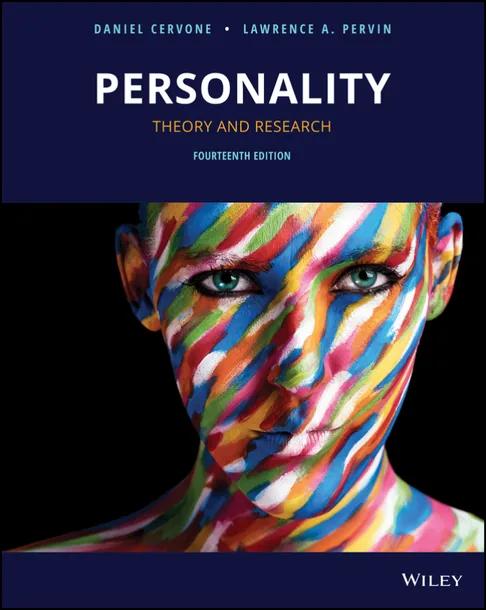
Personality
Theory and Research
by Daniel Cervone, Lawrence A. Pervin
14th Edition
Publisher: Wiley
Book Details
| Print ISBN | 9781119492061 |
| eText ISBN | 9781119492016 |
| Publisher | Wiley |
| Publishing Year | 2019 |
| Edition | 14th Edition |
| Language | English |
| Pages | 496 |
Personality: Theory and Research, 14th Edition, is a textbook that examines the structures, processes, and developmental patterns of personality alongside therapeutic change. It blends foundational theory, modern empirical research, and integrated case studies to investigate how human personality functions.
The text surveys major theoretical perspectives, including psychodynamic, trait, and social-cognitive models, while exploring biological foundations and contextual influences. Discussions balance historical frameworks with contemporary research to examine how interpersonal relationships, culture, and life-span development shape individuals.
Suitable for introductory coursework, advanced study, and professional reference, the textbook presents theoretical perspectives in an objective, critical manner. This comparative approach encourages students to evaluate empirical evidence, assess psychological data, and draw informed conclusions.
Table of Contents
Chapter 1: Personality Theory: From Everyday Observations to Systematic Theories
- • Questions to be Addressed in this Chapter
- • Defining Personality
- • Why Study Personality?
- • Three Goals for the Personality Theorist
- • Answering Questions about Persons Scientifically: Understanding Structures, Processes, Development, and Therapeutic Change
- • Important Issues in Personality Theory
- • Evaluating Personality Theories
- • The Personality Theories: An Introduction
- • Major Concepts
- • Review
Chapter 2: The Scientific Study of People
- • Questions to be Addressed in this Chapter
- • The Data of Personality Psychology
- • Goals of Research: Reliability, Validity, Ethical Behavior
- • Three General Strategies of Research
- • Personality Theory and Personality Research
- • Personality Assessment and the Case of Jim
- • Major Concepts
- • Review
Chapter 3: A Psychodynamic Theory: Freud’s Psychoanalytic Theory of Personality
- • Questions to be Addressed in this Chapter
- • Sigmund Freud (1856–1939): A View of the Theorist
- • Freud’s View of the Person
- • Freud’s View of the Science of Personality
- • Freud’s Psychoanalytic Theory of Personality
- • Major Concepts
- • Review
Chapter 4: Freud’s Psychoanalytic Theory: Applications, Related Theoretical Conceptions, and Contemporary Research
- • Questions to be Addressed in this Chapter
- • Psychodynamic Personality Assessment: Projective Tests
- • Psychopathology
- • Psychological Change
- • The Case of Jim
- • Related Theoretical Conceptions
- • Contemporary Developments in Personality Theory: Neuropsychoanalysis
- • Critical Evaluation
- • Major Concepts
- • Review
Chapter 5: A Phenomenological Theory: Carl Rogers’s Person-Centered Theory of Personality
- • Questions to be Addressed in this Chapter
- • Carl R. Rogers (1902–1987): A View of the Theorist
- • Rogers’s View of the Person
- • Rogers’s View of the Science of Personality
- • The Personality Theory of Carl Rogers
- • Major Concepts
- • Review
Chapter 6: Rogers’s Phenomenological Theory: Applications, Related Theoretical Conceptions, and Contemporary Research
- • Questions to be Addressed in this Chapter
- • Clinical Applications
- • The Case of Jim
- • Related Conceptions: Human Potential, Positive Psychology, and Existentialism
- • Developments in Research: The Self and Authenticity
- • A Limitation of Rogerian Theory: What Exactly is the “Integrated Self”?
- • Personality Systems Interaction Theory
- • Illustrative Research
- • Implications for Rogers’s Self Theory of Personality
- • Critical Evaluation
- • Major Concepts
- • Review
Chapter 7: Trait Theories of Personality: Allport, Eysenck, and Cattell
- • Questions to be Addressed in this Chapter
- • A View of the Trait Theorists
- • Trait Theory’s View of the Person
- • Trait Theory’s View of the Science of Personality
- • Trait Theories of Personality: Basic Perspectives Shared by Trait Theorists
- • The Trait Theory of Gordon W. Allport (1897–1967)
- • Identifying Primary Trait Dimensions: Factor Analysis
- • The Factoranalytic Trait Theory of Raymond B. Cattell (1905–1998)
- • The Three-factor Theory of Hans J. Eysenck (1916–1997)
- • Major Concepts
- • Review
Chapter 8: Trait Theory: The Five-Factor Model and Contemporary Developments
- • Questions to be Addressed in this Chapter
- • On Taxonomies of Personality
- • The Five-Factor Model of Personality: Research Evidence
- • Five-Factor Theory
- • Maybe We Missed One? The Six-Factor Model
- • Cross-cultural Research: Are the Big Five Dimensions Universal?
- • Contemporary Developments in Trait Theory: Reinforcement Sensitivity Theory
- • The Case of Jim—Factor-Analytic Trait-Based Assessment
- • The Person-Situation Controversy
- • Critical Evaluation
- • Major Concepts
- • Review
Chapter 9: Biological Foundations of Personality
- • Questions to be Addressed in this Chapter
- • Temperament
- • Evolution, Evolutionary Psychology, and Personality
- • Genes and Personality
- • Mood, Emotion, and the Brain
- • Plasticity: Biology as Both Cause and Effect
- • Neuroscientific Investigations of “Higher-Level” Psychological Functions
- • Summary
- • Major Concepts
- • Review
Chapter 10: Behaviorism and The Learning Approaches To Personality
- • Questions to be Addressed in this Chapter
- • Behaviorism’s View of the Person
- • Behaviorism’s View of the Science of Personality
- • Watson, Pavlov, and Classical Conditioning
- • Skinner’s Theory of Operant Conditioning
- • Critical Evaluation
- • Major Concepts
- • Review
Chapter 11: A Cognitive Theory: George a Kelly’s Personal Construct Theory of Personality
- • Questions to be Addressed in this Chapter
- • George A. Kelly (1905–1966): A View of the Theorist
- • Kelly’s View of the Science of Personality
- • Kelly’s View of the Person
- • The Personality Theory of George A. Kelly
- • Clinical Applications
- • The Case of Jim
- • Related Points of View and Recent Developments
- • Critical Evaluation
- • Major Concepts
- • Review
Chapter 12: Social-Cognitive Theory: Bandura and Mischel
- • Questions to be Addressed in this Chapter
- • Relating Social-Cognitive Theory to the Previous Theories
- • A View of the Theorists
- • Social-Cognitive Theory’s View of the Person
- • Social-Cognitive Theory’s View of the Science of Personality
- • Social-Cognitive Theory of Personality: Structure
- • Social-Cognitive Theory of Personality: Process
- • Social-Cognitive Theory of Growth and Development
- • Major Concepts
- • Review
Chapter 13: Social-Cognitive Theory: Applications, Related Theoretical Conceptions, and Contemporary Developments
- • Questions to be Addressed in this Chapter
- • Cognitive Components of Personality: Beliefs, Goals, and Evaluative Standards
- • Contemporary Developments in Personality Theory: The KAPA Model
- • Clinical Applications
- • Stress, Coping, and Cognitive Therapy
- • The Case of Jim
- • Critical Evaluation
- • Major Concepts
- • Review
Chapter 14: Personality In Context: Interpersonal Relations, Culture, and Development Across The Course of Life
- • Questions to be Addressed in this Chapter
- • Interpersonal Relationships
- • Meeting Academic and Social Challenges: Optimistic Strategies and Defensive Pessimism
- • Personality Development in Socioeconomic Context
- • Personality Functioning Across the Life Span
- • Persons in Cultures
- • Putting Personality in Context into Practice
- • Summary
- • Major Concepts
- • Review
Customer Reviews
0.0
0 reviews
No reviews yet. Be the first to review this book!
Write a Review
Reviewed by GradeFocus Editorial Team