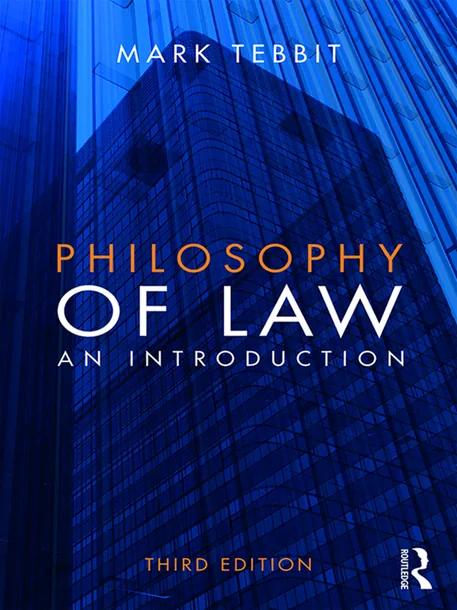
Philosophy of Law
An Introduction
by Mark Tebbit
3rd Edition
Publisher: Routledge
Book Details
| Print ISBN | 9780415827454 |
| eText ISBN | 9781315280998 |
| Publisher | Routledge |
| Publishing Year | 2017 |
| Edition | 3rd Edition |
| Language | English |
| Pages | 314 |
Mark Tebbit's Philosophy of Law: An Introduction, 3rd Edition, is a textbook that introduces students of philosophy and law to the central problems of legal theory.
The volume is organized into three main thematic parts that examine what law is, the reach of legal authority, and foundational issues in criminal law. Core topics include natural law, legal positivism, legal realism, civil disobedience, rights, and theories of punishment.
Written without assuming prior knowledge of either discipline, the text sets theoretical disputes against their historical background. Chapters conclude with dedicated study questions and further reading sections for study practice.
Table of Contents
Chapter 1: Morality, justice and natural law
- • Morality and law at variance
- • What is justice?
- • Natural law theory and legal positivism
- • Traditional natural law theory
- • Conclusion
- • Study questions and further reading
Chapter 2: From common law to modern positivism
- • Common law today
- • Early positivism: an age of philosophical transition
- • Austin’s legal positivism
- • Austin’s command theory
- • Conclusion
- • Study questions and further reading
Chapter 3: Hart’s legal positivism
- • Hart’s challenge to Austin
- • Legal and moral obligation
- • Internalisation
- • Conventions and obligations
- • Minimal natural law
- • Primary and secondary rules
- • The rule of recognition
- • Positivist doubts about Hart’s system of rules
- • Conclusion
- • Study questions and further reading
Chapter 4: Legal theory and the Nazi legality problem
- • Hans Kelsen’s pure theory of law
- • Radbruch against Kelsen
- • Fuller’s secular version of natural law
- • The problem of Nazi legality
- • Conclusion
- • Study questions and further reading
Chapter 5: Legal realism
- • Pragmatism and legal realism
- • Who were the realists?
- • Legal theory and judicial practice
- • The pragmatist attack on certainty
- • The realist revolt against formalism
- • Abductive inference to the best explanation
- • Realism and rule-scepticism
- • The pragmatics of justice
- • Hart’s criticism
- • Conclusion
- • Study questions and further reading
Chapter 6: Competing images of law in contemporary jurisprudence
- • Hard cases and legal positivism
- • Dworkin’s theory of law as integrity
- • Dworkin’s hard cases
- • Criticisms of Dworkin
- • Conclusion
- • Study questions and further reading
Chapter 7: Radical challenges to mainstream theories
- • The roots of modernity and the Enlightenment
- • Critics of the Enlightenment: Marx and Nietzsche
- • The postmodernist attack on modernity: Foucault and Derrida
- • Critical Legal Studies
- • The contradictions in liberalism
- • Justice modern and postmodern
- • Conclusion: Perspectivism and truth
- • Study questions and further reading
Chapter 8: Obedience and disobedience
- • Natural law and positivist responses
- • H.D.Thoreau: Conscience as the sole basis for obligation
- • Socrates’ arguments in Plato’s Crito
- • Consequentialist arguments for conditional obedience
- • Classical contract theory: Hobbes and Locke
- • Rawls: the original position and the conditional duty to obey
- • Injustice and civil disobedience
- • Conclusion
- • Study questions and further reading
Chapter 9: Legal and moral rights
- • Rights and rights-scepticism
- • Bentham’s attack on rights
- • Responses to rights-scepticism
- • Absolute rights
- • Rights versus utility – Bentham and Mill
- • Dworkin’s theory of rights
- • The Human Rights Act (1998) and the case of the conjoined twins
- • Conclusion
- • Study questions and further reading
Chapter 10: Law and private morals
- • Liberalisation and the Wolfenden Report
- • J.S. Mill and liberty
- • Devlin’s critique of the Wolfenden Report
- • Hart’s reply to Devlin
- • Dworkin’s critique of Devlin
- • Conclusion
- • Study questions and further reading
Chapter 11: Radical critiques of liberal theories of law
- • The liberal concept of the individual
- • The contextualisation of universal rights
- • Marx and Marxism
- • Feminist jurisprudence and the rights of women
- • Rights in relation to class, sex and race
- • Conclusion
- • Study questions and further reading
Chapter 12: Guilty minds: recklessness, manslaughter and murder
- • Criminal responsibility and the mens rea doctrine in English common law
- • Negligence and recklessness
- • Intentional killing and murder
- • Direct and oblique intention
- • The subjective-objective controversy
- • Conclusion
- • Study questions and further reading
Chapter 13: Unlawful killing: the defences of necessity and duress
- • The defence of duress
- • Murder and the Hale authority
- • The defence of necessity
- • The classic cases
- • Arguments for and against necessity as a defence to murder
- • Should the Hale authority allow any exceptions?
- • A veil of ignorance test
- • Intention
- • Study questions and further reading
Chapter 14: Insanity and diminished responsibility
- • Traditional problems with insanity
- • The case of Daniel M’Naghten
- • The M’Naghten Rules and their critics
- • Diminished responsibility and the 1957 Homicide Act
- • Conclusion
- • Study questions and further reading
Chapter 15: Theories of punishment
- • The problem of justification
- • Punishment justified by its effects
- • Justifying punishment retrospectively
- • Criticisms of the traditional theories
- • Weaknesses of retributivism
- • Modifications and compromises
- • Punishment as communication: Nozick and Hampton
- • Desert and deterrence in sentencing
- • Conclusion
- • Study questions and further reading
Chapter 16: Radical perspectives on crime and punishment
- • Enlightenment liberalism and its critics
- • The range of radical criticisms
- • The individual and society
- • Intention and determinism
- • Free agency, criminal intention and mens rea
- • Conclusion: Enlightenment values and the rule of law
- • Study questions and further reading
Customer Reviews
0.0
0 reviews
No reviews yet. Be the first to review this book!
Write a Review
Reviewed by GradeFocus Editorial Team