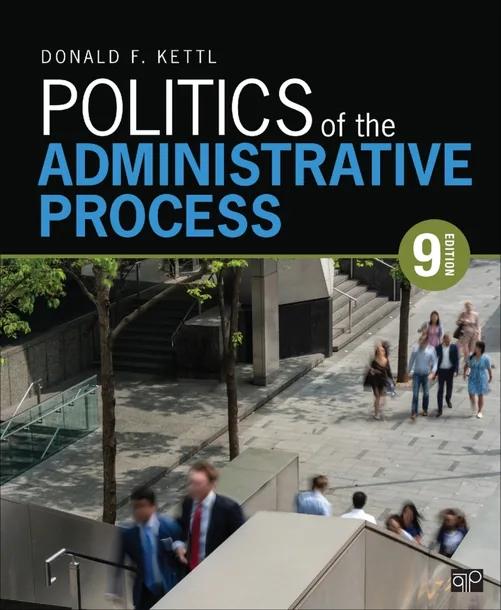
Politics of the Administrative Process
by Donald F. Kettl
9th Edition
Publisher: CQ Press
Book Details
| Print ISBN | 9781071875551 |
| eText ISBN | 9781071875575 |
| Publisher | CQ Press |
| Publishing Year | 2024 |
| Edition | 9th Edition |
| Language | English |
| Pages | 480 |
Politics of the Administrative Process, 9th Edition, by Donald F. Kettl, is an introductory public administration textbook designed for college and university students. The volume provides a systematic framework for understanding how administrative agencies function within political settings while carrying out state and federal policy mandates.
The text focuses on three foundational dimensions of governance: politics, performance, and accountability. Kettl demonstrates how administrative theories apply to real-world government operations by integrating contemporary event analyses into the text, including a thorough examination of institutional decision-making and operational responses throughout the COVID-19 pandemic.
This ninth edition expands its thematic scope by introducing an additional chapter to the main text. Alongside this structural addition, the update integrates recent academic scholarship, modern data sets, and fresh case studies, giving university courses an updated study of bureaucratic structure and administrative practice.
Table of Contents
Chapter 1: The Foundations of Public Administration
- • Public Administration and COVID-19
- • The Federal Strategy
- • COVID-19 in the States and Cities
- • COVID-19 and Public Administration
- • The Foundations of Public Administration
- • Is Private Administration Better Than Public?
- • The Problem of Trust in Government
- • Understanding the Public’s Demands on Government
- • Historical Roots
- • Key Concepts
- • For Further Reading
- • Suggested Websites
Chapter 2: Accountability
- • What Is Accountability?
- • Avoiding the “Gotcha” of Accountability
- • Tracing Accountability to Individuals
- • Approaches to Accountability
- • Legal Boundaries
- • The Role of Politics
- • Political Solutions
- • Evolving Policy Problems
- • Elements of Accountability
- • Holding Administration Accountable
- • Governmental Power and Administrative Ethics
- • The Public Service
- • Key Concepts
- • For Further Reading
- • Suggested Websites
Chapter 3: What Government Does—and How It Does It
- • The Size of Government
- • Five Myths about “Big Government”
- • Number of Governments
- • Government Employment and Spending
- • What Government Does
- • How Government Does It: The Tools of Government
- • Contracts
- • Grants
- • Regulations
- • Tax Expenditures
- • Loan Programs
- • Implications for Public Administration
- • Conclusion
- • Key Concepts
- • For Further Reading
- • Suggested Websites
Chapter 4: What Is Public Administration?
- • The Origins of “Public Administration”
- • The Meaning of Public Administration
- • Public versus Private Administration
- • The Critical Role of Public Authority
- • Processes That Make Public Administration Public
- • Policy Execution versus Policy Formation
- • Policy Execution
- • Policy Formation
- • The Politics-Administration Dichotomy
- • Administrative Responsibility
- • The Study of Public Administration
- • Public Administration in Time
- • Complexity and Simplicity
- • Key Concepts
- • For Further Reading
- • Suggested Websites
Chapter 5: Organizational Theory
- • The Structural Approach to Large Organizations
- • Authority and Hierarchy
- • Propositions about the Role of Authority in Public Administration
- • Two Models: Classical and Bureaucratic
- • The Classical Model
- • The Bureaucratic Model
- • Systems Theory
- • Challenges to the Traditional Theories
- • The Humanist Challenge
- • Jobs, Productivity, and Happiness
- • Self-Actualizing Behavior
- • The Pluralist Challenge
- • Organizational Culture
- • Assessment
- • Formal Models of Bureaucracy
- • Principals and Agents
- • Criticism
- • Blended Government
- • The Role of Interorganizational Networks
- • Complexity in Blended Government
- • Conclusion
- • Key Concepts
- • For Further Reading
- • Suggested Websites
Chapter 6: The Executive Branch
- • The Building Blocks of Structure and Coordination
- • Executive Branch Components
- • The Cabinet
- • Independent Agencies
- • Bureaus
- • Field Offices
- • Leadership of the Executive Branch
- • Problems for Executive Management
- • The Executive Office and the White House
- • E-government
- • Conclusion
- • Key Concepts
- • For Further Reading
- • Suggested Websites
Chapter 7: Organization Problems
- • The Fundamental Values
- • The Search for Effective Organization
- • Good Organizations
- • Interagency Conflict
- • Purpose versus Clientele
- • Function versus Area
- • Conflicts among Purpose-Based Agencies
- • Interagency Coordination
- • Horizontal Cooperation
- • Vertical Coordination
- • The Role of Staff
- • The Pure-Staff Role
- • The Auxiliary Role
- • The Control Role
- • Power Building
- • Solutions?
- • Reorganization
- • Comprehensive Reorganization
- • Obstacles to Reorganization
- • Conclusion
- • Key Concepts
- • For Further Reading
- • Suggested Websites
Chapter 8: Administrative Reform
- • Administrative Reform as a Driving Force in Public Administration
- • Reform in America
- • Competing Theories
- • Downsizing
- • Tax Limitation
- • Privatization
- • Reinventing Government
- • Assessment
- • Reengineering
- • Starting from Scratch
- • Can Citizens Be Customers?
- • Motivation
- • The Focus on Quality
- • Engaging Employees
- • Delivery Framework
- • Assessing the Reforms
- • All the World’s a Stage
- • Conclusion
- • Key Concepts
- • For Further Reading
- • Suggested Websites
Chapter 9: The Civil Service
- • The Fundamentals of the Civil Service
- • Basic Elements of the Civil Service System
- • Applying for a Government Job
- • Fairness, Merit, and Complexity
- • Position Classification
- • Staffing
- • Finding Talent
- • Engaging Workers
- • Challenges to the Merit System
- • The “Rule of Three”
- • Internships
- • Veterans’ Preference
- • Diversity
- • Promotion
- • Separation from Government Service
- • Compensation
- • Should Government Hire the Most Talented People?
- • Employee Rights and Obligations
- • Unionization and Collective Bargaining
- • Political Activity
- • Revolving-Door Restrictions
- • Conclusion
- • Key Concepts
- • For Further Reading
- • Suggested Websites
Chapter 10: Human Capital
- • The Accelerating Pace of Change
- • The Struggle to Hire Workers
- • The Foundation for the Future of Human Capital
- • Technology
- • Productivity
- • Telework
- • Skill Gaps
- • Managing the Human Capital Challenge
- • Building Human Capital
- • Leadership
- • Strategic Human Capital Planning
- • Hiring, Developing, and Retaining Talent
- • Results-Oriented Culture
- • Government Reforms
- • Rethinking the Meaning of Merit
- • At-Will Employment in the States
- • At-Will Employment in the Federal Government
- • How Many Government Workers Is Enough?
- • Leadership in the Public Service
- • Conclusion
- • Key Concepts
- • For Further Reading
- • Suggested Websites
Chapter 11: Decision-Making
- • The Challenge of “Fake News”
- • What Should We Believe?
- • Policy Decisions and Political Value
- • Information and Values
- • Information
- • Values
- • Rational Decision-Making
- • Basic Steps
- • Appraisal
- • Public Choice
- • Bargaining
- • Participative Decision-Making
- • Limits on Decision-Making Theories
- • Uncertainty
- • Information Pathologies
- • Crisis Decision-Making
- • Managing Risk
- • Steps toward Effective Risk Management
- • Overcoming Barriers to Risk Management
- • Conclusion
- • Key Concepts
- • For Further Reading
- • Suggested Websites
Chapter 12: Budgeting
- • Why Budgets Matter
- • The Budget’s Twin Roles
- • The Economic Role
- • The Budget’s Effect on the Economy
- • Using the Budget to Steer the Economy
- • The Decline of Fiscal Policy as an Economic Tool
- • The Economy’s Effect on the Budget
- • The Political Role
- • The Budget and Politics
- • The Rise of Presidential Power
- • Budget Preparation
- • Budget Targets: Top-Down
- • Budgets and Incrementalism: Bottom-Up
- • Breaking the Incremental Pattern
- • The Rise of the Uncontrollables
- • Appropriation by the Legislature
- • Bumps in the Federal Budget Process
- • Budgets as the Focus of Political Polarization
- • Budget Execution
- • Budgeting Challenges for State and Local Governments
- • Conclusion
- • Key Concepts
- • For Further Reading
- • Suggested Websites
Chapter 13: Implementation and Performance
Chapter 14: Regulation and the Courts
Chapter 15: Accountability and Oversight
Customer Reviews
0.0
0 reviews
No reviews yet. Be the first to review this book!
Write a Review
Reviewed by GradeFocus Editorial Team
▶Research Sources (11)
- Politics of the Administrative Process
- Politics of the Administrative Process - Donald F. Kettl
- Politics of the Administrative Process eBook by Donald F. Kettl - EPUB
- Politics of the Administrative Process [9 ed.] 1071875558, 9781071875551
- Politics of the Administrative Process
- Politics of the Administrative Process | Rent | 9781071875551
- Politics of the Administrative Process: Texas State University
- Politics of the Administrative Process - Donald F. Kettl
- Politics of the administrative process - Citation guides
- Donald F. Kettl, Politics of the Administrative Process
- Donald F. Kettl | LBJ School of Public Affairs