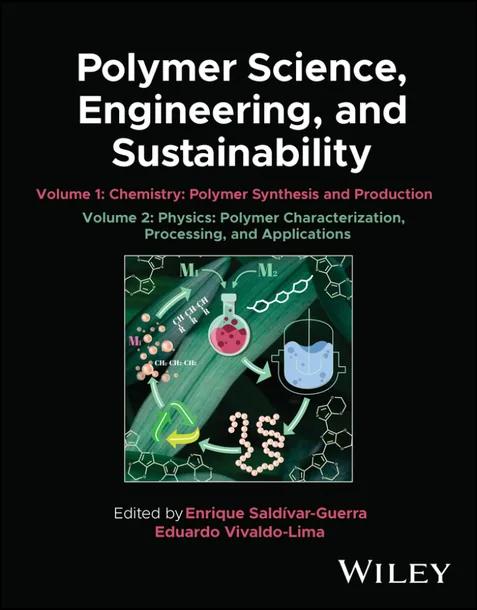
Polymer Science, Engineering, and Sustainability, 2 Volume Set
by Enrique Saldivar-Guerra, Eduardo Vivaldo-Lima
1st Edition
Publisher: Wiley-Blackwell
Book Details
| Print ISBN | 9781119820093 |
| eText ISBN | 9781119820116 |
| Publisher | Wiley-Blackwell |
| Publishing Year | 2025 |
| Edition | 1st Edition |
| Language | English |
| Pages | 1408 |
Polymer Science, Engineering, and Sustainability, 2 Volume Set, 1st Edition presents a broad treatment of polymer chemistry, industrial manufacturing, and environmental management. Authors Enrique Saldivar-Guerra and Eduardo Vivaldo-Lima designed this textbook to connect molecular synthesis with large-scale production and modern sustainability requirements.
The first volume examines fundamental chemical reactions and industrial polymer production processes. Detailed chapters cover polycondensation, free-radical polymerization, reversible-deactivation radical polymerization, coordination polymerization, copolymerization, and anionic polymerization. Each topic emphasizes the chemical mechanisms required to synthesize tailored macromolecular structures.
Sustainable engineering practices frame the entire two-volume work, which incorporates the twelve principles of green chemistry across its 1,408 pages. This structured presentation provides practical learning value for postgraduate students in polymer engineering or production programs, chemical engineers, and materials scientists.
Table of Contents
Chapter 1: Introduction to Polymers and Polymer Types
- • 1.1 Introduction to Polymers
- • 1.1.1 Basic Concepts
- • 1.1.2 History
- • 1.1.3 Mechanical and Rheological Properties
- • 1.1.3.1 Mechanical Properties
- • 1.1.3.2 Rheological Properties
- • 1.1.4 Polymer States
- • 1.1.5 Molecular Weight
- • 1.1.5.1 Moments of the Molar Mass Distribution
- • 1.1.6 Main Types and Uses
- • 1.2 Classification of Polymers
- • 1.2.1 Classification Based on Structure
- • 1.2.2 Classification Based on Mechanism
- • 1.2.2.1 Step-Growth Polymerization (SGP)
- • 1.2.2.2 Chain or Chain-growth Polymerization (CP)
- • 1.2.3 Classification by Chain Topology
- • 1.2.4 Other Classification Criteria
- • 1.2.4.1 Homo and Copolymers
- • 1.2.4.2 Origin
- • 1.2.4.3 Biodegradability and Sustainability
- • 1.2.4.4 Production Volume
- • 1.3 Nomenclature
- • 1.3.1 Conventional Nomenclature
- • 1.3.2 IUPAC Structure-based Nomenclature
- • 1.3.3 Trade, Common Names, and Abbreviations
- • 1.4 Further Reading
Chapter 2: Polycondensation
- • 2.1 Introduction
- • 2.1.1 General Principles
- • 2.1.2 Number-Average Degree of Polymerization
- • 2.1.3 Molecular Weight Distribution
- • 2.1.4 Polymers Obtained by Polycondensation Polymerization
- • 2.2 Polycondensation Kinetics
- • 2.3 Polyamides
- • 2.3.1 Polyamidation
- • 2.3.2 Aromatic Polyamides
- • 2.4 Polyimides
- • 2.5 Polyesters
- • 2.5.1 Polyesters from Diols
- • 2.5.2 Polyethers
- • 2.5.3 Polyurethanes
- • 2.5.4 Polyureas
- • 2.5.5 Polycarbonates
- • 2.5.6 Polysulfones
- • 2.5.7 Polybenzimidazole
- • 2.5.8 Depolymerization and Recycling
- • 2.6 Inorganic Condensation Polymers
- • 2.6.1 Polysiloxanes
- • 2.6.2 Polysilanes
- • 2.6.3 Polyphosphazenes
- • 2.7 Dendrimers
- • 2.8 Thermoset Polycondensation Polymers
- • 2.8.1 Polyester Resins
- • 2.8.2 Epoxy Resins
- • 2.8.3 Alkyd Resins
- • 2.8.4 Phenolic Resins
- • 2.8.5 Urea-Formaldehyde Resins
- • 2.9 Bio-based Step-Growth Polymers
- • 2.10 Bio-based Polycondensation Polymers
- • 2.10.1 Dicarboxylic Acids and Diols
- • 2.10.2 Hydroxy Acids and Hydroxyl Esters
- • 2.10.3 Amino Acids and Lactams
- • 2.10.4 Diamines
- • 2.11 Controlled Molecular Weight Condensation Polymers
- • 2.11.1 Solid Phase Synthesis
- • 2.11.2 Use of Macromonomers in Condensation Reactions
Chapter 3: Free-Radical Polymerization
- • 3.1 Introduction
- • 3.2 Basic Mechanism
- • 3.2.1 Chemical Initiation
- • 3.2.2 Propagation
- • 3.2.3 Termination
- • 3.3 Other Free Radical Reactions
- • 3.3.1 Chain Transfer to Small Species
- • 3.3.2 Chain Transfer to Monomer
- • 3.3.3 Chain Transfer to Initiator
- • 3.3.4 Chain Transfer to Solvent and Chain Transfer Agents
- • 3.3.5 Chain Transfer to Impurities
- • 3.3.6 Chain Transfer to Polymer
- • 3.3.7 Backbiting
- • 3.3.8 Reactions to Internal and Terminal Double Bonds and Crosslinking
- • 3.3.9 Inhibition
- • 3.4 Kinetics and Polymerization Rate
- • 3.4.1 Diffusion-Controlled (DC) Effects
- • 3.5 Molecular Weight and Molecular Weight Distribution
- • 3.5.1 Full Molecular Weight Distribution
- • 3.6 Experimental Determination of Rate Constants
- • 3.7 Thermodynamics of Polymerization
Chapter 4: Reversible-Deactivation Radical Polymerization (RDRP)
- • 4.1 Introduction to RDRP
- • 4.1.1 Terminology for RDRP
- • 4.1.1.1 RDRP with Unimolecular Activation – Stable radical-mediated Polymerization
- • 4.1.1.2 RDRP with Bimolecular Activation – Atom-Transfer Radical Polymerization
- • 4.1.1.3 RDRP with Activation by Degenerative Chain Transfer – Degenerative Chain-Transfer Radical Polymerization
- • 4.1.1.4 Multiple Mechanism RDRP
- • 4.2 Nitroxide-Mediated Polymerization (NMP)
- • 4.2.1 Historical Background
- • 4.2.2 Polymer Chemistry of NMP
- • 4.2.2.1 Mechanistic Aspects and Chemical Routes
- • 4.2.2.2 Nitroxides Most Commonly Used
- • 4.2.2.3 Structure Control and Macromolecular Architectures
- • 4.2.3 A Polymer Reaction Engineering (PRE) View of NMP
- • 4.2.3.1 Kinetics and Mathematical Modeling
- • 4.2.3.2 Dispersed-Phase Polymerizations
- • 4.2.3.3 NMP in scCO2
- • 4.2.3.4 Continuous NMP
- • 4.2.4 Applications and Perspectives
- • 4.2.5 Closing Remarks
- • 4.3 Atom-Transfer Radical Polymerization (ATRP)
- • 4.3.1 Normal ATRP
- • 4.3.2 ATRP Variants
- • 4.3.3 Future Outlook
- • 4.4 Reversible-Addition-Fragmentation Chain-Transfer Polymerization (RAFT)
- • 4.4.1 RAFT Mechanism
- • 4.4.2 Monomers in RAFT Polymerization
- • 4.4.3 Initiation and Termination in RAFT Polymerization
- • 4.4.4 RAFT Agents
- • 4.4.4.1 Z Group Selection
- • 4.4.4.2 R Group Selection
- • 4.4.4.3 Other Considerations in RAFT Agent Selection
- • 4.4.5 Sequence-defined Oligomers
- • 4.4.6 (Multi)Block Copolymer Synthesis
- • 4.4.7 Star Synthesis
- • 4.5 Other RDRP Systems
- • 4.5.1 Degenerative Transfer Controlled Radical Polymerization Mediated by Organotellurium (TERP)
- • 4.5.2 Degenerative Transfer RDRP Mediated by Organostibine (SBRP) and Organobismuthine (BIRP)
- • 4.5.3 Iodine Transfer Polymerization (ITP) and Variants
- • 4.5.4 Reversible Chain-Transfer Catalyzed Polymerization (RTCP)
- • 4.5.5 Organometallic Mediated Radical Polymerization
- • 4.6 RDRP in Aqueous Dispersions
- • 4.6.1 Introduction
- • 4.6.2 Nitroxide-mediated Polymerization (NMP)
- • 4.6.2.1 Emulsion Polymerization
- • 4.6.2.2 Miniemulsion Polymerization
- • 4.6.2.3 Microemulsion Polymerization
- • 4.6.3 Atom-Transfer Radical Polymerization (ATRP)
- • 4.6.3.1 Emulsion Polymerization
- • 4.6.3.2 Miniemulsion Polymerization
- • 4.6.3.3 Microemulsion Polymerization
- • 4.6.4 Reversible-Addition-Fragmentation Chain-Transfer (RAFT) Polymerization
- • 4.6.4.1 Emulsion Polymerization
- • 4.6.4.2 Miniemulsion Polymerization
- • 4.6.4.3 Microemulsion Polymerization
- • 4.6.5 Tellurium-Mediated Radical Polymerization (TERP)
- • 4.6.6 Iodine Transfer Polymerization
- • 4.6.7 Concluding Remarks
Chapter 5: Coordination Polymerization
- • 5.1 Introduction
- • 5.2 Polyolefin Types
- • 5.3 Catalysts Types
- • 5.3.1 Phillips Catalyst
- • 5.3.2 Classical Ziegler–Natta Catalysts
- • 5.3.2.1 Conjugated and Nonconjugated Dienes Polymerizations
- • 5.3.3 Single-Site Catalysts
- • 5.3.3.1 Metallocenes and Constrained Geometry Catalysts
- • 5.3.3.2 Nonmetallocene Early Transition Metal-Based SSCs
- • 5.3.3.3 Late Transition Metal Catalysts
- • 5.3.3.4 Supported Single-Site Catalysts
- • 5.4 Coordination Polymerization Mechanism
- • 5.5 Polymerization Kinetics and Mathematical Modeling
- • 5.5.1 Polymer Microstructural Models
- • 5.6 Modeling Particle-Scale Phenomena
- • 5.7 Polymerization Reactor Models
Chapter 6: Copolymerization
- • 6.1 Introduction
- • 6.1.1 What Are Copolymers?
- • 6.1.2 Commercial Copolymer Examples
- • 6.1.2.1 Step-Growth Copolymerization
- • 6.2 Types of Copolymers
- • 6.2.1 Statistical Copolymers
- • 6.2.2 Alternating Copolymers
- • 6.2.3 Block Copolymers
- • 6.2.4 Gradient Copolymers
- • 6.2.5 Graft Copolymers
- • 6.2.6 Notes on Nomenclature
- • 6.3 Copolymer Composition and Microstructure
- • 6.3.1 Terminal Model Kinetics
- • 6.3.1.1 Copolymer Composition Behavior
- • 6.3.2 Other Copolymerization Models
- • 6.3.2.1 Penultimate Model
- • 6.3.2.2 Depropagation Models
- • 6.3.2.3 Models Involving the Participation of Complexes
- • 6.3.2.4 Model Discrimination
- • 6.3.3 Reactivity Ratio Estimation
- • 6.3.4 Sequence Length Distribution
- • 6.3.5 Composition Measurement Methods
- • 6.3.6 Extensions to Multicomponent Copolymerization
- • 6.4 Reaction Condition Considerations
- • 6.4.1 Copolymerization Rate
- • 6.4.2 Effect of Temperature
- • 6.4.3 Reaction Medium
- • 6.4.4 Monomer Concentration Effects
- • 6.4.5 Effect of Pressure
- • 6.4.6 Achieving Uniform Copolymer Composition
- • 6.4.6.1 Policy I
- • 6.4.6.2 Policy II
- • 6.5 Reversible-Deactivation Radical Copolymerization (RDRcoP)
- • 6.5.1 Reactivity Ratios for Linear Structures
- • 6.5.2 Conventional Copolymerizations and RDRcoP Leading to Nonlinear Structures (Effect of Branching and Cross linking)
- • 6.6 Copolymerization Systems Including Bio-Based Monomers
Chapter 7: Anionic Polymerization
- • 7.1 Introduction
- • 7.2 Living Anionic Polymerization
- • 7.2.1 Molecular Weight Control
- • 7.2.2 Molecular Weight Distribution
- • 7.3 General Considerations
- • 7.3.1 Monomers
- • 7.3.2 Solvents
- • 7.3.3 Initiators
- • 7.3.4 Initiation by Electron Transfer Alkali Metals
- • 7.3.4.1 Radical Anions
- • 7.3.5 Initiation by Nucleophilic Addition
- • 7.3.5.1 Alkyllithium Compounds
- • 7.3.5.2 Organoalkali Initiators
- • 7.3.5.3 Organoalkaline Earth Initiators
- • 7.3.5.4 Ate Complexes
- • 7.3.5.5 Difunctional Initiators
- • 7.3.5.6 Functionalized Initiators
- • 7.3.5.7 1,1-Diphenylmethyl Carbanions
- • 7.4 Kinetics and Mechanism of Polymerization
Customer Reviews
0.0
0 reviews
No reviews yet. Be the first to review this book!
Write a Review
Reviewed by GradeFocus Editorial Team
▶Research Sources (12)
- Polymer Science, Engineering, and Sustainability, 2 Volume Set ...
- Polymer Science, Engineering, and Sustainability, 2 Volume Set ...
- Polymer Science, Engineering, and Sustainability, 2 Volume Set - - e ...
- Polymer Science, Engineering, and Sustainability, 2 Volume Set ...
- Polymer Science, Engineering, and Sustainability, 2 Volume Set ...
- Self-Help - Macmillan Publishers
- Hornbook Treatises - Study Aids Collection | Search
- Polymer Science, Engineering, and Sustainability. Volume ...
- Polymer Science, Engineering, and Sustainability, 2 Volume Set
- Polymer Science, Engineering, and Sustainability, 2 ...
- Polymer Science, Engineering, and Sustainability, 2 ...
- Polymer Science, Engineering, and Sustainability, 2 ...