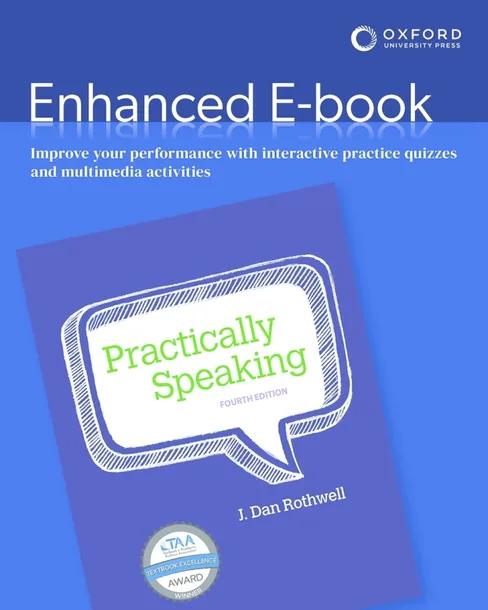
Practically Speaking
by J. Dan Rothwell
4th Edition
Publisher: Oxford University Press
Book Details
| Print ISBN | 9780197648414 |
| eText ISBN | 9780197648445 |
| Publisher | Oxford University Press |
| Publishing Year | 2022 |
| Edition | 4th Edition |
| Language | English |
| Pages | 480 |
In Practically Speaking, 4th Edition, author J. Dan Rothwell provides an introductory public speaking textbook designed to build communication competence across academic and professional settings. The text establishes concrete strategies for managing speech anxiety, conducting systematic audience analysis, capturing listener attention, and selecting suitable speech topics.
The volume leads readers through each major phase of speech development, from early research to final execution. Dedicated sections detail methods for gathering and using supporting materials effectively, structuring speech introductions and conclusions, organizing main ideas through formal outlining, refining speaking style through deliberate language choice, mastering physical delivery, and integrating visual aids.
Recognized with a Textbook Excellence Award from the Textbook & Academic Authors Association, this 480-page volume provides comprehensive assistance for formal speech instruction. The work supports high school students in introductory public speaking courses, college undergraduates, course instructors, and working professionals seeking to improve public communication skills.
Table of Contents
Chapter 1: Communication Competence and Public Speaking
- • DEFINING COMMUNICATION
- • Communication as a Transactional Process: Working with an Audience
- • Communication as Sharing Meaning: Making Sense
- • COMMUNICATION COMPETENCE IN PUBLIC SPEAKING
- • Effectiveness: Achieving Goals
- • Degrees of Effectiveness: From Deficiency to Proficiency
- • Audience Orientation: You Are Not Talking to Yourself
- • Appropriateness: Speaking by the Rules
- • ACHIEVING COMPETENT PUBLIC SPEAKING
- • Knowledge: Learning the Rules
- • Skills: Showing, Not Just Knowing
- • Sensitivity: Developing Receptive Accuracy
- • Commitment: Acquiring a Passion for Excellence
- • Ethics: Determining the Right and Wrong of Speaking
- • Ethical Standards: Judging Moral Correctness of Speech
- • Plagiarism: Never Inconsequential
- • SUMMARY
- • TED TALKS AND YOUTUBE VIDEOS
- • CHECKLIST
- • CRITICAL THINKING QUESTIONS
Chapter 2: Speech Anxiety
- • SPEECH ANXIETY AS A CHALLENGE
- • Pervasiveness of Speech Anxiety: A Common Experience
- • Intensity of Speech Anxiety: Fate Worse than Death?
- • [Box Feature] First Speech: Sample Narrative Speech of Introduction on Speech Anxiety
- • SYMPTOMS: FIGHT-OR-FLIGHT RESPONSE
- • Basic Symptoms: Your Body's Response to Threat
- • Appropriateness of Symptoms: Relevance to Public Speaking
- • CAUSES OF DYSFUNCTIONAL ANXIETY
- • Self-Defeating Thoughts: Sabotaging Your Speech
- • Catastrophic Thinking: Fear of Failure
- • Perfectionist Thinking: No Mistakes Permitted
- • The Illusion of Transparency: Being Nervous about Looking Nervous
- • Desire for Complete Approval: Trying Not to Offend
- • Anxiety-Provoking Situations: Considering Context
- • Novelty of the Speaking Situation: Uncertainty
- • Conspicuousness: The Spotlight Effect
- • Types of Speeches: Varying Responses
- • STRATEGIES FOR MANAGING SPEECH ANXIETY
- • Prepare and Practice: Transforming Novelty into Familiarity
- • Gain Realistic Perspective: Rational Not Irrational Thinking
- • Four Phases of Speech Anxiety
- • Rational versus Irrational Anxiety
- • RATIONAL SPEECH ANXIETY
- • Adopt a Noncompetitive Communication Orientation: Reframing
- • Use Coping Statements: Rational Reappraisal
- • Use Positive Imaging: Visualizing Success
- • Use Relaxation Techniques: Reducing Fight-or-Flight Response
- • Try Systematic Desensitization: Incremental Relaxation
- • SUMMARY
- • TED TALKS AND YOUTUBE VIDEOS
- • CHECKLIST
- • CRITICAL THINKING QUESTIONS
Chapter 3: Audience Analysis and Topic Selection
- • TYPES OF AUDIENCES
- • Captive Audience: Disengaged Listeners
- • Committed Audience: Agreeable Listeners
- • Contrary Audience: Hostile Listeners
- • Concerned Audience: Eager Listeners
- • Casual Audience: Unexpected Listeners
- • AUDIENCE COMPOSITION
- • Age: Possible Generation Gaps
- • Gender: Go Beyond Simplistic Stereotypes
- • Ethnicity and Culture: Sensitivity to Diversity
- • Group Affiliations: A Window into Listeners' Views
- • AUDIENCE ADAPTATION
- • Establish Identification: Connecting with Your Audience
- • Likability: I Can Relate to You
- • Stylistic Similarity: Looking and Acting the Part
- • Substantive Similarity: Establishing Common Ground
- • Build Credibility: Establishing Believability
- • Competence: Knowledge and Experience
- • Trustworthiness: Truthfulness
- • Dynamism: Display Energy
- • Composure: Stay in Control
- • Adapt to the Situation: Influence of Circumstances
- • Adapt While Speaking: Exhibit Sensitivity
- • TOPIC CHOICE AND AUDIENCE ADAPTATION
- • Exploring Potential Topics: Important Choice
- • Do a Personal Inventory: You as Topic Source
- • Brainstorm: New Possibilities
- • Crowdsourcing for Topics: Group Wisdom
- • Scanning for Topics: Quick Ideas
- • Appropriateness of Topic: Blending Topic and Audience
- • Speaker Appropriateness: Suitability for You
- • Audience Appropriateness: Suitability for Your Listeners
- • Occasion Appropriateness: Suitability for the Event
- • Narrowing the Topic: Making Subjects Manageable
- • SUMMARY
- • TED TALKS AND YOUTUBE VIDEOS
- • CHECKLIST
- • CRITICAL THINKING QUESTIONS
Chapter 4: Gathering Material
- • THE INTERNET: ONLINE RESEARCH
- • Search Engines
- • Virtual Libraries
- • Government Sites
- • Survey Sites
- • Wikipedia: Credible Scholarship or Mob Rule?
- • News and Blogging Sites: Be Very Choosy
- • Famous Quotation Sites: The Wisdom of Others
- • Evaluating Internet Information: Basic Steps
- • LIBRARIES: BRICKS-AND-MORTAR RESEARCH FACILITIES
- • Librarian: Expert Navigator
- • Library Catalogues: Computer Versions
- • Periodicals: Popular Information Sources
- • Newspapers: An Old Standby
- • Reference Works: Beyond Wikipedia
- • Databases: Computerized Collections of Credible Information
- • INTERVIEWING: QUESTIONING EXPERTS
- • Interview Plan: Be Prepared
- • Interview Conduct: Act Appropriately
- • Interviewing by Email: Surprise Yourself
- • SUMMARY
- • TED TALKS AND YOUTUBE VIDEOS
- • CHECKLIST
- • CRITICAL THINKING QUESTIONS
Chapter 5: Using Supporting Materials Effectively
- • USING EXAMPLES COMPETENTLY
- • Types of Examples: Specific Illustrations
- • Hypothetical Examples: It Could Happen
- • Real Examples: It Did Happen
- • Brief Examples: Short and to the Point
- • Extended Examples: Telling a Story
- • Using Examples Effectively: Choose Carefully
- • Choose Vivid Examples: Create Images
- • Use Representative Examples: Reflect What Is Accurate
- • Stack Examples: When One Is Not Enough
- • USING STATISTICS COMPETENTLY
- • Choose Statistics for Effect: Beyond Numbing Numbers
- • Use Accurate Statistics Accurately: No Distorting
- • Make Statistics Concrete: Meaningful Numbers
- • Make Statistical Comparisons: Gaining Perspective
- • Use Credible Sources: Build Believability
- • Stack Statistics: Creating Impact
- • Use Statistics Sparingly: Don't Overwhelm Your Listeners
- • Use Visual Aids: Clarify Statistical Trends and Analysis
- • USING TESTIMONY COMPETENTLY
- • Types of Testimony: Relying on Others
- • Testimony of Experts: Relying on Those in the Know
- • Eyewitness Testimony: You Had to Be There
- • Testimony of Non-Experts: Ordinary Folks Adding Color to Events
- • How to Use Testimony Effectively
- • Quote or Paraphrase Accurately: Consider Context
- • Use Qualified Sources: Credibility Matters
- • GENERAL CONSIDERATIONS ACROSS TYPES
- • Choose Interesting Supporting Materials: Counteracting Boredom
- • Be Aware of Source Bias: Choose Carefully
- • Cite Sources Completely: No Vague References
- • Abbreviate Repetitive Source Citations: Oral Reference Reminders
- • SUMMARY
- • TED TALKS AND YOUTUBE VIDEOS
- • CHECKLIST
- • CRITICAL THINKING QUESTIONS
Chapter 6: Attention: Getting People to Listen
- • NATURE OF ATTENTION: A TRANSACTIONAL PROCESS
- • Selective Attention of Listeners: Filtering Stimuli
- • How to Be a Mindful Listener: Assisting the Speaker
- • SPEAKER'S ATTENTION STRATEGIES: TRIGGERING LISTENING
- • The Vital Appeal: Meaningfulness
- • Novelty: The Allure of the New
- • Unusual Topics: Choosing Outside the Box
- • Unusual Examples: The Anti-Sedative
- • Unusual Stories: Compelling Attention
- • Unusual Phrasing: Wording Matters
- • Unusual Presentation: Song and Dance
- • Humorous Appeal: Keep Listeners Laughing
- • Do Not Force Humor: Not Everyone Is Funny
- • Use Only Relevant Humor: Stay Focused
- • Be Sensitive to Audience and Occasion: Humor Can Backfire
- • Consider Using Self-Deprecating Humor: "I'm Not Worthy"
- • Startling Appeal: Shake Up Your Listeners
- • Startling Statements, Facts, or Statistics: The "Oh WOW" Effect
- • Inappropriate Use: Beware Bizarre Behavior
- • Movement and Change: Our Evolutionary Protection
- • Intensity: Extreme Degree of a Stimulus
- • SUMMARY
- • TED TALKS AND YOUTUBE VIDEOS
- • CHECKLIST
- • CRITICAL THINKING QUESTIONS
Chapter 7: Introductions and Conclusions
- • OBJECTIVES FOR COMPETENT INTRODUCTIONS
- • Gain Attention: Focusing Your Listeners
- • Begin with a Clever Quotation: Let Others Grab Attention
- • Startle Your Audience: Surprise Opener
- • Use Questions: Engage Your Listeners
- • Tell a Relevant Story: Use Narrative Power
- • Begin with a Simple Visual Aid: Show and Tell
- • Refer to Remarks of Introduction: Acknowledging Praise
- • Make a Clear Purpose Statement: Providing Intent
- • Establish Topic Significance: Making Your Listeners Care
- • Establish Your Credibility: Why Listeners Should Believe You
- • Preview the Main Points: The Coming Attractions
- • OBJECTIVES FOR COMPETENT CONCLUSIONS
- • Summarize the Main Points: Connecting the Dots
- • Refer to the Introduction: Bookending Your Speech
- • Make a Memorable Finish: Sizzle, Don't Fizzle
- • SUMMARY
- • TED TALKS AND YOUTUBE VIDEOS
- • CHECKLIST
- • CRITICAL THINKING QUESTIONS
Chapter 8: Outlining and Organizing Speeches
- • EFFECTIVE OUTLINING
- • Standard Formatting: Using Correct Symbols
- • Division: Dividing the Pie
- • Coherence: Logical Consistency and Clarity
- • Completeness: Using Full Sentences
- • Balance: No Lopsided Time Allotment
- • [Box Feature] A Student Outline: Rough Draft and Revision
- • EFFECTIVE ORGANIZATION: CREATING PATTERNS
- • Topical Pattern: By the Subjects
- • Chronological Pattern: According to Time
- • Spatial Pattern: Visualization
- • Causal Pattern: Who or What Is Responsible
- • Problem-Solution Pattern: Meeting Needs
- • Problem-Cause-Solution Pattern: Knowing Why and How
- • Comparative Advantages Pattern: Who or What Is Better
- • Monroe's Motivated Sequence: Five-Step Pattern
- • Narrative Pattern: Telling a Story
- • CONNECTING THE DOTS: ADDITIONAL TIPS
- • Provide Definitions
- • Use Signposts
- • Make Transitions
- • Use Internal Previews
- • Give Internal Summaries
- • PREPARATION VERSUS PRESENTATION OUTLINES
- • SUMMARY
- • TED TALKS AND YOUTUBE VIDEOS
- • CHECKLIST
- • CRITICAL THINKING QUESTIONS
Chapter 9: Speaking Style: Using Language
- • ORAL VERSUS WRITTEN STYLE
- • STYLE IN THE ELECTRONIC AGE
- • STANDARDS OF COMPETENT ORAL STYLE
- • Clarity: Concise and on Point
- • Jargon: Beware Confusion
- • Euphemism: Linguistic Novocaine
- • Slang: Trying to Sound Cool
- • Precision: Picking the Apt Words
- • Vividness: Painting a Picture
- • Metaphor and Simile: Figures of Speech
- • Alliteration: Several of the Same Sounds
- • Repetition: Rhythmic Cadence
- • Antithesis: Using Opposites
- • SUMMARY
- • TED TALKS AND YOUTUBE VIDEOS
- • CHECKLIST
- • CRITICAL THINKING QUESTIONS
Chapter 10: Delivering Your Speech
- • METHODS OF COMPETENT DELIVERY
- • Manuscript Speaking: Looking for Precision
- • Memorized Speaking: Memory, Do Not Fail Me Now
- • Impromptu Speaking: Off-the-Cuff Presentations
- • Extemporaneous Speaking: The Virtues of an Outline
- • DEVELOPING COMPETENT DELIVERY
- • Eye Contact: Connecting with Your Audience
- • Voice: Developing Vocal Variety
- • Fluency: Avoiding Excessive Vocal Fillers
- • Speaking Rate: Finding the Right Pace
- • Articulation and Pronunciation: Striving for Clarity of Speech
- • Body Movements: Finding the Right Balance Nonverbally
- • Podium Usage: Avoiding the Lectern Lean
- • Microphone Usage: Amplifying Your Delivery
- • Distracting Behaviors: Avoiding Interference
- • Audience-Centered Delivery: Matching the Context
- • Q & A: They Have Questions, You Have Answers
- • SUMMARY
- • TED TALKS AND YOUTUBE VIDEOS
- • CHECKLIST
- • CRITICAL THINKING QUESTIONS
Chapter 11: Visual Aids
- • BENEFITS: REASONS TO USE AIDS
- • TYPES: MAKING APPROPRIATE CHOICES
- • Objects: Show and Tell
- • Models: Practical Representations
- • Graphs: Making Statistics Clear and Interesting
- • Maps: Making a Point Geographically
- • Tables: Factual and Statistical Comparisons
- • Photographs: Very Visual Aids
- • Drawings: Photo Substitutes
- • VISUAL AIDS MEDIA: VAST CHOICES
- • Chalkboard and Whiteboard: All Dinosaurs Are Not Extinct
- • Poster Board: Simplicity Itself
- • Handouts: An Old Standby
- • Video Excerpts: DVDs, YouTube, and Visual Power
- • Projection Equipment: Blowing It Up
- • Computer-Assisted Presentations
- • [Box Feature] PowerPoint: Lots of Power, Little Point?
- • GUIDELINES: AIDS, NOT DISTRACTIONS
- • Keep Aids Simple
- • Make Aids Visible
- • Make Aids Neat, Attractive, and Accurate
- • Do Not Block the Audience's View
- • Keep Aids Close to You
- • Put the Aid Out of Sight When Not in Use
- • Practice with Aids
- • Do Not Circulate Your Aids
- • Do Not Talk in the Dark
- • Anticipate Problems
- • SUMMARY
- • TED TALKS AND YOUTUBE VIDEOS
- • CHECKLIST
- • CRITICAL THINKING QUESTIONS
Chapter 12: Skepticism: Becoming Critical Thinking Speakers and Listeners
- • SKEPTICISM, TRUE BELIEF, AND CYNICISM
- • DANGERS OF TRUE BELIEF
- • THE PROCESS OF TRUE BELIEVING
- • Confirmation Bias: Searching for Support
- • Rationalization of Disconfirmation: Clinging to Falsehoods
- • Burden of Proof: Whose Obligation Is It?
- • SKEPTICISM PROCESS: INQUIRING MINDS WANT TO KNOW
- • Probability Model: Likely but Not Certain
- • Possibility: Could Happen, but Do Not Bet on It
- • Plausibility: Making a Logical Case
- • Probability: What Are the Odds?
- • Certainty: Without Exception
- • Skepticism and Open-Mindedness: Inquiring, Not Empty, Minds
- • Becoming a Skeptic: Practically Speaking
- • What Speakers as Skeptics Do
- • What Listeners as Skeptics Do
- • SUMMARY
- • TED TALKS AND YOUTUBE VIDEOS
- • CHECKLIST
- • CRITICAL THINKING QUESTIONS
Chapter 13: Argument, Reasoning, and Evidence
- • AN ARGUMENT: STAKING YOUR CLAIM
- • Syllogism: Formal Logic
- • Toulmin Structure of Argument: Informal Logic
- • CRITERIA: IS IT FACT OR FALLACY?
- • Credibility: Should We Believe You?
- • Manufactured or Questionable Statistics: Does It Make Sense?
- • Biased Sources: Grinding an Ax
- • Expert Quoted Out of Field: No Generic Experts Allowed
- • False Dichotomies: Either-Or Thinking
- • Relevance: Does It Follow?
- • Ad Hominem Fallacy: Diversionary Tactic
- • Ad Populum Fallacy: Arguing from Public Opinion
- • Sufficiency: Got Enough?
- • Self-Selected Sample: Partisan Power
- • Inadequate Sample: Large Margin of Error
- • Hasty Generalization: Arguing from Example
- • Correlation Mistaken for Causation: X Does Not Necessarily Cause Y
- • False Analogy: Mixing Apples and Oranges
- • SUMMARY
- • TED TALKS AND YOUTUBE VIDEOS
- • CHECKLIST
- • CRITICAL THINKING QUESTIONS
Chapter 14: Informative Speaking
- • INFORMATIVE VERSUS PERSUASIVE SPEAKING
- • Noncontroversial Information: Staying Neutral
- • Precursor to Persuasion: No Call to Action
- • TYPES OF INFORMATIVE SPEECHES
- • Reports: Facts in Brief
- • Explanations: Deeper Understanding
- • Demonstrations: Acting Out
- • Narratives: Storytelling
- • Speeches That Compare: Balancing the Pros and Cons
- • COMPETENT INFORMATIVE SPEAKING GUIDELINES
- • Be Informative: Tell Us What We Do Not Know
- • Adapt to Your Audience: Topic Choice and Knowledge Base
- • Avoid Information Overload: Beware the Data Dump
Chapter 15: Foundations of Persuasive Speaking
Chapter 16: Persuasive Speaking Strategies
Chapter 17: Speeches for Special Occasions
Chapter 18: Virtual Public Speaking
Chapter APPENDIX A: Text of an Informative Speech: "The Annual Plague"
Chapter APPENDIX B: Text of a Persuasive Speech: "Get Big Money Out of College Sports"
Chapter APPENDIX C: Group Oral Presentations
Customer Reviews
0.0
0 reviews
No reviews yet. Be the first to review this book!
Write a Review
Reviewed by GradeFocus Editorial Team
▶Research Sources (12)
- Practically Speaking - J. Dan Rothwell
- ISBN 9780197648445 - Practically Speaking 4th
- Practically Speaking: Dallas College
- Public Speaking
- Practically Speaking (Paperback) by J. Dan Rothwell - Buy, Rent or Sell
- Practically Speaking, Used TradePaperback | ISBN
- Practically Speaking - J. Dan Rothwell
- Practically Speaking | Rent | 9780197648414
- EBOOK Practically Speaking by J. Dan Rothwell
- Practically Speaking
- Practically Speaking 4th Edition : r/textbook
- Practically Speaking: 2nd Edition Overview | PDF