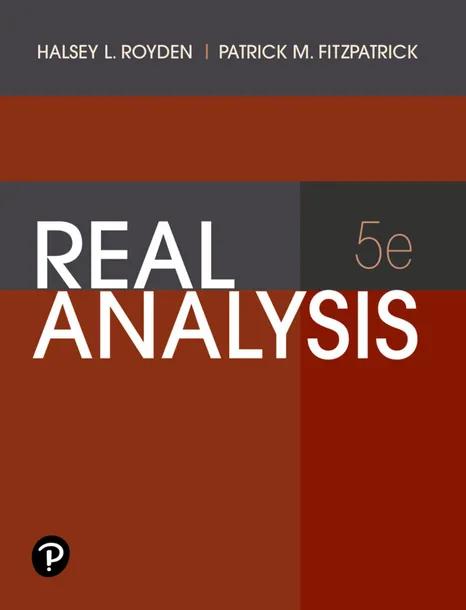
Real Analysis
by Patrick M. Fitzpatrick, Halsey L. Royden
5th Edition
Publisher: Pearson
Book Details
| Print ISBN | 9780137906529 |
| eText ISBN | 9780136853541 |
| Publisher | Pearson |
| Publishing Year | 2023 |
| Edition | 5th Edition |
| Language | English |
Real Analysis, 5th Edition, by Patrick M. Fitzpatrick and Halsey L. Royden, is a mathematics textbook covering measure theory, integration theory, and abstract spaces. Designed for mathematical analysis students, the work assumes a prior undergraduate course in the fundamental concepts of analysis.
The volume opens with Lebesgue measure and integration for functions of a single real variable, addressing measurable functions, integration theory, and differentiation. It subsequently explores general measure theory, product measures, and Lp spaces before examining topological, metric, Banach, and Hilbert spaces.
Organized into thematic parts, the text includes preliminaries on set relations, classical convergence theorems, and continuous linear operators to support advanced study.
Table of Contents
Chapter Preliminaries: Preliminaries on Sets, Mappings, and Relations
- • Unions and Intersections of Sets
- • Mappings Between Sets
- • Equivalence Relations, the Axiom of Choice and Zorn's Lemma
Chapter 1: The Real Numbers: Sets, Sequences and Functions
- • 1.1 The Field, Positivity and Completeness Axioms
- • 1.2 The Natural and Rational Numbers
- • 1.3 Countable and Uncountable Sets
- • 1.4 Open Sets, Closed Sets, and Borel Sets of Real Numbers
- • 1.5 Sequences of Real Numbers
- • 1.6 Continuous Real-Valued Functions of a Real Variable
Chapter 2: Lebesgue Measure
- • 2.1 Introduction
- • 2.2 Outer Measure
- • 2.3 The *σ*-algebra of Lebesgue Measurable Sets
- • 2.4 Finer Properties of Measurable Sets
- • 2.5 Countable Additivity and Continuity of Measure, and the Borel-Cantelli Lemma
- • 2.6 Vitali's Example of a Nonmeasurable Set
- • 2.7 The Cantor Set and the Cantor-Lebesgue Function
Chapter 3: Lebesgue Measurable Functions
- • 3.1 Sums, Products, and Compositions
- • 3.2 Sequential Pointwise Limits and Simple Approximation
- • 3.3 Littlewood's Three Principles, Egoroff's Theorem and Lusin's Theorem
Chapter 4: Lebesgue Integration
- • 4.1 Comments on the Riemann Integral
- • 4.2 The Integral of a Bounded, Finitely Supported, Measurable Function
- • 4.3 The Integral of a Non-Negative Measurable Function
- • 4.4 The General Lebesgue Integral
- • 4.5 Countable Additivity and Continuity of Integration
Chapter 5: Lebesgue Integration: Further Topics
- • 5.1 Uniform Integrability and Tightness: The Vitali Convergence Theorems
- • 5.2 Convergence in the Mean and in Measure: A Theorem of Riesz
- • 5.3 Characterizations of Riemann and Lebesgue Integrability
Chapter 6: Differentation and Integration
- • 6.1 Continuity of Monotone Functions
- • 6.2 Differentiability of Monotone Functions: Lebesgue's Theorem
- • 6.3 Functions of Bounded Variation: Jordan's Theorem
- • 6.4 Absolutely Continuous Functions
- • 6.5 Integrating Derivatives: Differentiating Indefinite Integrals
- • 6.6 Measurability: Images of Sets, Compositions of Functions
- • 6.7 Convex Functions
Chapter 7: The *L*Ρ Spaces: Completeness and Approximation
- • 7.1 Normed Linear Spaces
- • 7.2 The Inequalities of Young, Hölder and Minkowski
- • 7.3 *L*Ρ is Complete: Rapidly Cauchy Sequences and The Riesz-Fischer Theorem
- • 7.4 Approximation and Separability
Chapter 8: The *L*Ρ Spaces: Duality, Weak Convergence and Minimization
- • 8.1 Bounded Linear Functionals on a Normed Linear Space
- • 8.2 The Riesz Representation of the Dual of L*p*, 1 ≤ *p* < ∞
- • 8.3 Weak Sequential Convergence in L*p*
- • 8.4 The Minimization of Convex Functionals
Chapter 9: General Measure Spaces: Their Properties and Construction
- • 9.1 Measurable Sets and Measure Spaces
- • 9.2 Measures Induced by an Outer-measure
- • 9.3 The Carathéodory-Hahn Theorem
Chapter 10: Particular Measures: Lebesgue Measure on Euclidean Space, Borel Measures, and Signed Measure
- • 10.1 Lebesgue Measure on Euclidean Space
- • 10.2 Lebesgue Measurability and Measure of Images of Mappings
- • 10.3 Regularity of Borel Measures on R*n*, and Cumulative Distribution Functions
- • 10.4 Carathéodory Outer-measures and Hausdorff Measures
- • 10.5 Signed Measures: the Hahn and Jordan Decompositions
Chapter 11: Integration Over General Measure Spaces
- • 11.1 Measurable Functions: the Egoroff and Lusin Theorems
- • 11.2 Integration of Non-negative Measurable Functions: Fatou's Lemma, the Monotone Convergence Theorem and Beppo Levi's Theorem
- • 11.3 Integration of General Measurable Functions: the Dominated Convergence Theorem and the Vitali Convergence Theorem
- • 11.4 The Radon-Nikodym Theorem
- • 11.5 Product Measures: the Tonelli and Fubini Theorems
- • 11.6 Products of Lebesgue measure on Euclidean spaces: Cavalieri's Principle
Chapter 12: General L*p* Spaces: Completeness, Convolution, and Duality
- • 12.1 The Spaces L*p*(*X*; μ); 1 ≤ *p* ≤ ∞
- • 12.2 Convolution, Smooth Approximation and a Smooth Urysohn's Lemma
- • 12.3 The Riesz Representation Theorem for the Dual of L*p*(*X*; μ); 1 ≤ *p* < ∞
- • 12.4 Weak Sequential Compactness in L*p*(*X*; μ); 1 < *p* < ∞
- • 12.5 The Kantorovitch Representation Theorem for the Dual of L∞ (*X*; μ)
Chapter 13: Metric Spaces: General Properties
- • 13.1 Examples of Metric Spaces
- • 13.2 Open Sets, Closed Sets, and Convergent Sequences
- • 13.3 Continuous Mappings Between Metric Spaces
- • 13.4 Complete Metric Spaces
- • 13.5 Compact Metric Spaces
- • 13.6 Separable Metric Spaces
Chapter 14: Metric Spaces: Three Fundamental Theorems and Applications
- • 14.1 The Arzelà-Ascoli Theorem
- • 14.2 The Banach Contraction Principle
- • 14.3 The Baire Category Theorem
- • 14.4 The Nikodym Metric Space: The Vitali-Hahn-Saks Theorem and the Dunford-Pettis Theorem
Chapter 15: Topological Spaces: General Properties
- • 15.1 Open Sets, Closed Sets, Bases, and Subbases
- • 15.2 The Separation Properties
- • 15.3 Countability and Separability
- • 15.4 Continuous Mappings Between Topological Spaces
- • 15.5 Compact Topological Spaces
- • 15.6 Connected Topological Spaces
Chapter 16: Topological Spaces: Three Fundamental Theorems
- • 16.1 Urysohn's Lemma and the Tietze Extension Theorem
- • 16.2 The Tychonoff Product Theorem
- • 16.3 The Stone-Weierstrass Theorem
Chapter 17: Continuous Linear Operators Between Banach Spaces
- • 17.1 Normed Linear Spaces
- • 17.2 Linear Operators
- • 17.3 Compactness Lost: Infinite Dimensional Normed Linear Spaces
- • 17.4 The Open Mapping and Closed Graph Theorems
- • 17.5 The Uniform Boundedness Principle
Chapter 18: Duality for Normed Linear Spaces
- • 18.1 Linear Functionals, Bounded Linear Functionals, and Weak Topologies
- • 18.2 The Hahn-Banach Theorem
- • 18.3 Reflexive Banach Spaces and Weak Sequential Convergence
- • 18.4 Locally Convex Topological Vector Spaces
- • 18.5 The Separation of Convex Sets and Mazur's Theorem
- • 18.6 The Krein-Milman Theorem
Chapter 19: Compactness Regained: The Weak Topology
- • 19.1 Alaoglu's Extension of Helly's Theorem
- • 19.2 Reflexivity and Weak Compactness: Kakutani's Theorem
- • 19.3 Compactness and Weak Sequential Compactness: The Eberlein-Šmulian Theorem
- • 19.4 Metrizability of Weak Topologies
Chapter 20: Continuous Linear Operators on Hilbert Spaces
- • 20.1 The Inner Product and Orthogonality
- • 20.2 Bessel's Inequality and Orthonormal Bases
- • 20.3 The Dual Space and Weak Sequential Convergence
- • 20.4 Symmetric Operators
- • 20.5 Compact Operators
- • 20.6 The Hilbert-Schmidt Theorem
- • 20.7 The Riesz-Schauder Theorem: Characterization of Fredholm Operators
Chapter 21: Measure and Topology
- • 21.1 Locally Compact Topological Spaces
- • 21.2 Separating Sets and Extending Functions
- • 21.3 The Construction of Radon Measures
- • 21.4 The Representation of Positive Linear Functionals on *C*c (*X*): The Riesz-Markov Theorem
- • 21.5 The Riesz Representation Theorem for the Dual of *C*(*X*): The Riesz-Kakutani Theorem
- • 21.6 Regularity Properties of Baire Measures
Chapter 22: Invariant Measures
- • 22.1 Topological Groups: The General Linear Group
- • 22.2 Kakutani's Fixed Point Theorem
- • 22.3 Invariant Borel Measures on Compact Groups: von Neumann's Theorem
- • 22.4 Measure Preserving Transformations and Ergodicity: The Bogoliubov-Krilov Theorem
Customer Reviews
0.0
0 reviews
No reviews yet. Be the first to review this book!
Write a Review
Reviewed by GradeFocus Editorial Team