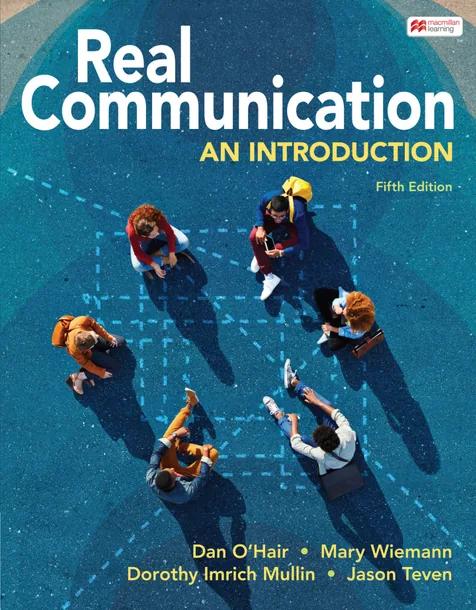
Real Communication
An Introduction
by Dan O'Hair, Mary Wiemann, Dorothy Imrich Mullin
5th Edition
Publisher: Bedford/St. Martin's
Book Details
| Print ISBN | 9781319201746 |
| eText ISBN | 9781319321741 |
| Publisher | Bedford/St. Martin's |
| Publishing Year | 2021 |
| Edition | 5th Edition |
| Language | English |
| Pages | 608 |
Real Communication: An Introduction, 5th Edition delivers a foundational grounding in human communication theory and practical skills for undergraduate college students and communication instructors. Designed for introductory college courses, this textbook applies a social-scientific approach to examine human interaction across contemporary social contexts.
The text establishes its organizing framework in Part One by examining basic communication processes alongside primary functional interaction goals. Across these core chapters, the coverage details how individuals use foundational processes to achieve essential social outcomes, specifically focusing on expressing affiliation, managing relationships, and influencing others in daily life.
To help students bridge theoretical principles and practical observation, the text incorporates real stories as small case studies throughout its chapters. These narrative case studies allow students to analyze realistic communication situations and see theory in practice across diverse social environments. The 608-page paperback edition offers an accessible core text for introductory college communication courses.
Table of Contents
Chapter 1: Communication: Essential Human Behavior
- • We Must Communicate: Functions Essential to Living
- • Expressing Affiliation
- • Managing Relationships
- • Influencing Others
- • How We Communicate
- • Communication Is Symbolic
- • Real Communicator: Real communicator — what job will you hold?
- • Communication Requires a Shared Code
- • Communication Is Linked to Culture
- • Communication Can Be Unintentional
- • Communication Occurs through Various Channels
- • Communication Is Transactional
- • Assessing Communicative Value
- • Communicating Competently
- • Competent Communication is Process-Oriented
- • Competent Communication is Appropriate and Effective
- • Competent Communication Involves Ethical Decisions
- • Competent Communication Involves Communication Skills
- • Competent Communication Involves Using Technology
- • Wireless Communications: Email Etiquette: How Not to Communicate with Your Professor
- • Modeling Communications
- • The Linear Model
- • The Interaction Model
- • The Competent Communication Model
- • Evaluating Communication Ethics: Friends Who Have More or Less than You
- • The Study of Communication
- • Communication Across Cultures: The Boko Haram Girls
- • REAL REFERENCE: A Study Tool
Chapter 2: Communicating in a Digital Age
- • Digital Origins
- • Then and Now
- • Ongoing Dynamic Changes
- • Qualities of Digital Channels
- • Evaluating Communication Ethics: The Distracted Notetaker
- • Synchronicity of Messages
- • Media Richness and Naturalness
- • Message Privacy and Control
- • Communication Across Cultures: Mobile Apps Compete for World Influence
- • The Power of the Crowd
- • Information Sharing
- • Social Support
- • Social Causes
- • Real Communicator: Heather Wight
- • Overcoming Digital Challenges
- • Digital Disparities
- • Feeding Insecurities and Obsessions
- • Wired for Communication: Who I Am: Selfies as Visual Conversation, Self-Promotion and Identity
- • Cyber Attacks
- • REAL REFERENCE: A Study Tool
Chapter 3: Perceiving the Self and Others
- • Perception: Making Sense of Your World
- • Schemas: Organizing Perceptions
- • Attributions: Interpreting Your Perceptions
- • The Cultural Context
- • Communication Across Cultures: Sports Culture and Womens Soccer
- • Improving Your Perceptions
- • Cognitions About Ourselves
- • Self-Concept: Who You Think You Are
- • Self-Esteem: How You Feel About Yourself
- • Self-Efficiacy: Assesing Your Own Abilities
- • Evaluating Communication Ethics: Ethics and the Self-Concept
- • Assessing Our Perceptions of Self
- • Real Communicator: Lisa M. Turay, CSJ
- • Behavior: Managing Our Identities
- • Self-Presentation
- • Self-Disclosure
- • Managing Feedback
- • Technology: Managing the Self and Perceptions
- • Wired for Communication: Avatars: An Idealized Self-Image
- • REAL REFERENCE: A Study Tool
Chapter 4: Verbal Communication
- • The Nature of Language
- • Language Is Symbolic
- • Thought Informs Language
- • Language Is Ruled by Grammar
- • The Functions of Language
- • Using Language as a Means of Control
- • Using Language to Share Information
- • Using Language to Express Feelings
- • Using Language to Express Creativity
- • Using Language as Ritual
- • Language and Meaning
- • Words Have Multiple Meanings
- • Abstraction
- • Problematic Uses of Language
- • Hateful and Hurtful Language
- • Labeling
- • Biased Language
- • Profanity and Civility
- • Evaluating Communication Ethics: Job Application Language
- • Language is Bound by Context
- • Situational Context
- • Relational Context
- • Communication Across Cultures: Racist Hats and Drums?
- • Cultural Context
- • Wired for Communication: Speaking in Code
- • Real Communicator: Scott Carper
- • Mediated Contexts
- • REAL REFERENCE: A Study Tool
Chapter 5: Nonverbal Communication
- • The Nature of Nonverbal Communication
- • Nonverbal Behavior Is Communicative
- • Nonverbal Communication Can be Intentional and Unintentional
- • Nonverbal Communication Is Ambiguous
- • People Trust Nonverbal Communication More Than Verbal Communication
- • Functions of Nonverbal Communication
- • Reinforcing Verbal Messages
- • Substituting for Verbal Messages
- • Contradicting Verbal Messages
- • Managing Impressions and Regulating Interactions
- • Creating Immediacy
- • Deceiving Others
- • Nonverbal Communication Codes
- • Gestures and Body Movements
- • Real Communicator: Octavia Spencer
- • Facial Expressions
- • Eye Behavior
- • Voice
- • Physical Appearance
- • Evaluating Communication Ethics: The Job Killer Tat
- • Touch
- • Space and Environment
- • Time
- • Influences on Nonverbal Communication
- • Culture and Nonverbal Communication
- • Communication Across Cultures: What Nurses Wear
- • Mediated Nonverbal Communication
- • Wireless Communication: War Games Without Weapons, Sometimes Without Words
- • The Situational Context
- • REAL REFERENCE: A Study Tool
Chapter 6: Communication and Culture
- • Understanding Culture
- • Culture Is Learned
- • Culture Is Expressed Through Communication
- • Intercultural Communication Matters
- • Communication and Cultural Variations
- • High- and Low-Context Cultures
- • Real Communicator: Tanya Higuera
- • Collectivist and Individualist Orientations
- • Approaches to Power Distance
- • Flexible and Stable Self-Concepts
- • Time Orientation
- • Value of Emotional Expression
- • Understanding Group Affiliations
- • Co-Cultural Communication
- • Social Identity and Intergroup Communication
- • Wireless Communication: Online Gamers: Women are Hard-core, Too
- • Communication Across Cultures: The It Gets Better Project
- • Intercultural Communication Challenges
- • Anxiety
- • Ethnocentrism
- • Discrimination
- • Improving Intercultural Communication
- • Mindfulness
- • Openness to Other Cultures
- • Effective Intergroup Contact
- • Appropriate Accommodation
- • Evaluating Communication Ethics: That Is Not Impossible Meat
- • Practice Using Your Skills
- • REAL REFERENCE: A Study Tool
Chapter 7: Listening
- • The Listening Process
- • Hearing Versus Listening
- • The Components of Listening
- • Real Communicator: Tammy Lin
- • Communication Across Cultures: A Quick Lesson in Deaf Etiquette
- • Listening Fidelity
- • Listening to Meet Goals
- • Relational Listening
- • Task-Oriented Listening
- • Analytical Listening
- • Critical Listening
- • Social Listening
- • Listening Challenges
- • Negative Attitudes
- • Environmental Factors
- • Biological Factors
- • Ineffective Listening
- • Defensive Listening
- • Biased Listening
- • Evaluating Communication Ethics: Listening When You’re Sick of Hearing
- • Self-Absorbed Listening
- • Pseudolistening
- • Improving Your Listening
- • The Situational Context
- • Wireless Communication: The Quiet Zone
- • Listening for Success
- • Effective Listening
- • Effective Listening Saves Time and Money
- • Effective Listening Creates Opportunities
- • Effective Listening Strengthens Relationships
- • REAL REFERENCE: A Study Tool
Chapter 8: Developing and Maintaining Relationships
- • Types of Interpersonal Relationships
- • Family Relationships
- • Evaluating Communication Ethics: Money, Family, and Paying the Bills
- • Friendship and Social Relationships
- • Romantic Relationships
- • Online and Mediated Relationships
- • Wireless Communication: Is This Relationship Real?
- • Why We Form Relationships
- • Proximity
- • Attractive Qualities
- • Similarity
- • Personal and Social Needs
- • Managing Relationship Dynamics
- • Costs and Rewards
- • What About You? Assessing the Costs and Rewards of a Relationship
- • Reducing Uncertainty
- • Dialectical Tensions
- • Self-Disclosure and Interpersonal Relationships
- • Social Penetration
- • Managing Privacy
- • Strategic Topic Avoidance
- • Real Communicator: May Hui
- • Stages of a Relationship
- • Initiating Stage
- • Exploratory Stage
- • Intensification Stage
- • Stable Stage
- • Declining Stage
- • Repair Stage
- • Termination Stage
- • Communication Across Cultures: Grieving Relationships
- • Reconciliation
- • REAL REFERENCE: A Study Tool
Chapter 9: Managing Conflict in Relationships
- • Understanding Conflict
- • Unproductive Conflict
- • Productive Conflict
- • Conflict Triggers
- • Inaccurate Perceptions
- • Perceived Incompatible Goals
- • Relational Transgressions
- • Provocation
- • Factors Affecting Conflict
- • Power Dynamics
- • Attitudes Toward Conflict
- • Communication Climate
- • Culture and Conflict
- • Communication Channel
- • Wireless Communication: When Conflict Goes Viral
- • Strategies for Managing Conflict
- • Escapist Strategies
- • Competitive Strategies
- • Communication Across Cultures: Yours, Mine, and Both of Ours
- • Cooperative Strategies
- • Evaluating Communication Ethics: The Accidental Relationship Counselor
- • What About You? Self-Assessment on Conflict Management Styles
- • Reconciliation
- • Apology
- • Forgiveness
- • Real Communicator: Nicole Becker, Psy D.
- • REAL REFERENCE: A Study Tool
Chapter 10: Communicating in Groups
- • Understanding Groups
- • Characteristics of Groups
- • Types of Groups
- • Wirelessr Communication: Smart Mobs: What Flash Mobs and Political Protests Have in Common
- • Models of Group Development
- • Real Communicator: Bambi Francisco Roizen
- • Size of Groups
- • The Formation of Cliques
- • Social Loafing
- • Group Networks
- • Understanding Group Roles
- • Task Roles
- • Social Roles
- • Antigroup Roles
- • Role Conflict
- • Status
- • Group Climate
- • Cohesion
- • Communication Across Cultures: The International American Pastime
- • Norms
- • Clarity of Goals
- • Individual Differences
- • Evaluating Communication Ethics: Sketchy Behavior
- • REAL REFERENCE: A Study Tool
Chapter 11: Leadership and Decision Making in Groups
- • Understanding Group Leadership
- • Sources of Power
- • Shared Leadership
- • Group Leadership Behavior
- • Communication Across Cultures: Gender Judo
- • Leadership Qualities
- • What About You? What Type of Leader Are You?
- • Evaluating Communication Ethics: Leading the Interns
- • Unethical Leadership
- • Culture and Group Leadership
- • Decision Making in Groups
- • Groupthink
- • The Problem-Solving Process
- • Leadership in Meetings
- • Planning Meetings Effectively
- • Managing Meetings Effectively
- • Real Communicator: Aaron Tolson
- • Using Meeting Technology Effectively
- • Wireless Communication: Robots are here to stay
- • Evaluating Group Performance
- • Informational Considerations
- • Procedural Effectiveness
- • Interpersonal Performance
- • Individual Performance
- • REAL REFERENCE: A Study Tool
Chapter 12: Communicating in Organizations
- • Approaches to Managing Organizations
- • Classical Management Approach
- • Human Relations Approach
- • Human Resources Approach
- • The Systems Approach
- • Communicating Organizational Culture
- • Organizational Storytelling
- • Learning About Organizational Culture
- • Real Communicator: Cathy Black
- • Relational Contexts in Organizations
- • Supervisor-Supervisee Relationships
- • Mentor–Mentee Relationships
- • Peer Relationships
- • Evaluating Communication Ethics: More Than Friends at Work
- • Organizational Challenges
- • Workplace Conflict
- • Using Technology
- • Wired for Communication: Working Here, There, and Everywhere
- • Globalization
- • Communication Across Cultures: Work–Life Balance: Around the Globe and Around the Block
- • Work–Life Balance
- • REAL REFERENCE: A Study Tool
Chapter 13: Preparing and Researching Presentations
- • The Power of Public Speaking
- • Clarify the General Purpose of Your Speech
- • Informative Speeches
- • Persuasive Speeches
- • Special-Occasion Speeches
- • Analyze Your Audience
- • Considering Audience Expectations and Situational Factors
- • Considering Audience Demographics and Psychographics Anticipating Your Audience’s Response
- • Anticipating Your Audiences Response
- • Choose Your Topic
- • Real Communicator: Matt Schermerhorn
- • Finding a Topic That Intrigues You
- • Brainstorming and Clustering
- • Narrowing Your Topic
- • Determining the Specific Purpose of Your Speech
- • Developing a Thesis Statement
- • Research the Topic
- • Types of Information to Consider
- • Communication Across Cultures: Human Trafficking: Art, Survival, and Advocacy
- • Finding Supporting Material
- • Wireless Communication: The Library in the Sky
- • Evaluating Supporting Material
- • Ethical Speaking: Take Responsibility for Your Speech
- • Recognizing Plagiarism
- • Evaluating Communication Ethics: Didn’t I Already Say That?
- • Taking Accurate Notes
- • REAL REFERENCE: A Study Tool
Chapter 14: Organizing, Writing and Outlining Presentations
- • Organizing Your Speech Points
- • Identifying Your Main Points
- • Supporting Your Main Points
- • Arranging Your Points
- • Evaluating Communication Ethics: The Ethics of Using Research
- • Connecting Your Points
- • Communication Across Cultures: Evidence, Popular Culture, and the “CSI Effect”
- • Using Language That Works
- • Respect Your Audience
- • Keep It Simple
- • Use Vivid Language
- • Incorporate Repetition, Allusion, and Comparisons
- • Crafting a Strong Introduction
- • Capture Your Audience’s Attention
- • Introduce Your Purpose and Thesis
- • Preview Your Main Points
- • Connect with Your Audience
- • Crafting a Strong Conclusion
- • Signal the End
- • Reinforce Your Topic, Purpose, and Main Points
- • Make an Impact
- • Real Communicator: Mark Weinfeld
- • Challenge the Audience to Respond
- • Outlining Your Speech
- • Essentials of Outlining
- • Wireless Communication: Bullets on the Brain
- • Styles of Outlines
- • From Preparation Outline to Speaking Outline
- • What About You? Assessing Your Outlining Skills
- • REAL REFERENCE: A Study Tool
Chapter 15: Delivering Presentations
- • Understand and Address Anxiety
- • Identify Anxiety Triggers
- • Relax and Prepare Mentally
- • Build Your Confidence
- • Wireless Communication: Face Your Public Speaking Fears in Virtual Reality
- • Methods of Delivery
- • Speaking from Manuscript
- • Speaking from Memory
- • Speaking Spontaneously
- • Speaking Extemporaneously
- • Guidelines for Effective Delivery
- • Effective Vocal Delivery
- • Effective Visual Delivery
- • Communication Across Cultures: You Sound Like You’re From . . .
- • Connecting with Your Audience
- • Evaluating Communication Ethics: Judging Speeches
- • Additional Guidelines for Online Speech Delivery
- • Real Communicator: Tonya Graves
- • Effective Presentation Aids
- • The Function of Presentation Aids
- • Types of Presentation Aids
- • Practicing Your Speech
- • Remember Your Speaking Outline
- • Practice Using Presentation Aids
- • Simulate the Situation
- • Practice Your Delivery
- • REAL REFERENCE: A Study Tool
Chapter 16: Informative Speaking
- • The Goals of Informative Speaking
- • Meeting the Audience’s Informational Needs
- • Informing, Not Persuading
- • Speaking Appropriately and Ethically
- • Topics for Informative Presentations
- • People
- • Places
- • Communication Across Cultures: Let’s Talk About Sex
- • Events
- • Evaluating Communication Ethics: Ulterior Motives
- • Processes
- • Concepts
- • Issues
- • Plans and Policies
- • Approaches to Conveying Information
- • Description
- • Demonstration
- • Wireless Communication: Talk Amongst Yourselves
- • Definition
- • Explanation
- • Guidelines for Informative Speeches
- • Create Information Hunger
- • Satisfy Audience Hunger
- • Real Communicator: K. C. Ellis
- • REAL REFERENCE: A Study Tool
Chapter 17: Persuasive Speaking
- • The Goals of Persuasive Speaking
- • Developing a Persuasive Topic and Thesis
- • Propositions of Fact
- • Propositions of Value
- • Propositions of Policy
- • Understanding Your Audience
- • Your Audience’s Existing Attitudes
- • Your Audience’s Readiness to Change
Customer Reviews
0.0
0 reviews
No reviews yet. Be the first to review this book!
Write a Review
Reviewed by GradeFocus Editorial Team
▶Research Sources (13)
- Real Communication 5th Edition | Dan O'Hair
- Real Communication, 5th Edition
- Real Communication by: Dan O'Hair - 9781319321741
- Real Communication - Dan O'Hair, Mary Wiemann, Dorothy Imrich ...
- Textbook...Real Communication: An Introduction
- Real Communication - ISBN 9781319321741
- Communication in the Real World - An Introduction to ...
- Real Communication An Introduction | Rent | 9781319201746
- Real Communication | Rent | 9781319201746
- Anyone have a PDF of Real Communication, 5th Edition
- (PDF) O hair dan wiemann mary real communication an introduction
- Real Communication An Introduction Fifth Edition by Dan OHair Mary ...
- Real Communication An Introduction