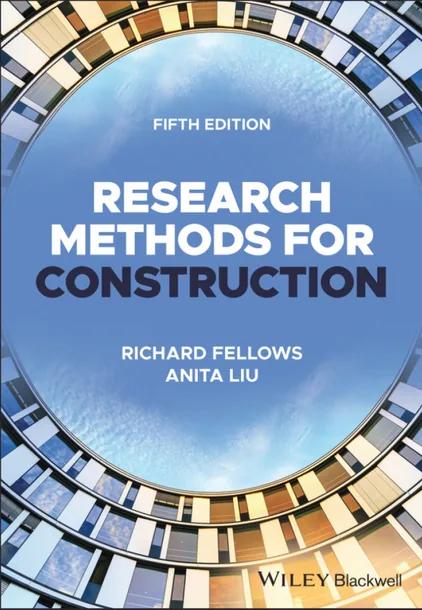
Research Methods for Construction
by Richard F. Fellows, Anita M. M. Liu
5th Edition
Publisher: Wiley-Blackwell
Book Details
| Print ISBN | 9781119814733 |
| eText ISBN | 9781119814757 |
| Publisher | Wiley-Blackwell |
| Publishing Year | 2022 |
| Edition | 5th Edition |
| Language | English |
| Pages | 384 |
Research Methods for Construction, 5th Edition, is a comprehensive textbook designed to help students develop the research skills needed for projects across construction fields. The volume addresses theoretical, philosophical, and practical dimensions of inquiry across varied construction topics.
The text articulates key stages of the research process, guiding readers through preparing proposals, executing research, and reporting results. It examines both qualitative and quantitative approaches alongside statistical considerations.
The authors also address ethical, legal, and regulatory issues, while outlining data requirements for engineering experiments, simulations, modelling, and socio-economic management topics.
Table of Contents
Chapter 1: Introduction
- • 1.1 The concept of research
- • 1.1.1 Research: a careful search/investigation
- • 1.1.2 Research: contribution to knowledge
- • 1.1.3 A learning process
- • 1.1.4 Contextual factors affecting research
- • 1.2 Classifications of research
- • 1.2.1 Pure and applied research
- • 1.2.2 Quantitative and qualitative research
- • 1.2.3 Other categories of research
- • 1.3 Theories and paradigms
- • 1.3.1 Development of knowledge
- • 1.3.2 Testing a theory
- • 1.3.3 Paradigms
- • 1.3.4 Positivism
- • 1.3.5 Interpretivism
- • 1.3.6 Pragmatism
- • 1.3.7 Models and hypotheses
- • 1.4 Research styles/methods
- • 1.4.1 Action research
- • 1.4.2 Ethnographic research
- • 1.4.3 Surveys
- • 1.4.4 Case studies
- • 1.4.5 Experiments
- • 1.5 Quantitative and qualitative approaches
- • 1.5.1 Quantitative approaches
- • 1.5.2 Qualitative approaches
- • 1.5.3 Triangulated studies
- • 1.5.4 Data sources
- • 1.6 Where to begin
- • 1.7 Summary
- • References
Chapter 2: Topic for Study
- • 2.1 Selection of a topic
- • 2.1.1 Resources
- • 2.1.2 Subject selection
- • 2.1.3 Choosing a topic
- • 2.1.4 Evaluating alternatives
- • 2.1.5 Refining a topic
- • 2.2 Writing the proposal
- • 2.2.1 Aim
- • 2.2.2 Proposition
- • 2.2.3 Objectives
- • 2.2.4 Hypotheses
- • 2.2.5 Methodology and methods
- • 2.2.6 Programme
- • 2.2.7 Deliverables and industrial / practitioner support
- • 2.3 Summary
- • References
Chapter 3: Initial Research
- • 3.1 The research process
- • 3.1.1 Initial phase
- • 3.1.2 Data and information
- • 3.1.3 Dynamic process
- • 3.2 Initial search
- • 3.2.1 Definitions and assumptions
- • 3.2.2 Theory and literature reviews
- • 3.2.3 Analysing data from a search
- • 3.3 Literature based discovery
- • 3.4 Assembling the theoretical framework
- • 3.4.1 Theory borrowing
- • 3.4.2 Theorising
- • 3.5 Philosophy and paradigms
- • 3.5.1 Ontology, epistemology and axiology
- • 3.5.2 Positivism
- • 3.5.3 Realism
- • 3.5.4 Interpretivism
- • 3.5.5 Constructivism
- • 3.5.6 Phenomenalism
- • 3.5.7 Postmodernism
- • 3.5.8 Pragmatism
- • 3.6 Fuzzy thinking
- • 3.7 Theoretical models and constructs
- • 3.7.1 Theoretical model
- • 3.7.2 Constructs
- • 3.8 Proper referencing
- • 3.9 Summary
- • References
Chapter 4: Approaches to Empirical Work
- • 4.1 Starting data collection
- • 4.2 Experience
- • 4.3 Reasoning and inference
- • 4.3.1 Sensemaking
- • 4.3.2 Motivated reasoning
- • 4.3.3 Determinism and stochasticism
- • 4.3.4 Complexity
- • 4.4 Systems of methods
- • 4.5 Research design
- • 4.5.1 Context
- • 4.5.2 Variance and errors
- • 4.5.3 Empiricism, rationalism and verification
- • 4.6 Qualitative and quantitative approaches
- • 4.6.1 When are qualitative approaches employed?
- • 4.6.2 When are quantitative approaches employed?
- • 4.7 Experimental
- • 4.7.1 Experiments and quasi-experiments
- • 4.7.2 Variables
- • 4.7.3 Experimental control
- • 4.7.4 Replication
- • 4.7.5 Between-subjects design (simple randomised experiments)
- • 4.7.6 Between-subjects design (matched randomised groups)
- • 4.7.7 Within-subject design (repeated measure design)
- • 4.7.8 Factorial experiments
- • 4.8 Survey
- • 4.9 Secondary
- • 4.9.1 Archival
- • 4.9.2 Meta-analysis
- • 4.10 Case study
- • 4.11 Ethnographic
- • 4.11.1 Ethnography
- • 4.11.2 Ethnomethodology
- • 4.12 Action
- • 4.13 Grounded theory (development of theory from data)
- • 4.14 Narrative
- • 4.15 Modelling
- • 4.15.1 Classification of models
- • 4.15.2 Deterministic and stochastic models
- • 4.15.3 The modelling process
- • 4.16 Simulation
- • 4.16.1 Dynamism
- • 4.16.2 Heuristics
- • 4.16.3 Approaches
- • 4.17 Level of research
- • 4.18 Practise-based research
- • 4.19 Summary
- • References
Chapter 5: Hypotheses
- • 5.1 Essentials of a valid hypothesis
- • 5.2 Roles of hypotheses
- • 5.3 Objective testing of hypotheses
- • 5.4 Role of sampling
- • 5.5 Common statistical measures
- • 5.5.1 Normal distribution
- • 5.6 Null hypotheses
- • 5.7 Validities
- • 5.8 Summary
- • References
Chapter 6: Data Collection
- • 6.1 Data requirements
- • 6.2 Sources of quantitative data
- • 6.3 Collecting data from respondents
- • 6.3.1 Questionnaires
- • 6.3.2 Interviews
- • 6.4 Case studies
- • 6.5 Triangulation
- • 6.6 Sampling
- • 6.6.1 Sample size
- • 6.7 Scales of measurement
- • 6.7.1 Scaling techniques (non-metric and metric)
- • 6.7.2 Common scaling methods
- • 6.7.3 Development of multi-item scales
- • 6.8 Obtaining data
- • 6.9 Translation
- • 6.10 Response styles and biases
- • 6.11 Summary
- • References
Chapter 7: Data Analysis
- • 7.1 Analysing data
- • 7.2 Plotting data
- • 7.3 Statistical methods
- • 7.4 Non-parametric tests
- • 7.4.1 Sign test
- • 7.4.2 Rank-sum rests
- • 7.4.3 Chi-square (c2) test
- • 7.4.4 Goodness of fit
- • 7.5 Parametric tests
- • 7.5.1 _t_\-Test
- • 7.5.2 Analysis of variance (ANOVA)
- • 7.5.3 Regression and correlation
- • 7.5.4 Multiple regression
- • 7.5.5 Time series
- • 7.5.6 Index numbers
- • 7.6 Other analytical techniques
- • 7.6.1 Cluster analysis
- • 7.6.2 Factor analysis
- • 7.6.3 Path analysis
- • 7.6.4 Analytic hierarchy process (AHP)
- • 7.7 Analysis of qualitative data
- • 7.7.1 Analysing documents (from texts)
- • 7.7.2 Conversation analysis
- • 7.7.3 Discourse analysis
- • 7.7.4 Social network analysis
- • 7.7.5 Multi-level research
- • 7.7.6 Meta-analysis
- • 7.7.7 Longitudinal research
- • 7.8 Summary
- • References
Chapter 8: Ethics in Research
- • 8.1 The concepts of morals and ethics
- • 8.2 Research ethics
- • 8.2.1 Theory and literature
- • 8.2.2 Data collection, use and disposal
- • 8.3 Data analysis, intellectual property and data protection
- • 8.3.1 Data analysis, results and reporting
- • 8.3.2 Intellectual property
- • 8.3.3 Data protection
- • 8.4 Equality, diversity and inclusion
- • 8.5 Summary
- • References
Chapter 9: Results, Inferences and Conclusions
- • 9.1 Requirements for valid results
- • 9.2 Potential sources of error
- • 9.3 Reliability
- • 9.4 Results
- • 9.4.1 Producing the results
- • 9.4.2 Introductory results
- • 9.4.3 Substantive results
- • 9.4.4 Inferences
- • 9.4.5 Causal relationships
- • 9.4.6 Interpretation
- • 9.5 Conclusions
- • 9.5.1 How to write conclusions
- • 9.5.2 Further research
- • 9.6 Summary
- • References
Chapter 10: Reports and Presentations
- • 10.1 Report production
- • 10.2 Communication
- • 10.3 Contents of the report
- • 10.3.1 How to begin
- • 10.3.2 Text of the report
- • 10.3.3 Theory and literature
- • 10.3.4 Reporting on methodology and methods
- • 10.3.5 Reporting on data sourcing and data collection
- • 10.3.6 Presentation of results
- • 10.3.7 Discussion of results
- • 10.3.8 Conclusions
- • 10.3.9 Limitations
- • 10.3.10 Recommendations
- • 10.3.11 Introduction
- • 10.3.12 Remainder of the report
- • 10.4 Oral presentation
- • 10.5 Summary
Customer Reviews
0.0
0 reviews
No reviews yet. Be the first to review this book!
Write a Review
Reviewed by GradeFocus Editorial Team